



Comment choisir un fabricant de compteurs d'eau — 9 Critères de sélection du fabricant de compteurs d'eau soutenus par 5 Années de données sur les plaintes?
J'ai vu un compteur bon marché devenir cher après installation. Un processus fournisseur faible peut donner lieu à des plaintes, retravailler, rejet, et risque de facturation.
Les meilleurs critères de sélection des fabricants de compteurs d’eau sont la traçabilité des réclamations, contrôle des modifications de conception, certifications imposées, contrôle de la chaîne d'approvisionnement, alignement du banc d'essai, contrôle des risques par lots, Réalité de l'indice IP, notification de changement à long terme, et références régionales.
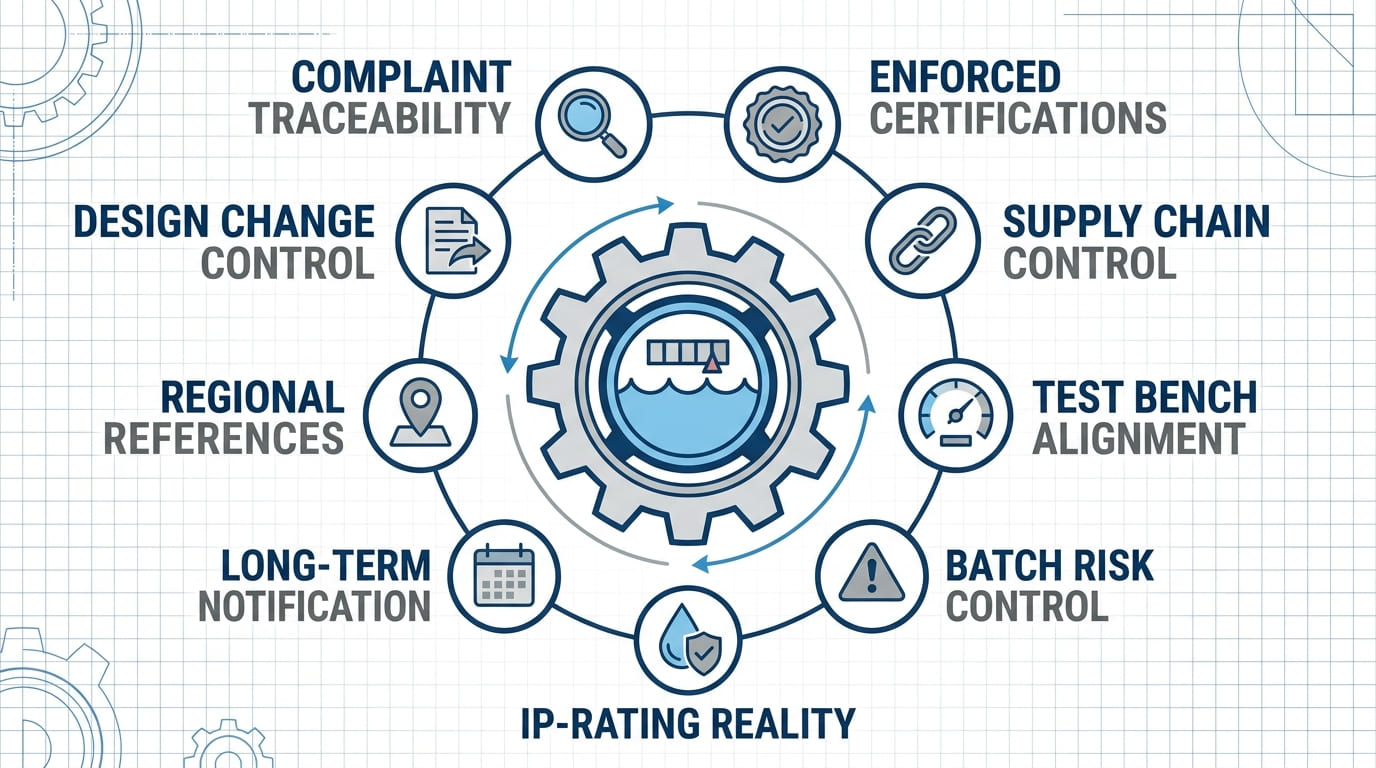
Je ne choisis pas un fabricant de compteurs d'eau uniquement en fonction du prix. Je choisis en fonction du risque qui subsistera après la sortie d'usine des compteurs. Ce risque peut résider dans le matériau du corps, le registre, le module électronique, la batterie, le micrologiciel, le banc d'essai, ou le processus après-vente. J'ai appris cela grâce aux données des plaintes, pas des brochures commerciales.
Pourquoi les critères de sélection des fabricants de compteurs d'eau sont-ils plus importants que le prix?
J'ai vu des équipes d'approvisionnement économiser une petite somme par mètre, puis perdre beaucoup plus grâce aux visites sur le terrain, plaintes des clients, rejet du laboratoire, et facturation retardée.
Les critères de sélection des fabricants de compteurs d’eau sont importants car un compteur n’est pas seulement un produit. C'est un outil de facturation, un appareil de mesure légal, un atout de terrain, et parfois un terminal de communication. ISO 4064 les tests incluent la perturbation du débit, durabilité, champ magnétique, dispositif auxiliaire, environnement, et tests de facteurs d'influence, la sélection des fournisseurs doit donc couvrir plus que le prix.
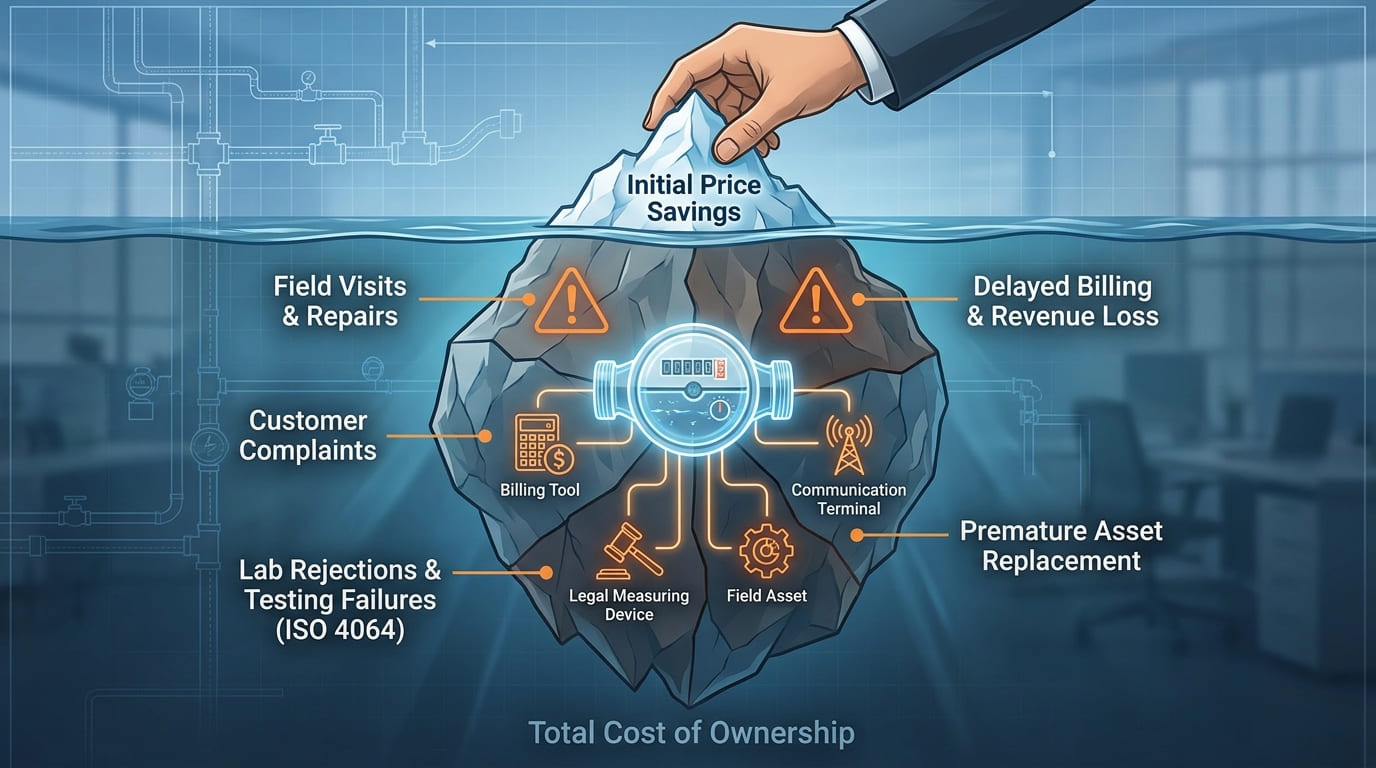
J'utilise les critères de sélection des fabricants de compteurs d'eau pour réduire les risques liés au cycle de vie
Je commence chaque avis de fournisseur par une seule question. je demande, « Que se passe-t-il si ce produit tombe en panne après 50,000 les unités sont installées?« Cette question change la rencontre. Un prix unitaire bas semble moins attractif lorsque le fournisseur ne peut pas retracer les lots, expliquer les sources matérielles, ou montrer les dossiers de plainte.
J'ai vu quatre cas qui ont façonné ma méthode. Un défaut de conception anti-effraction a entraîné des retouches sur 573,500 mètres. Un problème de corps en laiton causé 26,000 les compteurs tombent en panne parce que la teneur en plomb dépasse les exigences du projet. Un changement dans la conception du pointeur non magnétique n'a pas été annoncé, et 15,573 échec des compteurs de lecture à distance. Une différence de banc d'essai INACAL au Pérou créée autour d'un 50% taux de rejet lors de l'acceptation.
Ces cas ne proviennent pas d'un mauvais travailleur ou d'un envoi malchanceux.. Ils provenaient de systèmes de fournisseurs faibles. Le fournisseur n'a pas contrôlé le changement. Le fournisseur n'a pas verrouillé le matériel. Le fournisseur n'a pas comparé les conditions des bancs d'essai locaux. Le fournisseur n'a pas isolé suffisamment tôt le risque lié aux lots.
| Achat uniquement sur le prix | Sélection du fabricant basée sur les risques |
|---|---|
| Je compare le prix unitaire. | Je compare le risque du cycle de vie. |
| Je fais confiance à l'échantillon. | Je vérifie l'historique des lots. |
| Je demande des certificats. | Je vérifie l'utilisation du certificat en production. |
| Je me concentre sur la livraison. | Je vérifie également la réponse à la plainte. |
| Je négocie une remise. | Je réduis le coût des échecs futurs. |
Critère 1: Quels critères de sélection des fabricants de compteurs d'eau prouvent la traçabilité des plaintes?
Je deviens prudent lorsqu'un fabricant dit, "Nous n'avons presque aucune plainte à formuler." Dans de vrais projets, cette réponse peut signifier un suivi faible.
Un fabricant solide devrait afficher les données de réclamation par modèle, lot, mode de défaillance, composant, état d'installation, et actions correctives. La traçabilité des réclamations est l'un de mes critères de sélection les plus importants pour les fabricants de compteurs d'eau, car elle montre si l'usine tire des leçons des échecs..
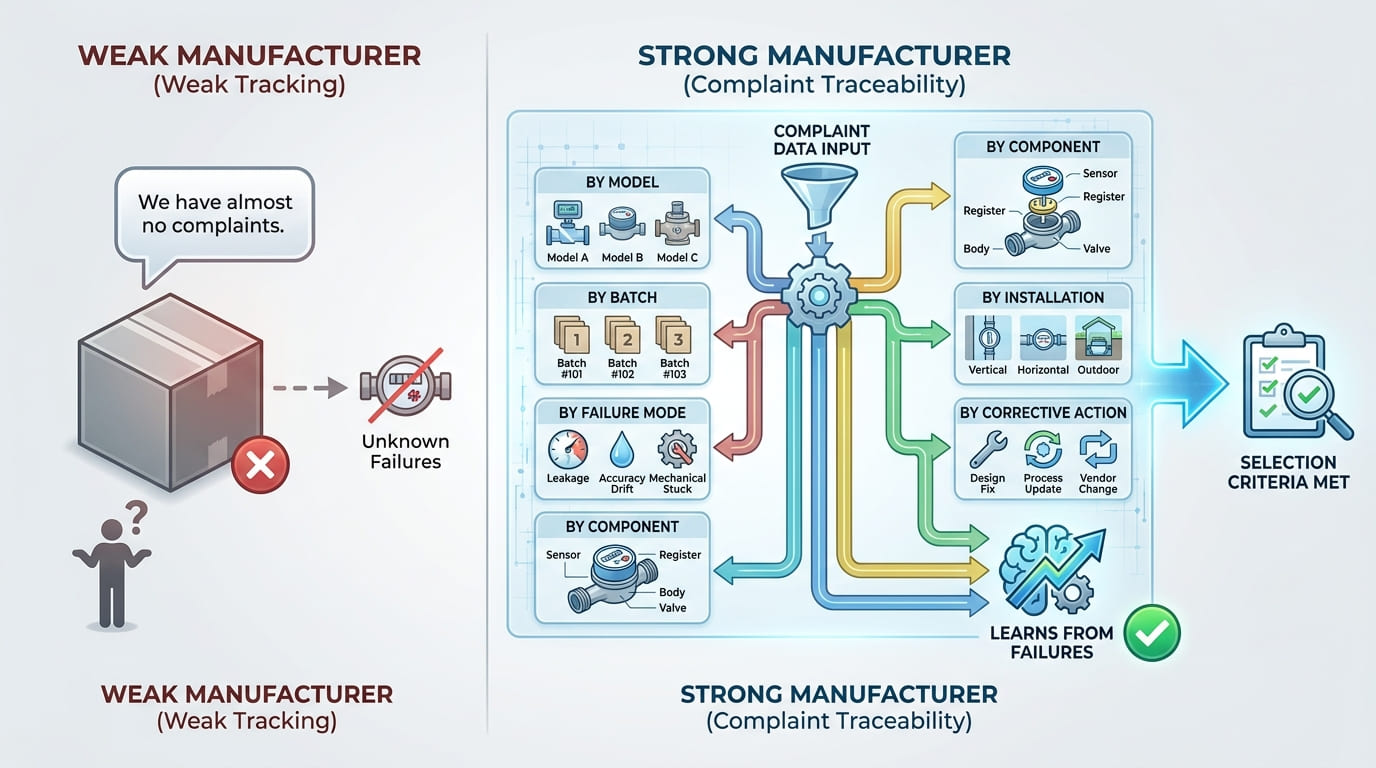
Je demande des dossiers de plainte avant de demander des promesses
Je ne demande pas seulement un taux de réclamation. Je demande comment le fournisseur définit une réclamation. Je demande si les compteurs retournés sont testés. Je demande si chaque plainte est liée à un numéro de série, date de fabrication, lot de composants, banc d'essai, opérateur, et dossier d'expédition.
Un rapport de plainte utile doit séparer plusieurs causes. Il convient de distinguer la véritable défaillance du compteur de l'erreur d'installation.. Il convient de distinguer les problèmes de qualité de l'eau des défaillances des registres.. Cela devrait séparer la perte de communication des problèmes de batterie. Il doit séparer les dommages dus au transport des fuites corporelles. Si tous les problèmes se trouvent dans un seul fichier général, le fournisseur ne peut pas améliorer le produit.
Je demande également des données sur cinq ans. Un mois peut paraître propre. Une année peut cacher des problèmes saisonniers. Cinq ans peuvent montrer des schémas répétés. Je veux voir des registres embués, mécanismes bloqués, joints faibles, pannes de batterie, abandons de communication, couvercles anti-effraction cassés, et taux de rejet anormaux.
| Élément de données de la plainte | Pourquoi je le demande |
|---|---|
| Modèle et taille | J'ai besoin de trouver des modèles au niveau du produit. |
| Numéro de lot | Je dois isoler les expéditions concernées. |
| Mode de défaillance | J'ai besoin de savoir ce qui a réellement échoué. |
| État du site | Je dois séparer les risques liés au produit et à l'installation. |
| Action corrective | J'ai besoin d'une preuve que le problème a été résolu. |
Critère 2: Comment les critères de sélection des fabricants de compteurs d'eau couvrent-ils la notification de modification de conception?
Je m'inquiète plus des changements silencieux que des défauts visibles. Un défaut visible peut être contrôlé. Un changement caché peut pénétrer des milliers de mètres.
La notification de modification de conception est un critère clé de sélection du fabricant de compteurs d'eau, car une petite modification de pièce peut affecter la lecture., sortie à distance, scellage, comportement en pression, communication, ou approbation locale.
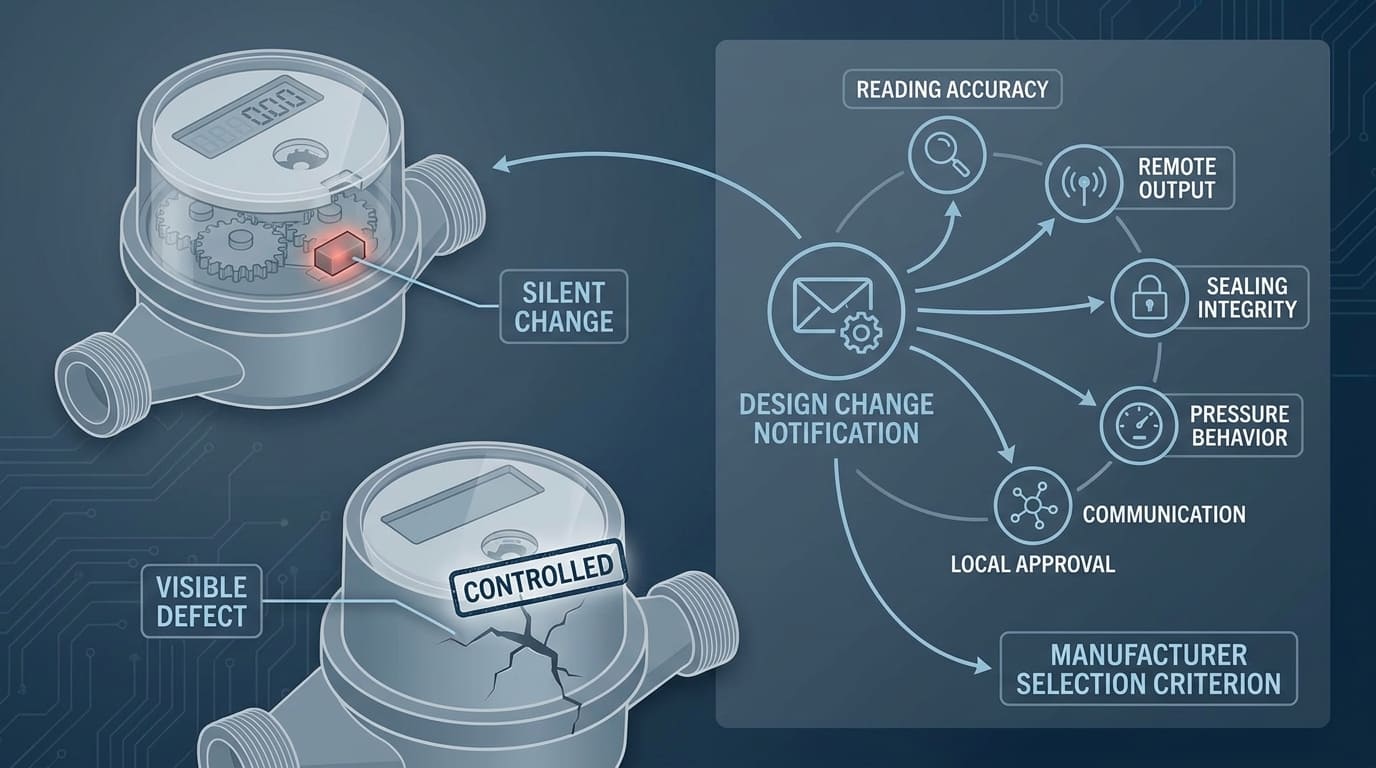
Je traite chaque changement de conception critique comme un événement de projet
Un cas me reste encore en tête. Un fabricant a modifié la conception du pointeur non magnétique mais n'en a pas informé l'équipe du projet.. Le nom du compteur n'a pas changé. La page du catalogue n'a pas changé. L'emballage n'a pas changé. Mais le système de lecture à distance ne fonctionne plus correctement. À la fin, 15,573 échec des compteurs de lecture à distance.
Cette affaire m'a appris que « même modèle » ne signifie pas toujours « même produit ». Un pointeur, aimant, capteur, enregistrer le matériel, PCB, batterie, antenne, câble, joint, ou le matériau du corps peut modifier le résultat du champ. L'acheteur peut ne pas voir le changement tant que le système n'est pas déjà déployé.
Je demande à chaque fabricant un processus de notification de modification technique. Je veux savoir qui ouvre le changement. Je veux savoir qui examine les risques métrologiques. Je veux savoir qui vérifie l'impact de la certification. Je veux savoir qui teste le lot pilote. Je veux savoir qui le dit au client. Je demande également si le fournisseur peut geler la conception de mon projet.
| Changer de type | Risque du projet |
|---|---|
| Changement d'enregistrement | La sortie de lecture peut changer. |
| Changement de pointeur | La lecture à distance peut échouer. |
| Changement d'aimant | Le comportement du pouls ou du capteur peut changer. |
| Changement de PCB | La communication peut devenir instable. |
| Changement de batterie | La durée de vie peut diminuer. |
| Changement de joint | La protection IP ou la protection contre les altérations peuvent s'affaiblir. |
Critère 3: Quels critères de sélection du fabricant de compteurs d'eau prouvent que les certifications sont appliquées?
Je ne considère pas les certificats comme des documents marketing. Je les traite comme des preuves contrôlées qui doivent correspondre au produit réel.
Les certifications n'ont d'importance que lorsque le modèle certifié, liste des composants, marquages, conditions d'essai, et le processus de production reste aligné. ISO 4064 la planification des tests comprend plusieurs domaines de performance tels que la perturbation du débit, durabilité, champ magnétique, appareils auxiliaires, et tests environnementaux.
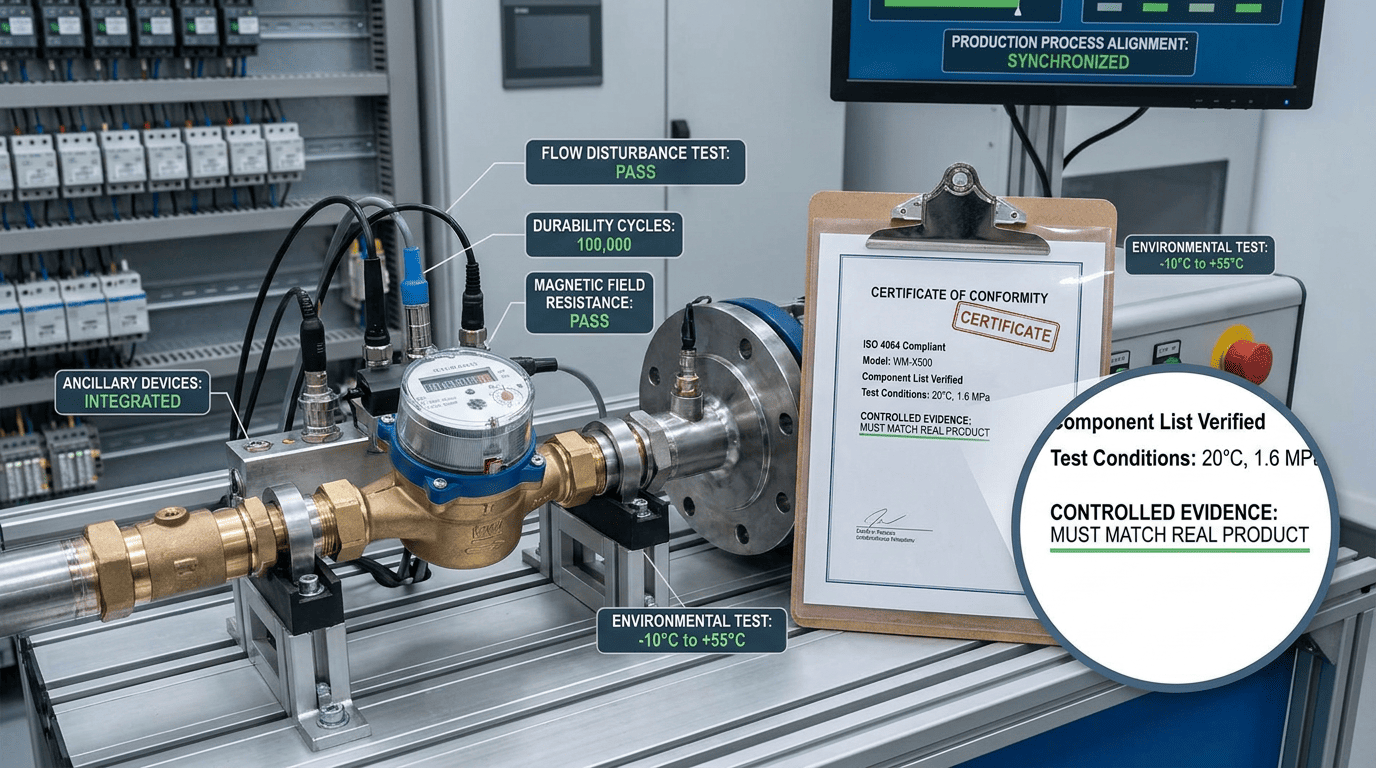
Je vérifie les certificats par rapport au compteur livré
Un certificat peut être réel mais néanmoins être utilisé à mauvais escient. J'ai vu des certificats affichés pour une taille différente. J'ai vu des certificats affichés pour une version mécanique lorsque le produit fourni avait un module de communication. J'ai vu des marquages qui ne correspondaient pas au certificat. Ces lacunes créent un risque d’appel d’offres et un risque d’acceptation.
Je vérifie le nom du produit, Valeur T3, gamme de tailles, classe de précision, matériel, type de registre, module de communication, et conditions d'installation. Je demande également si le fabricant a modifié un composant certifié après approbation. Si le fournisseur ne peut pas répondre clairement, Je ralentis le projet.
Pour compteur d'eau intelligents, Je vérifie également les appareils auxiliaires et la réflexion sur les tests environnementaux. ISO 4064 les références de tests incluent des tests sur des dispositifs auxiliaires et des tests environnementaux, je ne révise donc pas le compteur de base uniquement lorsque le projet nécessite une lecture à distance.
| Contrôle de certification | Ma question |
|---|---|
| Nom du modèle | Est-ce qu'il correspond au compteur proposé? |
| Gamme de tailles | Couvre-t-il la gamme de projets requise? |
| Version compteur | La version intelligente est-elle incluse? |
| Matériel | Le corps correspond-il à la voie d'approbation? |
| Marquage | Le marquage du compteur correspond-il au document? |
| Portée des tests | Des dispositifs auxiliaires ont-ils été envisagés? |
Critère 4: Comment les critères de sélection des fabricants de compteurs d'eau vérifient-ils le contrôle de la chaîne d'approvisionnement?
Je ne fais pas confiance à un compteur fini si l'usine ne peut pas expliquer d'où proviennent les pièces critiques.
Le contrôle de la chaîne d'approvisionnement est l'un de mes principaux critères de sélection de fabricant de compteurs d'eau, car la qualité des composants contrôle la sécurité des matériaux., force de pression, stabilité de lecture, Protection IP, communication, et fiabilité à long terme.

J'ai appris cela grâce à un boîtier en laiton de 26 000 pièces
Le cas matériel le plus clair dans mes données impliqué 26,000 compteurs de corps en laiton. La teneur en plomb a dépassé les exigences du projet. Le fournisseur avait livré un produit qui semblait normal. Le corps était en laiton. La surface semblait acceptable. Les documents semblaient routiniers. Mais le résultat du test local a créé un problème majeur pour le projet.
Cette affaire m'a appris que le « corps en laiton » ne suffit pas. J'ai besoin d'un contrôle des alliages. J'ai besoin d'une inspection à l'arrivée. J'ai besoin d'une traçabilité des lots. J'ai besoin d'un contrôle des fournisseurs. J'ai besoin d'un lien clair entre le rapport de matériel et le numéro de série du compteur. Si le constructeur achète des carrosseries auprès de plusieurs sources, J'ai besoin de savoir comment ils empêchent le mélange.
Je demande qui fait le corps, registre, verre, pièces en plastique, pièces magnétiques, PCB, batterie, scellés, et module de communication. La production interne peut aider, mais ce n'est pas suffisant en soi. La production externalisée peut également fonctionner, mais seulement lorsque les audits des fournisseurs et les tests entrants sont réels.
| Composant | Risque si incontrôlé | Les preuves que je demande |
|---|---|---|
| Corps en laiton | Plomb, corrosion, fuite | Rapport matière et traçabilité des lots |
| Registre | Échec de lecture | Dossier du fournisseur et données d'inspection |
| Pièces magnétiques | Échec de la lecture à distance | Contrôle des performances magnétiques |
| PCB | Abandon de la communication | Dossier de test fonctionnel |
| Batterie | Durée de vie courte | Lot de batterie et données de test |
| Scellés | Pénétration d'eau | Contrôle des matériaux et de l'assemblage |
Critère 5: Comment les critères de sélection des fabricants de compteurs d'eau font-ils correspondre les bancs d'essai d'usine avec les tests des autorités locales?
Je compare toujours le banc d’essai d’usine avec le banc des autorités locales de l’acheteur. Deux bancs peuvent tous deux être sérieux, mais les résultats peuvent encore différer.
L'alignement du banc d'essai est un critère de sélection critique du fabricant de compteurs d'eau, car l'acceptation locale peut dépendre de la configuration du débit., contrôle des perturbations, conditions environnementales, orientation du compteur, méthode de lecture, et la pratique de l'autorité. ISO 4064 comprend des tests de perturbation du débit et des tests de performance liés aux facteurs d'influence et aux perturbations.
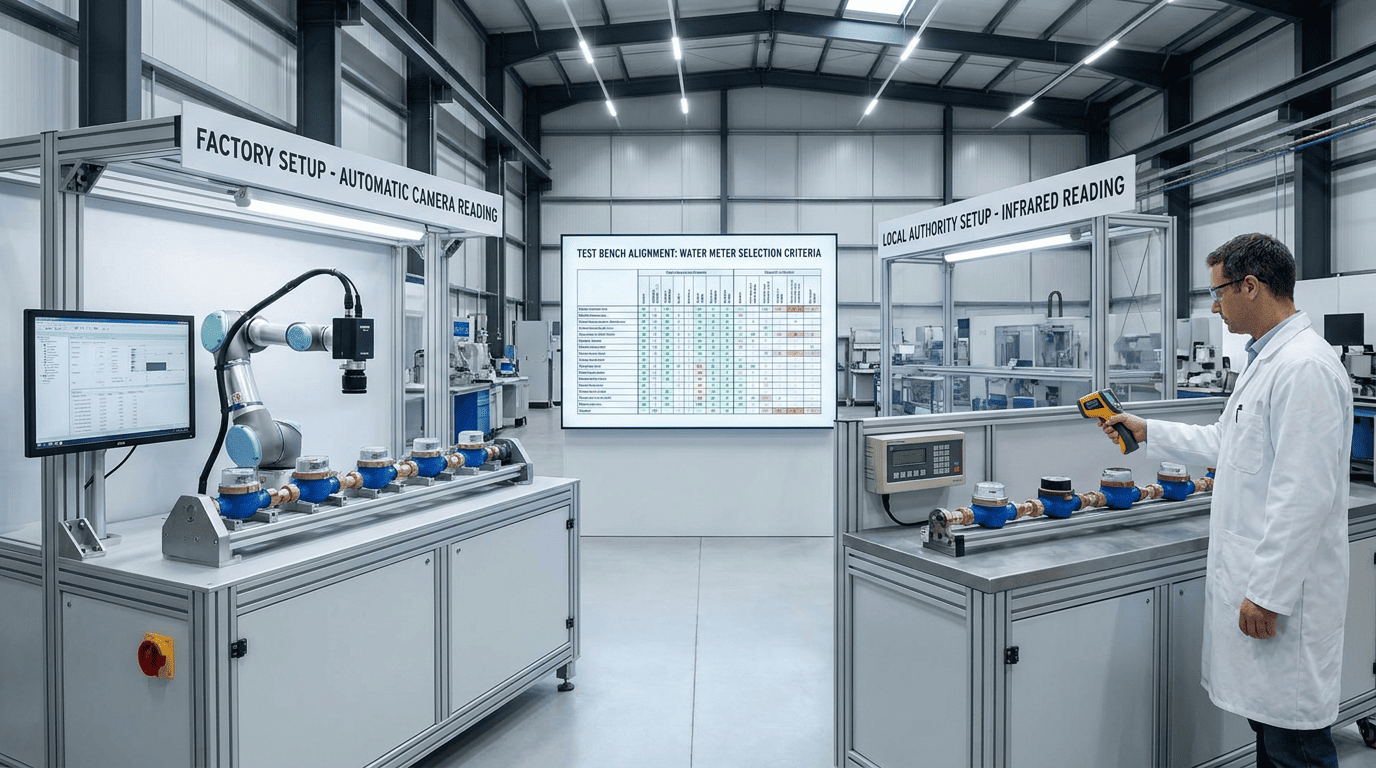
J'utilise le cas Pérou INACAL comme avertissement
L'affaire INACAL au Pérou a changé ma façon de gérer le risque d'acceptation. L'usine pensait que les compteurs étaient acceptables. Le tribunal des autorités locales a rejeté 50% des compteurs. Le problème n’était pas seulement la qualité des compteurs. Le problème impliquait des différences dans les conditions de test, interprétation locale, et le comportement d'un banc à l'autre.
Je demande maintenant que les échantillons avant expédition soient testés dans des conditions proches de celles de l'autorité locale.. Je demande à propos tuyau droit, conditionnement du flux, méthode start-stop, pression, température, résolution de lecture, et l'incertitude. Je demande également si le même compteur a déjà passé devant cette autorité.
Cette étape est particulièrement importante dans les projets d’export. Un pass d'usine protège l'usine. Un pass local protège le projet. Ce n'est pas toujours la même chose. je veux les deux.
| Facteur de banc d'essai | Pourquoi je le vérifie |
|---|---|
| Perturbation du débit | Cela peut affecter les résultats d'erreur. |
| Tuyau droit | Cela affecte le profil de flux. |
| Pression | Cela affecte la stabilité du test. |
| Température | Cela affecte la répétabilité. |
| Méthode de lecture | Cela affecte les données d'acceptation. |
| Histoire des autorités locales | Cela réduit le risque de rejet. |
À la recherche d’un fournisseur de compteurs d’eau fiable?
YOUNIO fabrique des compteurs d'eau mécaniques et ultrasoniques du DN15 au DN500, Certifié MID et testé selon ISO 4064. Échantillons gratuits et rapports de tests en usine disponibles pour les acheteurs qualifiés.
Critère 6: Quels critères de sélection du fabricant de compteurs d'eau contrôlent le risque de lot?
Je n'ai pas peur d'un compteur en panne. Je crains un vice caché qui se répète sur des centaines de milliers d'unités.
La gestion des risques liés aux lots permet au fabricant de trouver, isoler, arrêt, et corriger un défaut avant que le projet reçoive la quantité totale. C'est l'un des critères de sélection les plus pratiques des fabricants de compteurs d'eau..
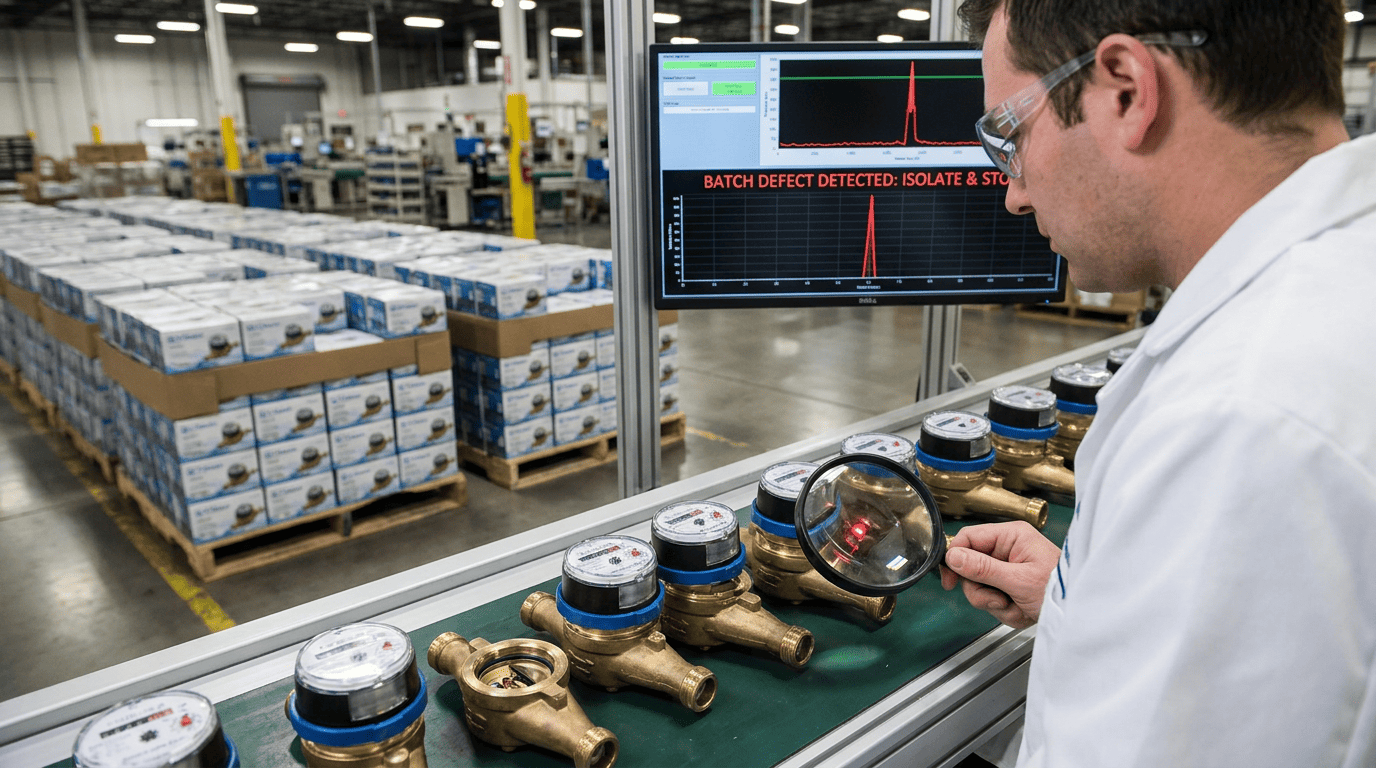
J'utilise le boîtier anti-effraction de 573 500 mètres comme leçon sur les risques par lots
Le cas le plus important dans mes données de réclamation est impliqué 573,500 mètres. Le problème venait d'un défaut de conception anti-effraction. D'abord, le problème ne ressemblait pas à un désastre. C'est devenu un désastre car la même faiblesse s'est répétée en très grande quantité.
Ce boîtier m'a montré que la conception anti-effraction n'est pas un petit détail accessoire. Cela affecte la confiance sur le terrain. Cela affecte l'inspection. Cela affecte les litiges des utilisateurs. Cela affecte la capacité d'un service public à défendre ses données de facturation.. Une fois qu'une conception faible est déjà installée sur de nombreux sites, le coût de réparation devient beaucoup plus élevé que le coût de la pièce d'origine.
Je demande à chaque fabricant un plan de contrôle des lots. Je veux une inspection du premier article. Je veux l'approbation du lot pilote. Je veux des points de contrôle critiques pour la qualité. Je veux une règle de retenue des envois. Je veux la traçabilité du numéro de série. Je veux des photos d'assemblages critiques. Je veux avoir le droit d'arrêter la livraison si un problème répété apparaît.
| Élément de contrôle par lots | Ce que j'attends |
|---|---|
| Lot pilote | Test avant production en série |
| Inspection du premier article | Approbation signée avec photos |
| Liste des éléments critiques pour la qualité | Éléments clés et points clés du processus |
| Traçabilité série | Lien vers la ligne, date, et lots de composants |
| Règle de maintien | Arrêter l'expédition lorsqu'un risque apparaît |
| Action corrective | Cause profonde et prévention |
Critère 7: Comment les critères de sélection des fabricants de compteurs d'eau testent-ils la réalité de l'indice de protection IP ??
J'ai vu des indices IP paraître solides sur le papier et faibles dans des chambres boueuses.. Les conditions sur le terrain sont plus difficiles que les conditions du catalogue.
La réalité de l'indice IP est un critère de sélection du fabricant de compteurs d'eau car la pénétration d'eau, condensation, fuite de câble, faiblesse du couvercle de la batterie, et un mauvais empotage peut nuire aux performances des compteurs intelligents.
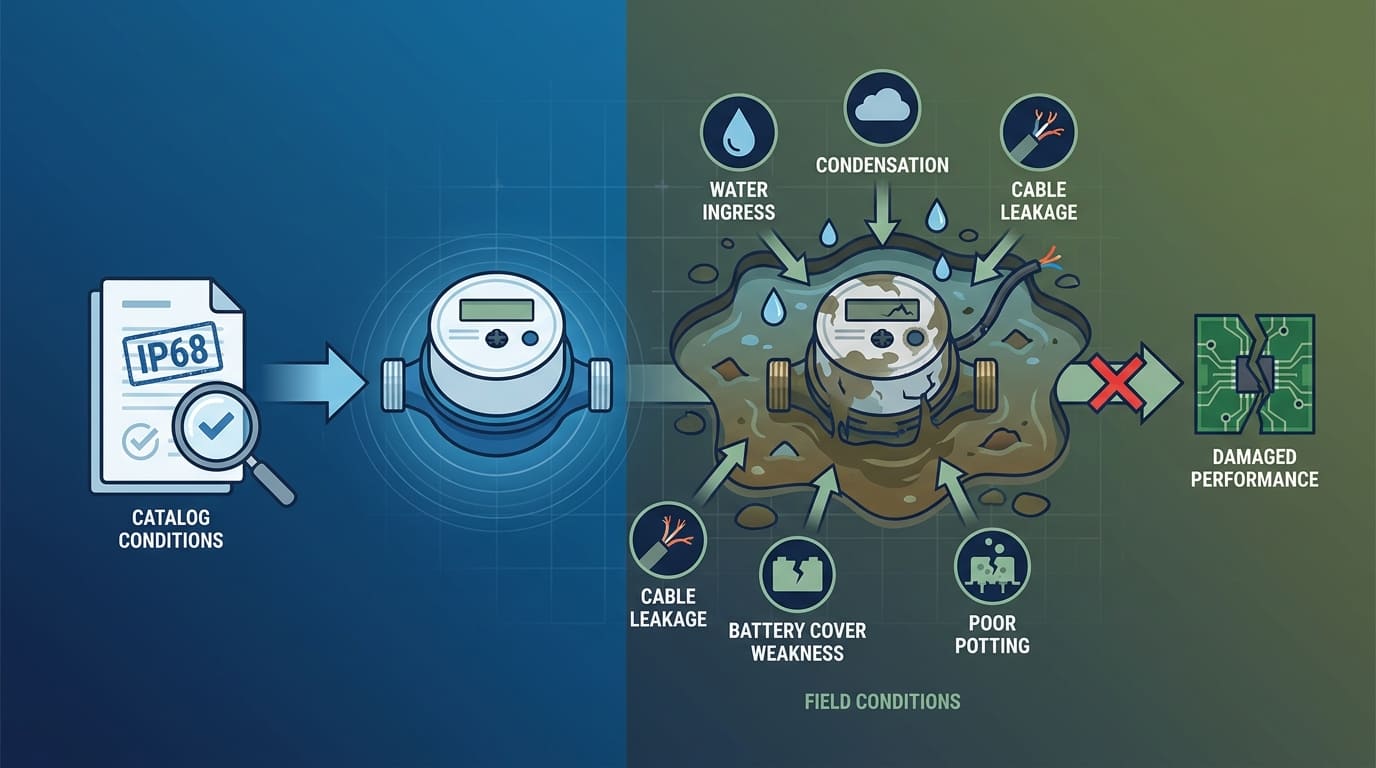
Je vérifie le système d'étanchéité, pas seulement l'étiquette IP
Une étiquette IP68 peut être utile. Mais je demande quand même comment le fournisseur le prouve. Je demande où sera installé le compteur. Je demande s'il va rester dans une salle sèche, une box extérieure, une fosse inondée, ou une chambre enterrée. Je demande si le câble, antenne, couvercle de la batterie, et le registre sont protégés au même niveau.
Pour les compteurs intelligents, Je demande également comment les données peuvent être surveillées après l'installation. Dans un système LoRa, le concentrateur doit être installé dans un bon emplacement, et les obstacles entre le concentrateur et les compteurs doivent être réduits pour améliorer les performances du signal. Si le compteur a une bonne étanchéité mais une mauvaise communication à cause du site, le projet souffre encore.
Je vérifie également comment le système affiche l'état de la communication. Une interface du système LoRa peut indiquer si le concentrateur est connecté à Internet, avec le vert affiché en ligne et le rouge affiché hors ligne. Ce type de surveillance simple aide l'opérateur à distinguer un problème de compteur d'un problème de réseau..
| Vérification de la réalité de la propriété intellectuelle | Ma question de terrain |
|---|---|
| Fenêtre d'inscription | Est-ce qu'il y aura de la buée ou une fuite? |
| Sortie de câble | L'eau peut-elle entrer par le câble? |
| Couvercle de batterie | Peut-il sceller après le service? |
| Empotage | Peut-il vieillir et se fissurer? |
| Boîtier d'antenne | L'étanchéité réduit-elle le signal? |
| État de la chambre | Le site est-il sec, mouillé, ou inondé? |
Critère 8: Comment les critères de sélection des fabricants de compteurs d'eau gèrent-ils les notifications de modifications à long terme ??
Je n'achète pas seulement la fiche technique d'aujourd'hui. J'achète une plateforme de produits qui peut rester dans mon système pendant des années.
La notification de changement à long terme est un critère de sélection du fabricant de compteurs d'eau, car les compteurs, modules, piles, micrologiciel, applications, concentrateurs, et les plateformes peuvent changer au cours d'un projet pluriannuel.
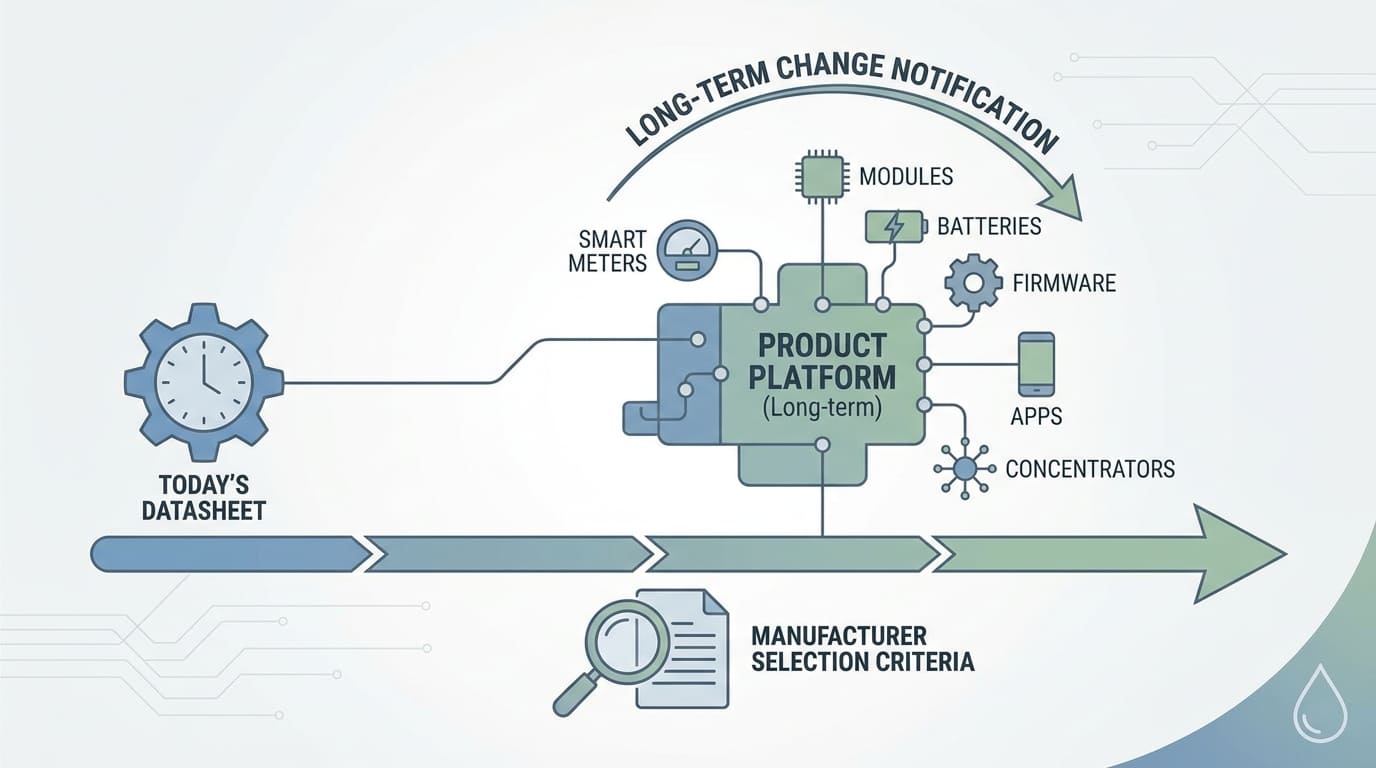
Je demande l'historique du produit et l'historique du système
Un fabricant peut changer de fournisseur de batteries. Il peut mettre à jour le firmware. Cela peut changer l'antenne. Cela peut changer le registre. Cela peut modifier le flux de travail de l'application mobile. Cela peut changer le matériel du concentrateur. Chaque changement peut être raisonnable. Mais j'ai besoin de savoir quand le changement affecte mon projet.
En fonctionnement du compteur LoRa, il existe des procédures sur le terrain telles que la connexion d'un écrivain au module LoRa et le téléchargement de lectures via une application Mobile CRM. Il existe également des procédures pour réinitialiser la lecture initiale lorsqu'un module LoRa est déplacé d'un compteur à un autre.. Ces étapes opérationnelles montrent pourquoi la cohérence du système à long terme est importante.
Si le fabricant change le module, application, ou réinitialiser le processus sans préavis, l’équipe de terrain du service public peut perdre du temps. Si le fabricant modifie le firmware sans enregistrement clair de la version, l'équipe informatique ne sait peut-être pas pourquoi les lectures se comportent différemment. Si le fournisseur change la batterie sans préavis, l'opérateur peut découvrir le problème seulement après des échecs sur le terrain.
| Changement à long terme | Pourquoi j'ai besoin d'un préavis |
|---|---|
| Micrologiciel | Cela peut affecter le comportement de lecture. |
| Batterie | Cela peut affecter la durée de vie. |
| Module de communication | Cela peut affecter l'adhésion au réseau. |
| Processus d'application mobile | Cela peut affecter le travail sur le terrain. |
| Matériel de concentrateur | Cela peut affecter la communication. |
| Conception de registre | Cela peut affecter la sortie de lecture. |
Critère 9: Pourquoi les critères de sélection des fabricants de compteurs d'eau nécessitent-ils des projets de référence régionaux?
Je fais davantage confiance aux références lorsqu’elles correspondent au pays de l’acheteur, qualité de l'eau, pression, climat, autorité, et habitudes d'installation.
Les références régionales constituent un critère de sélection pratique pour les fabricants de compteurs d'eau, car les réglementations locales, bancs d'essais locaux, pratique d'installation, et les attentes en matière de service peuvent changer la réussite du projet.

Je demande des projets similaires, pas seulement des projets célèbres
Un fournisseur peut avoir une grande référence dans une autre région. Cette référence peut aider. Mais je demande quand même si le même modèle a fonctionné dans mon pays cible ou sur un marché similaire.. Je demande si le même matériau du corps, même registre, même module de communication, même itinéraire de certificat, et le même processus d'acceptation des tests a été utilisé.
Pour les projets AMR ou AMI, Je demande également si le fournisseur a déployé le système complet. Un projet de compteur intelligent inclut des compteurs, modules, concentrateurs, applications, serveur ou plateforme cloud, et procédures de terrain. Un concentrateur LoRa a besoin d’une connectivité électrique et télécom, et dans des conditions normales, il peut se connecter à Internet environ deux minutes après la configuration. Ce détail semble simple, mais c'est important lorsqu'une équipe locale doit installer de nombreux sites.
Je demande également si le fournisseur peut prendre en charge la formation locale. Les équipes de terrain devront peut-être télécharger immédiatement les relevés via un rédacteur manuscrit et une application Mobile CRM pendant les tests.. Les opérateurs peuvent également avoir besoin d'une lecture en temps réel d'un collecteur lorsque le concentrateur est en ligne.. Ce ne sont pas seulement des caractéristiques du produit. Ce sont des exigences de service.
| Question de référence | Réponse forte |
|---|---|
| Même région? | Oui, avec une autorité ou un climat similaire. |
| Même modèle? | Même corps de compteur et même registre. |
| Même communication? | Même LoRa, Nb-iot, M-Bus, ou autre système. |
| Même chemin d'acceptation? | Test similaire en laboratoire ou utilitaire local. |
| Même échelle? | Taille de lot et risque de projet similaires. |
| Même modèle de support? | Formation locale et pièces détachées. |
Liste de contrôle des critères de sélection pratiques des fabricants de compteurs d'eau?
J'utilise une liste de contrôle car l'évaluation des fournisseurs doit être reproductible. Une liste de contrôle réduit également les décisions émotionnelles lors de la négociation des prix.
Une liste de contrôle pratique pour la sélection du fabricant de compteurs d'eau devrait évaluer la traçabilité des plaintes., changer de contrôle, certificats, chaîne d'approvisionnement, alignement du banc d'essai, contrôle des lots, Réalité de la propriété intellectuelle, notification à long terme, et références régionales.
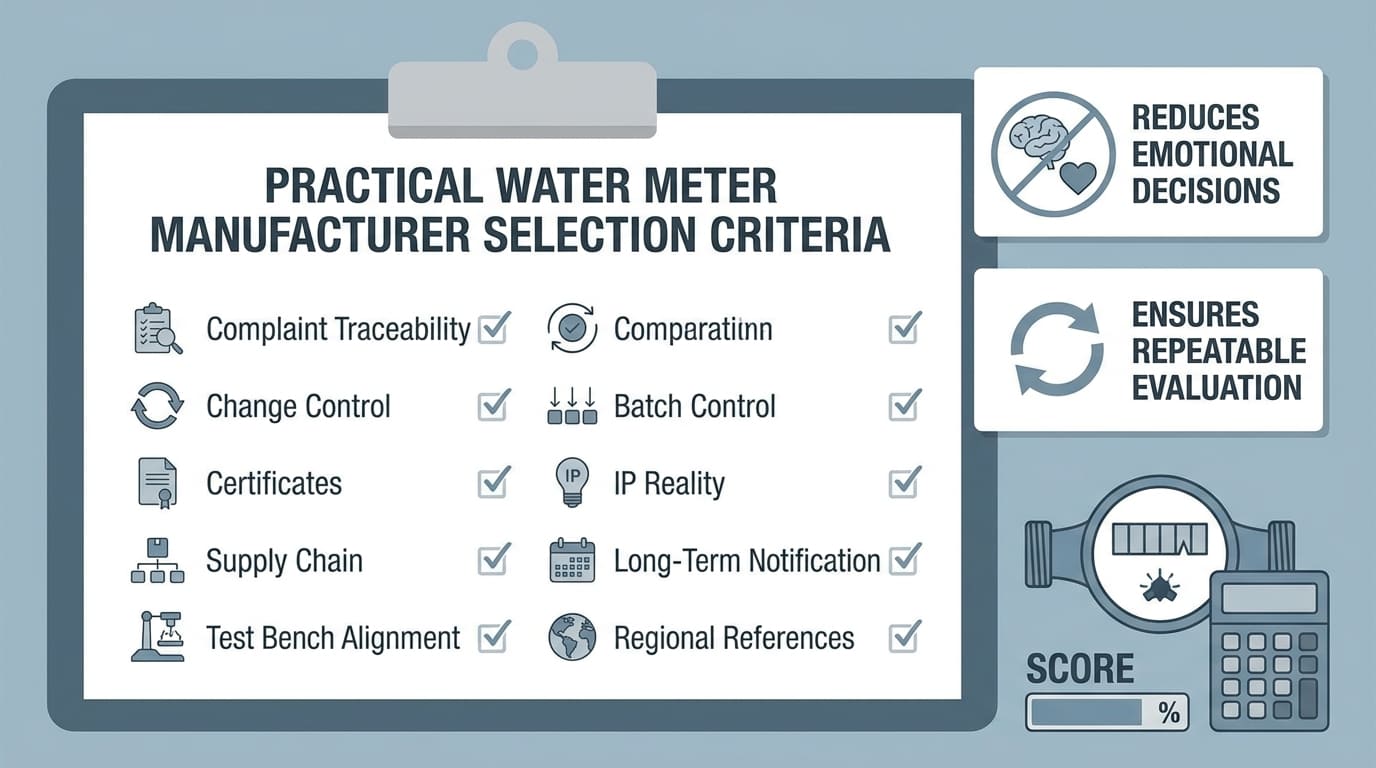
Je note des preuves, pas un langage de vente
Je ne donne pas de notes élevées pour des réponses sûres. Je donne des notes élevées aux documents, enregistrements, des photos, liens vers les numéros de série, rapports de tests, traçabilité des composants, et références de travail. Je demande également au fournisseur d'expliquer un échec passé. Un fournisseur qui peut expliquer clairement son échec est souvent plus en sécurité qu'un fournisseur qui revendique la perfection..
| Critère de sélection du fabricant de compteurs d'eau | Question clé | Preuve que je demande | Drapeau rouge |
|---|---|---|---|
| Traçabilité des réclamations | Peuvent-ils montrer des données sur cinq ans? | Liste des réclamations par modèle et lot | Un seul taux de plainte total |
| Notification de modification de conception | Est-ce qu'ils notifient les changements de pièces? | Processus ECN et journal de révision | "Même modèle, pas besoin d'informer" |
| Application des certifications | Le certificat correspond-il à la production? | Certificat, marquage, Nomenclature, portée du test | Le certificat ne correspond pas au produit |
| Contrôle de la chaîne d'approvisionnement | Qui fabrique les pièces critiques? | Liste des fournisseurs et rapports sur les matériaux | Source matérielle inconnue |
| Alignement du banc d'essai | Peuvent-ils correspondre aux conditions des autorités locales? | Comparaison de bancs et échantillons | Pass usine uniquement |
| Contrôle des risques par lots | Peuvent-ils isoler un mauvais lot? | Lot pilote et règle de conservation | Pas de traçabilité série |
| Réalité de l'indice IP | La chasse au phoque survit-elle aux sites de terrain? | Preuves IP et photos de terrain | Étiquette IP sans preuve |
| Notification à long terme | Peuvent-ils contrôler des années de changements? | Historique du matériel et du firmware | Remplacement silencieux |
| Références régionales | Ont-ils travaillé sur des marchés similaires? | Liste des projets et dossier de support | Allégations mondiales génériques |
J'utilise différents poids pour différents projets
Pour un projet de compteur résidentiel mécanique, J'accorde plus de poids aux certificats, matériels, contrôle des lots, et acceptation des tests locaux. Pour un projet de compteur intelligent, J'accorde plus de poids à la protection de la propriété intellectuelle, durée de vie de la batterie, micrologiciel, communication, et support système. Pour un projet AMI, J'accorde encore plus de poids aux procédures de données, stabilité de la plateforme, surveillance du concentrateur, et formation locale.
| Type de projet | Critères de poids le plus élevé |
|---|---|
| Compteurs résidentiels mécaniques | Attestation, matériel, contrôle des lots |
| Compteurs résidentiels intelligents | Indice IP, batterie, micrologiciel, changer de contrôle |
| Compteurs industriels | Pression, matériel, banc d'essai, références |
| Cadre utilitaire | Données sur les plaintes, risque de lot, chaîne d'approvisionnement |
| Projet d'exportation | Autorité locale, certificats, référence régionale |
| Projet AMI | Communication, plate-forme, soutien, stabilité des données |
Je garde quatre questions incontournables
J'arrête l'évaluation si un fabricant ne peut pas répondre à quatre questions. Peuvent-ils retracer chaque compteur par numéro de série et lot? Peuvent-ils prouver la conformité matérielle pour le pays cible? Peuvent-ils notifier tous les changements critiques de conception et de fournisseur? Peuvent-ils tester les conditions des autorités locales avant une expédition massive?
Ces questions sont simples. Ils protègent également l'acheteur des pannes les plus coûteuses que j'ai vues. Le boîtier anti-effraction de 573 500 mètres était un avertissement de contrôle de lots. Le 26,000 le boîtier en laiton était un avertissement de contrôle des matériaux. Le 15,573 l'échec de la lecture à distance était un avertissement de changement de conception. L’affaire INACAL au Pérou était un avertissement de banc d’essai.
Conclusion
Je choisis un fabricant de compteurs d'eau sur preuves, pas seulement par le prix. Je souhaite une traçabilité des réclamations, changements contrôlés, vrais certificats, chaînes d'approvisionnement stables, alignement des tests locaux, contrôle des risques par lots, Protection IP prête sur le terrain, notification à long terme, et références régionales. Si vous examinez les fournisseurs de compteurs d’eau pour un service public, promoteur, ou projet AMI, YOUNIO peut soutenir la discussion avec des options de compteurs certifiés, solutions de communication intelligentes, documentation du projet, et coopération pratique pour une fiabilité du cycle de vie à long terme.
À la recherche d’un fournisseur de compteurs d’eau fiable?
YOUNIO fabrique des compteurs d'eau mécaniques et ultrasoniques du DN15 au DN500, Certifié MID et testé selon ISO 4064. Échantillons gratuits et rapports de tests en usine disponibles pour les acheteurs qualifiés.