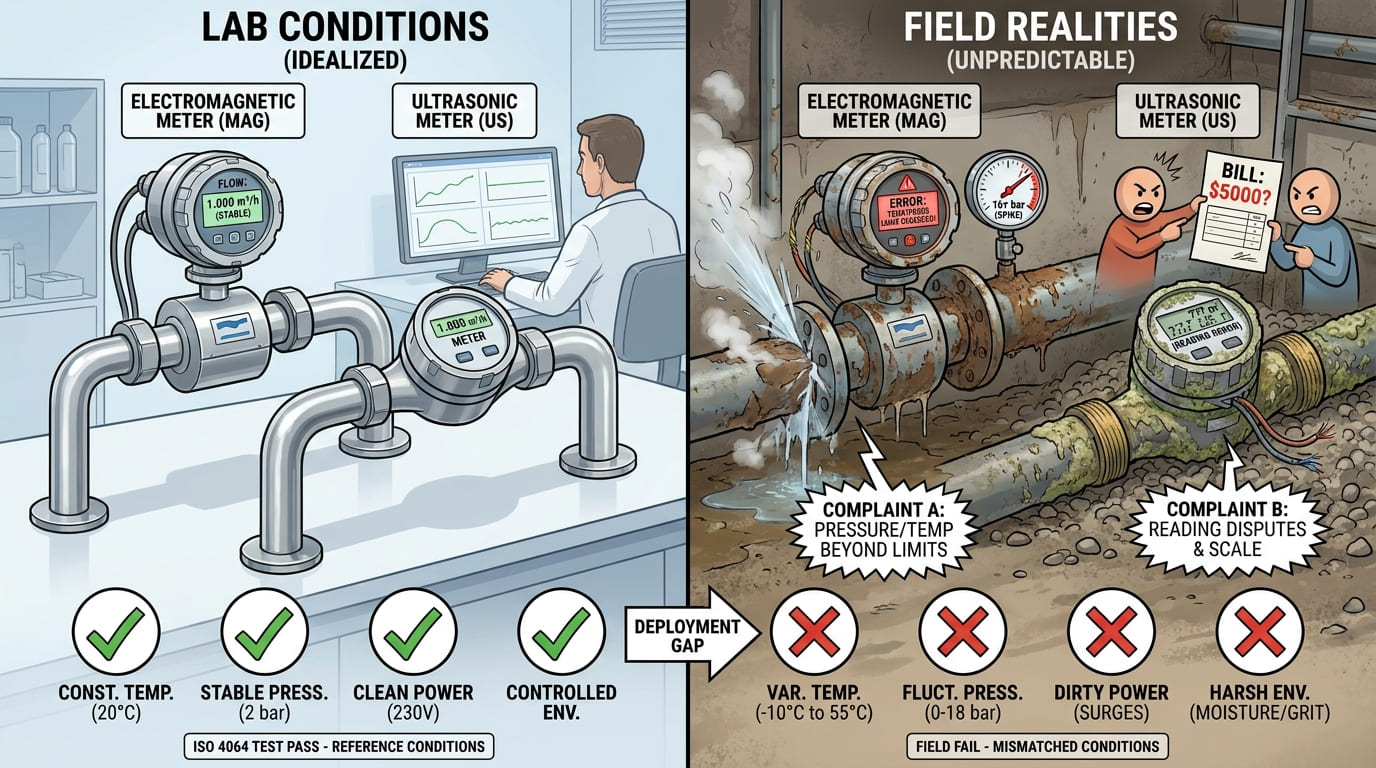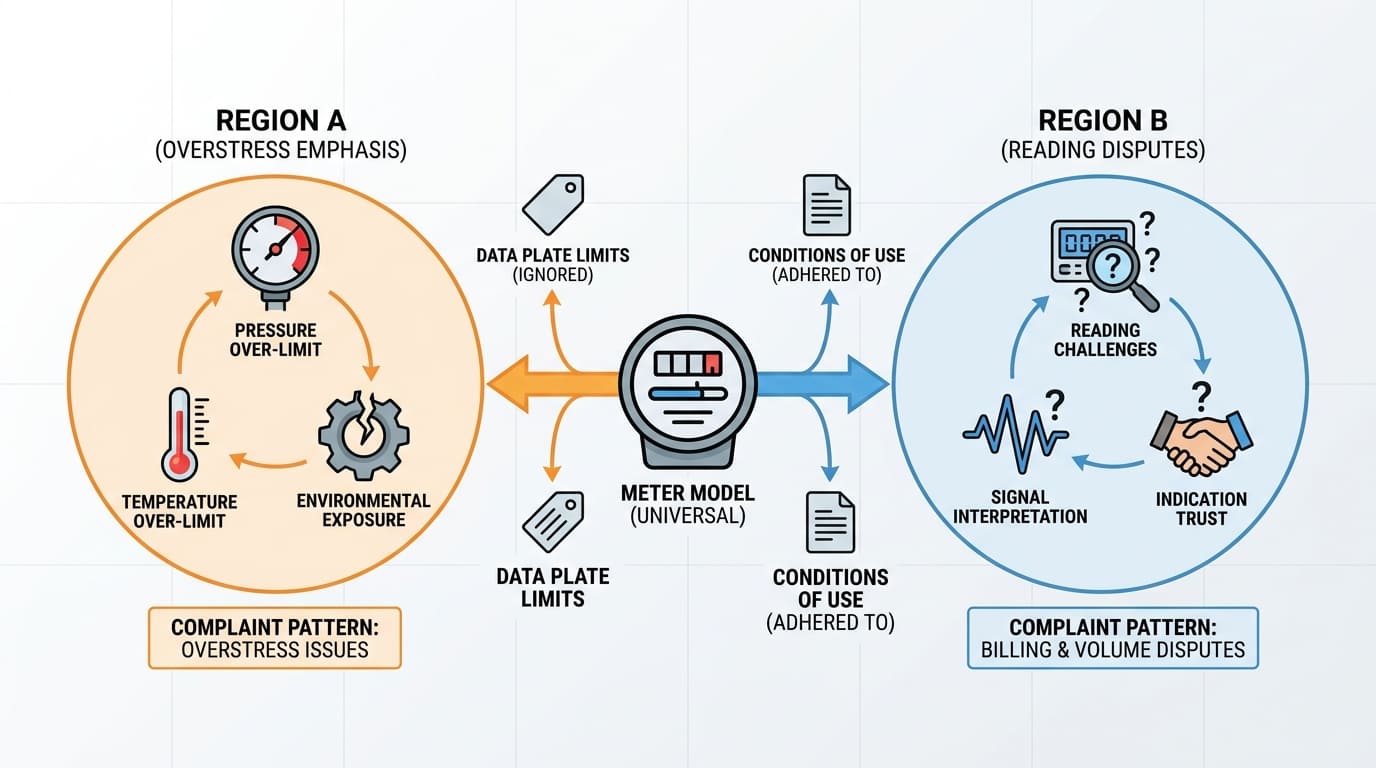

Many engineers compare electromagnetic and ultrasonic water meters in the lab and expect the same result in the field. I have learned that the field is less polite. The same model can go to two different countries and produce two very different complaint structures. In one market, the main issue is pressure or temperature beyond limits. In another, the main issue is reading disputes.
The short answer is this: electromagnetic and ultrasonic water meters can both perform well, but field success depends less on brochure claims and more on whether the meter’s approved conditions of use match the local pressure, temperature, power, and environmental realities. Lab performance is only the start, because ISO 4064 testing itself recognizes environmental classes, reference conditions, power supply effects, and the need to test either the full meter with water or simulated electronic inputs under controlled conditions.

I think this is where many project teams go wrong. They compare technologies as if “electromagnetic” and “ultrasonic” each behave the same everywhere. They do not. What matters in real projects is not only how the technology works, but also how the meter is installed, what environment class it was approved for, and whether the local network pushes it outside those limits.
How Electromagnetic Water Meters Work?
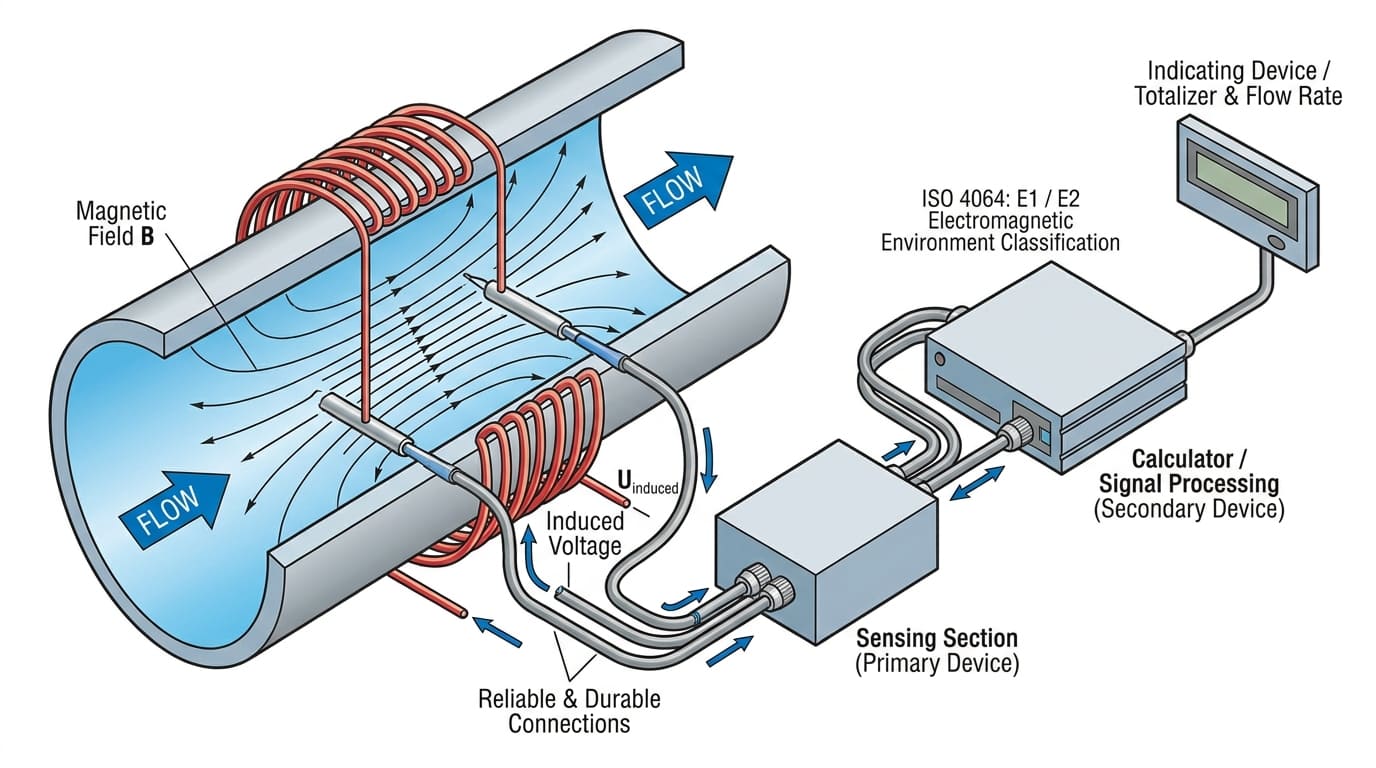
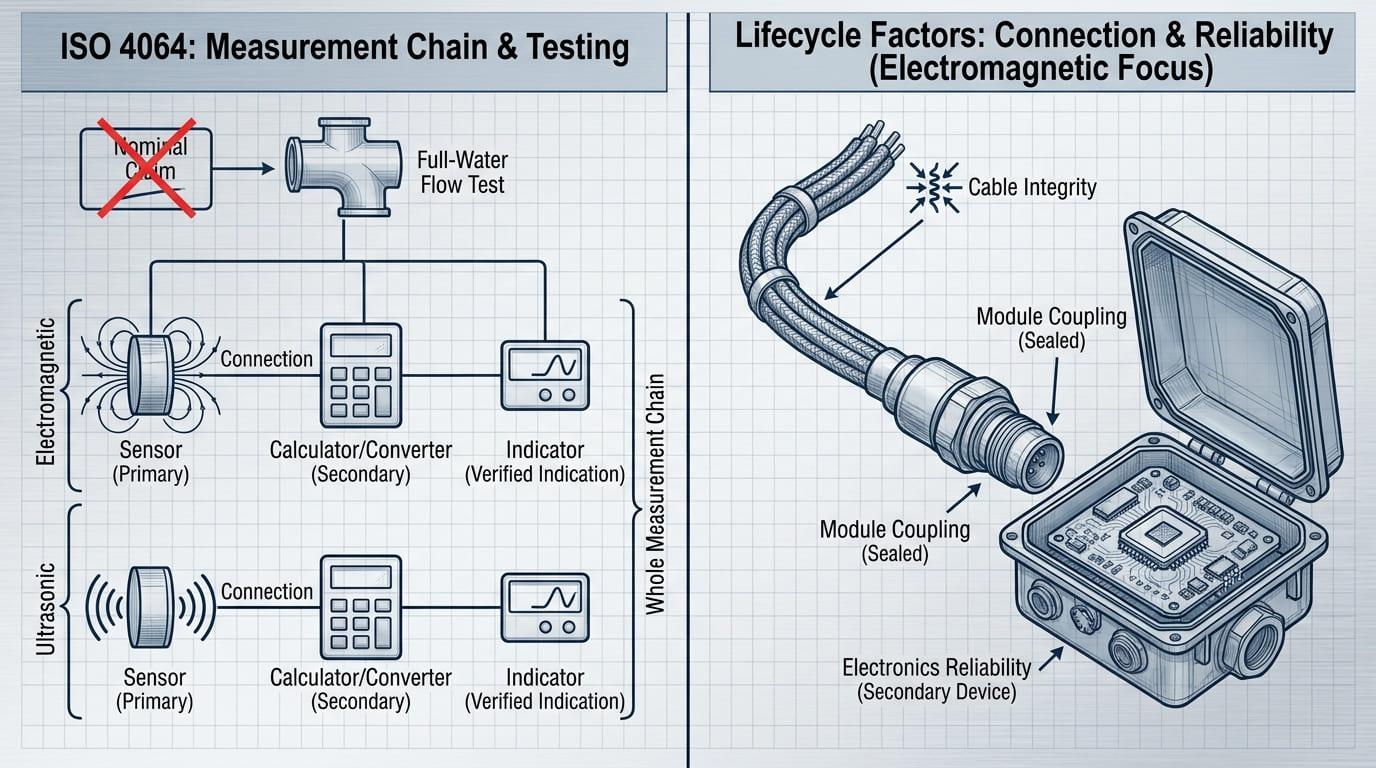
Electromagnetic water meters measure flow using an electronic measurement system built around the sensing section and electronic components. In ISO 4064 language, these meters can include separate primary and secondary devices, and the connections between the measurement transducer, calculator, and indicating device must be reliable and durable. The same reliability requirement also applies to the connections between the primary and secondary devices of electromagnetic meters.
In practical terms, I see electromagnetic meters as meters whose measuring principle depends strongly on stable electronic behavior, proper signal handling, and robust interconnection between sensing and calculating parts. ISO 4064 also treats water meters with electronic devices as belonging to electromagnetic environments, divided into E1 and E2 classes.

The standard gives me two very useful reminders about electromagnetic meters. 初め, the manufacturer must inform potential users of the conditions of use for which a meter is approved, and the data plate shall indicate the corresponding limits of use. 2番, those meters are divided into electromagnetic environment classes. E1 applies to residential, コマーシャル, and light industrial areas, while E2 applies to industrial environments. This matters because many field failures are not really “bad products.” They are meters used outside the environment they were effectively selected for.
I also note that electronic calculators and indicating devices can be type-evaluated separately by simulating inputs generated by suitable standards, and accuracy tests on the indications are required. That tells me electromagnetic meters are not judged only by the wet side. Their electronic interpretation chain matters too.
How Ultrasonic Water Meters Work?
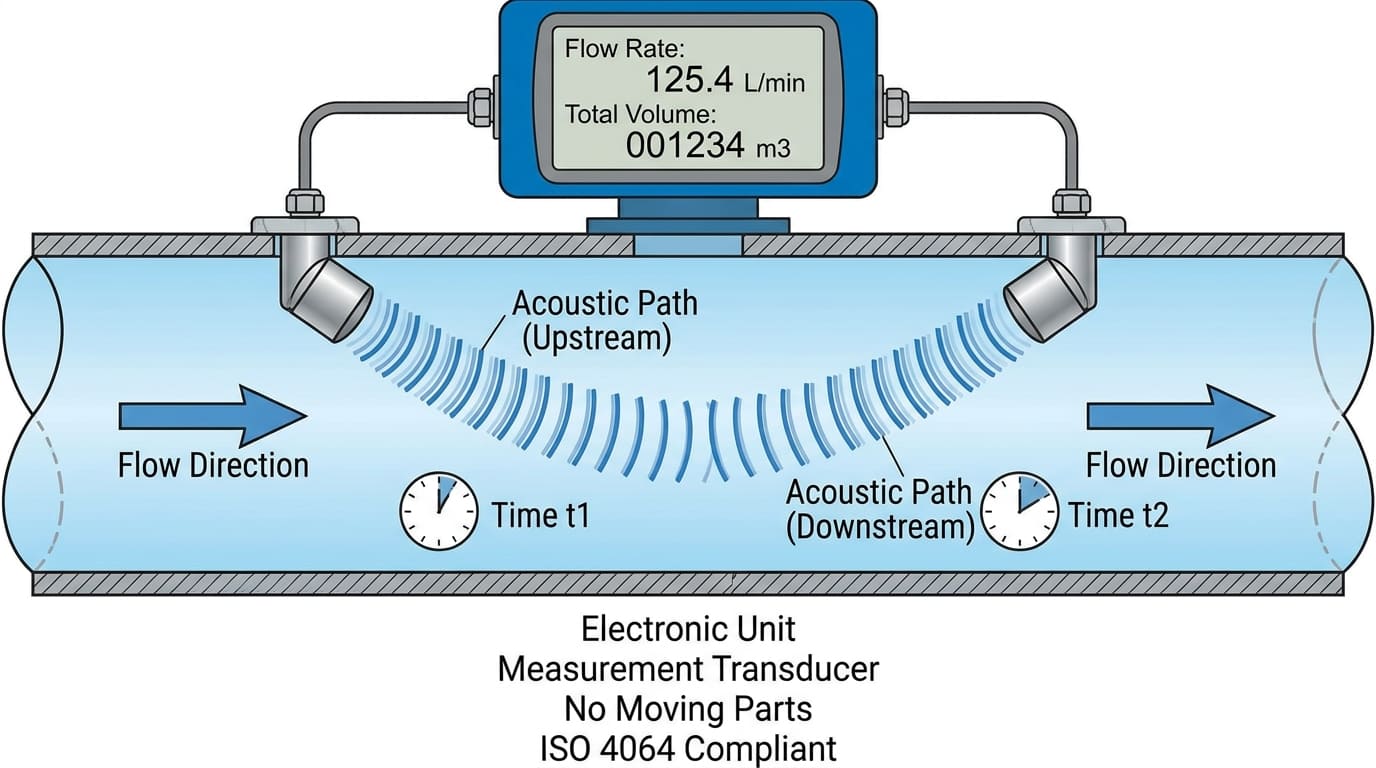
Ultrasonic water meters are also electronic in practical use, so many of the same ISO 4064 electronic framework ideas still matter even if the measuring principle is different. The references here do not explain the ultrasonic measuring principle directly, so I will describe it at a high level based on general engineering knowledge: ultrasonic meters determine flow by analyzing acoustic signal behavior through the water path. In field discussions, they are usually valued for having no mechanical moving parts in the measuring chamber.
What I can say directly from the references is that ISO 4064 test provisions include testing of the complete water meter and also separate testing of the measurement transducer, calculator, and indicating device as separate units where required. There are also two options for testing electronic meters: one with real water at the reference flow rate, and another using simulation of the measurement transducer for all electronic components, though testing with water is preferable.

That testing structure is very relevant for ultrasonic meters. It means engineers should not assume that a meter’s claimed performance came only from one simple full-flow bench result. The standard allows structured evaluation of both the whole device and its electronic parts under reference conditions. In the field, that matters because reading disputes often come from the gap between controlled test conditions and real pipeline behavior.
I also take seriously the requirement that totalization shall not change in the absence either of flow or of water. For ultrasonic meters, as for other electronic meters, that principle is important when customers question unexpected readings during no-flow periods.
Lab Performance vs Field Reality?
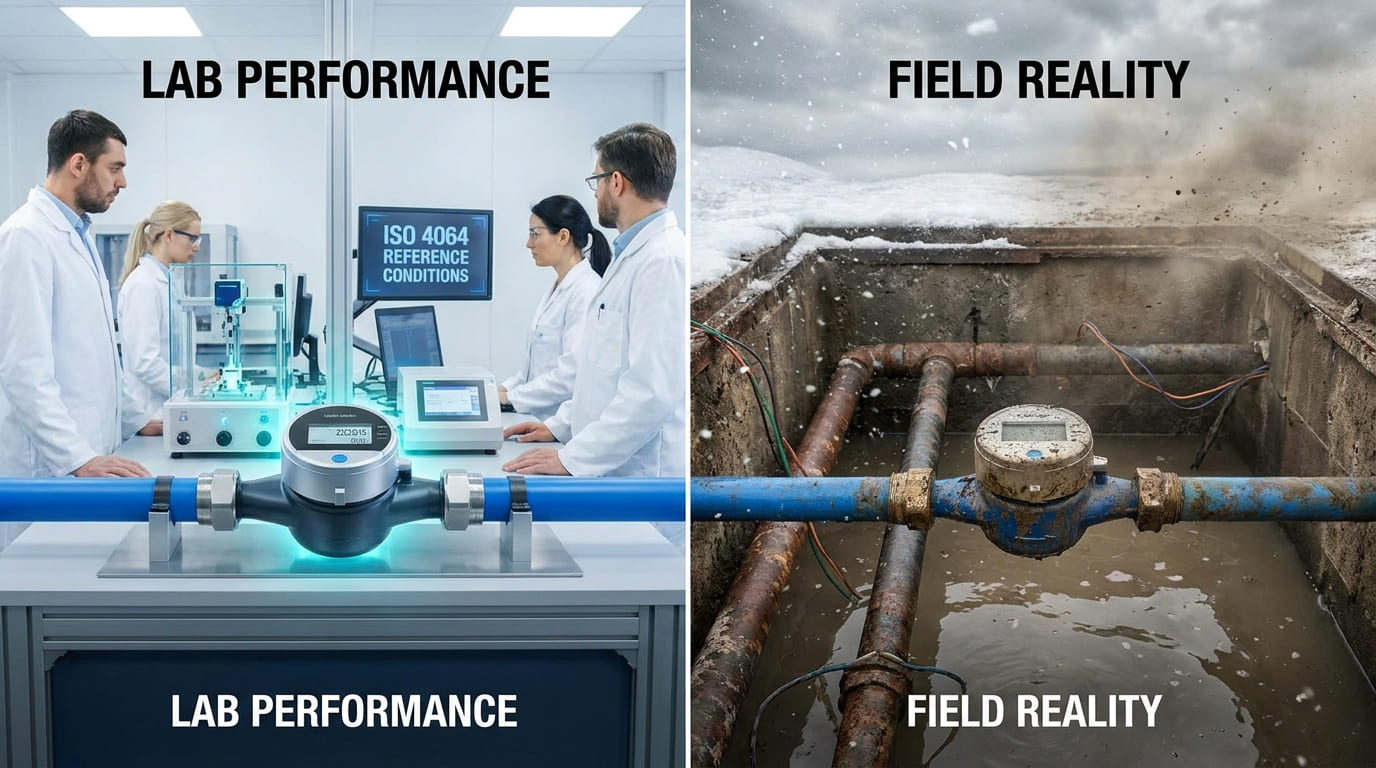
Lab performance is necessary, but it is not the same as field reality. ISO 4064 itself makes this clear because it defines reference conditions, environmental testing, electromagnetic classes, and power supply tests for electronic water meters.
The standard says that reference conditions should be used only if no regional or national standard defines more specific conditions for local use. That one sentence explains a lot of real-world complaint behavior. A meter can be tested correctly under reference conditions and still face different local realities after export, because another country may have tougher temperature, pressure, power, or environmental conditions in practice.

I think this is the reason why the same model can produce different complaint patterns in different regions. In one country, the meter may stay comfortably inside its approved limits. In another, pressure surges, hot climates, industrial electromagnetic exposure, or unstable power supply can push it into a much harder operating life. ISO 4064 requires that a water meter withstand static pressure tests of 1.6 times the maximum admissible pressure for 15 minutes and twice the maximum admissible pressure for 1 minute without leakage or damage. That is a strong test, but it is still a defined test, not a promise that every wild field condition is acceptable.
The standard also includes tests for devices powered by direct AC or AC/DC converters. Those tests verify performance during static deviations of mains voltage and frequency while the equipment is under reference conditions [5]. So if one export market has unstable power and another does not, complaint structures can diverge even with the same model.
| Lab factor | What ISO 4064 checks | Why field reality can differ |
|---|---|---|
| Reference conditions | Standardized test conditions | Local standards or site conditions may differ |
| Electromagnetic environment | E1 or E2 classification | Real industrial exposure may be harsher |
| Static pressure | Defined pressure resistance test | Field surges and misuse may exceed approved limits |
| Power supply stability | Voltage and frequency deviation tests | Local grid quality can vary a lot |
Complaint Patterns in Different Regions?
The most important field insight here is simple: the same meter model can create different complaint structures in different countries. I have seen markets where pressure and temperature over-limit issues dominate, and other markets where the main issue is reading disputes. The references help explain why that happens.
Manufacturers must inform users of the conditions of use for which the meter is approved, and the data plate shall indicate the corresponding limits of use. If a project team ignores those limits, then the complaint pattern is likely to center on overstress issues such as pressure, temperature, or environmental exposure. On the other hand, if the meter remains physically intact but users challenge the billed volume, the complaints may shift toward reading disputes, signal interpretation, or indication trust.

The standard’s environmental framework supports this regional difference. Water meters with electronic devices are divided into E1 and E2 environments. E1 covers residential, コマーシャル, and light industrial use, while E2 covers industrial use. So if a meter suited for one environment is used in another, the complaint pattern may reflect that mismatch. I also note that environmental tests require preconditioning and controlled procedures under relevant IEC standards. That means approved performance is always tied to defined test structures, not vague assumptions.
Reading disputes often appear when the local user expectation is “the number must match my intuition,” while the meter is actually operating within approval conditions. Pressure and temperature complaints usually appear when the site has gone beyond those conditions. Both problems can happen with the same model, just in different regions.
| Region-style complaint pattern | Likely field driver |
|---|---|
| Pressure / temperature over-limit complaints | Site conditions exceed approved use limits |
| Reading disputes | Gap between field perception and indicated result |
| Environment-related instability | Wrong E1/E2 fit or poor local protection |
| Power-related complaints | Mains instability or converter issues |
正確さ, Maintenance and Cost Comparison?
From an engineering view, both technologies depend on more than nominal accuracy claims. ISO 4064 requires accuracy tests on indications, and for electronic devices this can include simulated inputs or full-water testing, with testing using water being preferable. That tells me the comparison should include not only the sensing principle, but also the whole measurement chain.
The references do not give a direct side-by-side maintenance or lifecycle cost table for electromagnetic and ultrasonic meters, so I should not pretend the standard settles that question by itself. Still, I can draw a careful engineering conclusion. Electromagnetic meters have explicit attention in the standard to the durability and reliability of connections between primary and secondary devices and between the transducer, calculator, and indicator. That reminds me that cable integrity, module coupling, and electronics reliability are part of lifecycle performance for electromagnetic designs.

For ultrasonic meters, the same electronic test logic applies to the calculator and indicating chain, and testing may be carried out with simulated measurement transducer behavior if needed, though water testing is preferred. That means cost and maintenance comparison should include not only the wetted meter body, but also the stability of electronics, power arrangements, and complaint-handling burden in the target region.
If I summarize this as an engineer, I would say this: brochure-level accuracy is easy to compare, but field cost is driven by complaint type. A region that creates many reading disputes can consume service time, customer support time, and verification costs. A region that creates pressure or temperature overstress complaints can consume replacement budgets, warranty negotiation, and installation review time.
| Factor | Electromagnetic meter note | Ultrasonic meter note |
|---|---|---|
| Accuracy evaluation | Includes indication accuracy and electronic chain checks | Includes full meter or simulated electronic testing |
| Reliability focus | Connections between primary/secondary devices matter | Electronic interpretation chain still matters |
| Hidden cost risk | Environmental fit and module reliability | Reading-dispute handling and electronics stability |
| Best comparison basis | Whole-life field burden, not only lab claim | Whole-life field burden, not only lab claim |
Installation Requirements and Limitations?
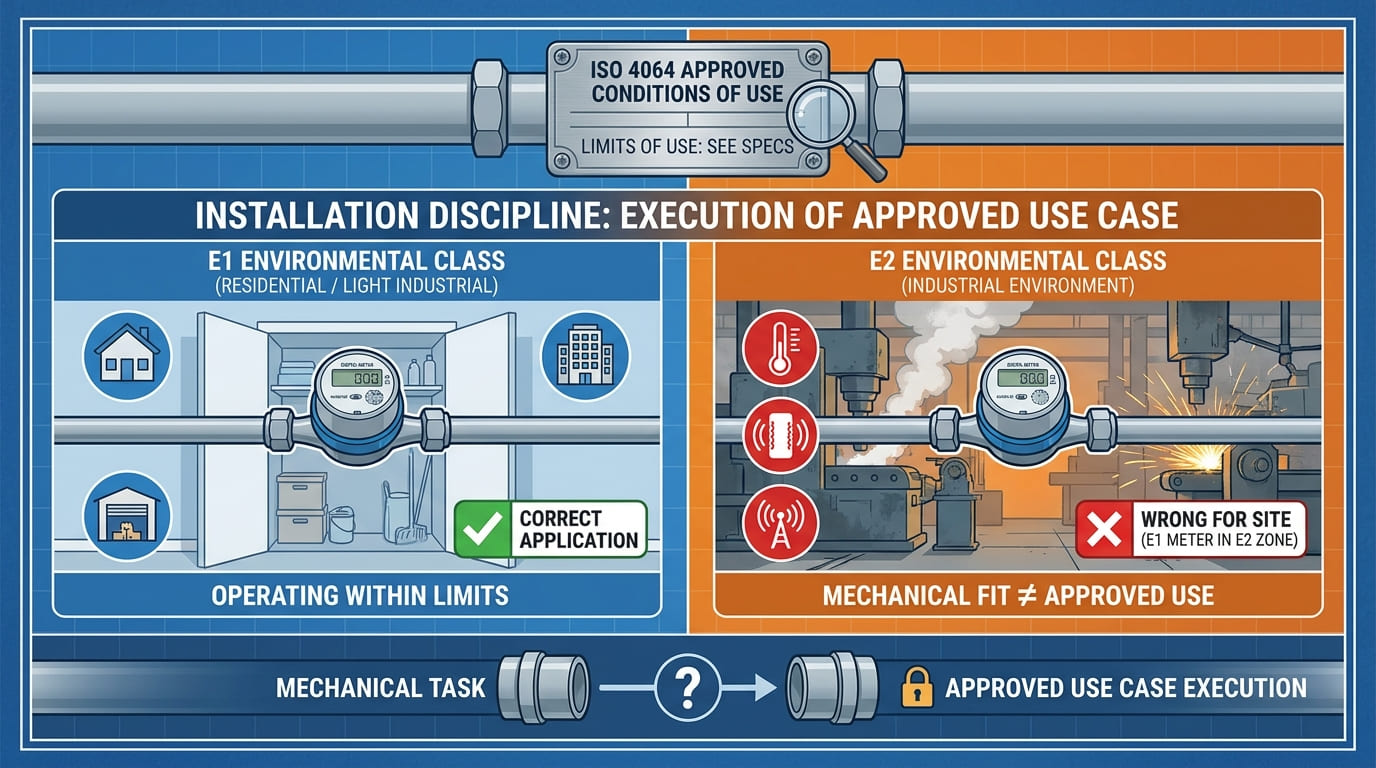
Installation discipline matters more than many teams admit. ISO 4064 requires manufacturers to inform users of the approved conditions of use, and the data plate shall show the corresponding limits of use. That means installation is not just a mechanical task. It is the execution of the approved use case.
For electronic water meters, environmental class is a practical installation filter. E1 meters are for residential, コマーシャル, and light industrial environments, while E2 meters are for industrial environments. If that distinction is ignored, the installation may technically “fit the pipe” but still be wrong for the site.

The test framework also shows two important installation-related limitations. 初め, reference conditions apply unless regional or national standards specify others designed for specific local conditions. So exported projects should not assume one installation expectation fits all countries. 2番, electronic devices powered by AC or AC/DC converters are tested against power voltage and frequency deviations under reference conditions. This means installation teams should pay attention to actual power quality, not only hydraulic conditions.
I also think engineers should remember the static pressure requirement. A water meter must withstand 1.6 times the maximum admissible pressure for 15 minutes and twice the maximum admissible pressure for 1 minute without leakage or damage. That does not remove the need to select the correct meter for the actual network. It only defines the test requirement.
Which Technology Fits Which Project Scenario?
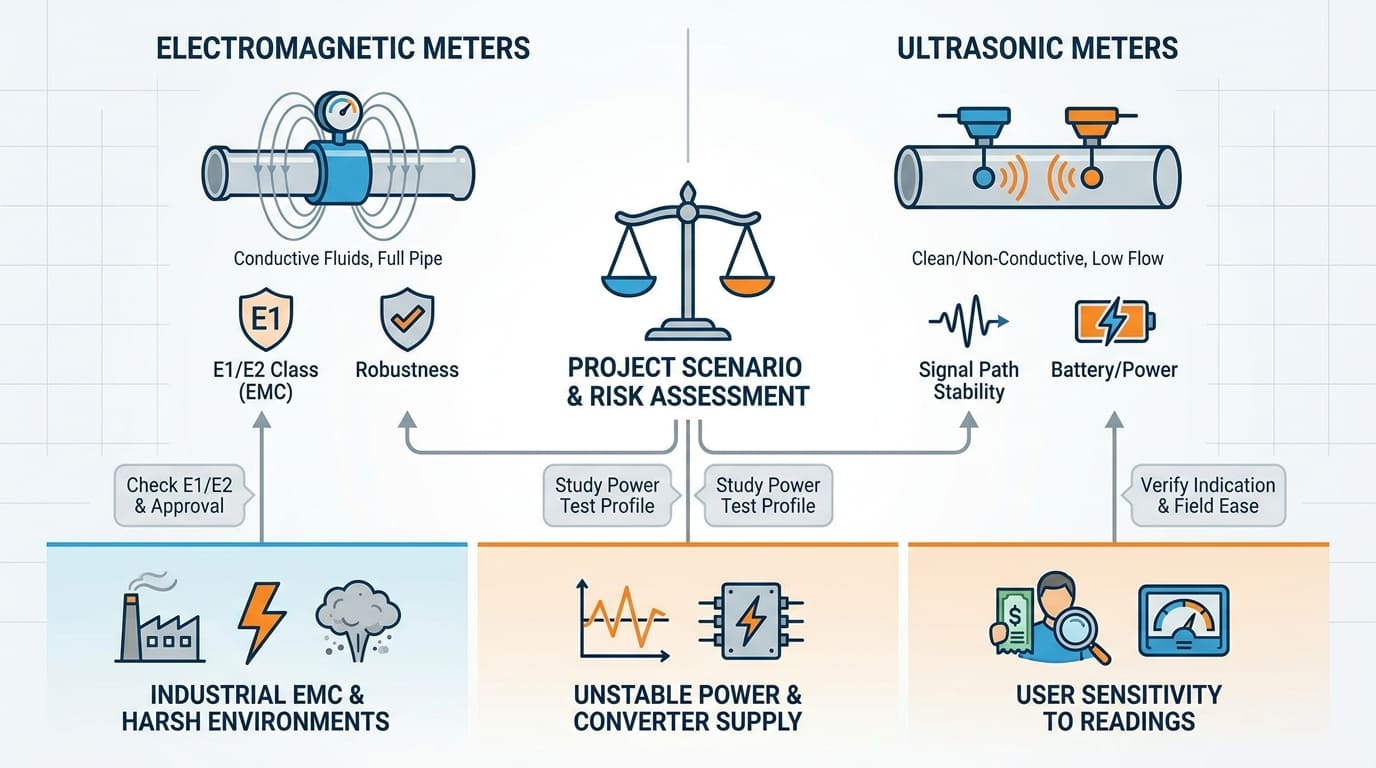
There is no universal winner between electromagnetic and ultrasonic water meters. The better choice depends on the project scenario, the complaint risk you fear most, and how closely the local site matches the meter’s approved conditions of use.
If I expect industrial electromagnetic exposure or harsher environmental conditions, I will pay very close attention to E1 versus E2 classification and whether the meter was approved for that environment. If I expect unstable mains power or converter-driven supply conditions, I will study the power-related test profile and think hard about local electrical quality. If I expect user sensitivity to billed readings, I will focus more on indication behavior, reference conditions, and how easy it is to explain and verify the meter’s performance in the field.

I would frame the decision like this:
- Choose based on field conditions, not only technology preference.
- Check the approved limits of use first.
- Match the electromagnetic environment class to the site.
- レビュー pressure and temperature reality, not only nominal design values.
- Consider the likely complaint structure in that country: overstress complaints or reading disputes.
- Compare the full measurement chain, not only the wet-end body.
| Project scenario | Better evaluation focus |
|---|---|
| 居住の / commercial protected area | Check E1 fit and reading clarity |
| Industrial site | Check E2 suitability and electronics robustness |
| Export market with unstable power | Review mains deviation test relevance |
| High-pressure or harsh field conditions | Review approved limits and static pressure tolerance |
| Market sensitive to billing disputes | Focus on indication trust and field verification logic |
結論
Electromagnetic and ultrasonic water meters can both be excellent choices, but field performance depends on matching the technology to the real operating environment. The same model can trigger pressure and temperature complaints in one country and reading disputes in another because ISO 4064 performance is always tied to approved limits of use, environmental class, reference conditions, and test assumptions.