
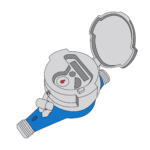

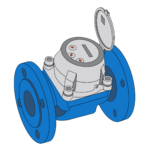



Many NRW projects lose money at low flow. The loss is small per hour, but it repeats daily. I calculate before recommending rollout.
For DN15 meters with Q3 = 2.5 m³/h, an R400 ultrasonic meter lowers Q1 from 31.25 L/h to 6.25 L/h compared with an R80 mechanical meter. The extra cost may pay back in high-loss connections, but not equally across every connection.
I do not answer this topic with one fixed payback number. I first define the meter boundary, then I calculate the recovered volume under clear assumptions.
Why Must the Comparison Boundary Be Fixed Before Comparing Mechanical and Ultrasonic Meters?
A higher R value sounds attractive. But without DN and Q3, the comparison is incomplete. I fix the technical boundary first.
Mechanical and ultrasonic meters should be compared only when meter size, Q3, R value, Q1, standard, application, price assumption, and installation condition are defined. Otherwise, the financial result can mislead the buyer.
I Start with DN15, Q3, R Value, and Q1
For the Malaysia NRW discussion, I use a clear boundary. The comparison is for DN15 residential meters. The permanent flow rate is Q3 = 2.5 m³/h. The mechanical reference is R80. The ultrasonic reference is R400. These values create a useful low-flow comparison because Q3 is fixed.
The formula is simple:
| Formula | Meaning |
|---|---|
| R = Q3 / Q1 | R value is the ratio between Q3 and Q1 |
| Q1 = Q3 / R | Q1 is the lowest flow within the declared measuring range |
With DN15 and Q3 = 2.5 m³/h, the Q1 result is different.
| Parameter | DN15 Mechanical R80 | DN15 Ultrasonic R400 |
|---|---|---|
| Meter size | DN15 | DN15 |
| Q3 assumption | 2.5 m³/h | 2.5 m³/h |
| R value | 80 | 400 |
| Q1 calculation | 2.5 ÷ 80 | 2.5 ÷ 400 |
| Q1 | 31.25 L/h | 6.25 L/h |
| Indicative unit price assumption | USD 20 | USD 40 |
| Incremental capital assumption | — | USD 20/unit |
These price numbers are indicative planning assumptions from the Malaysia discussion. Actual FOB price depends on body material, communication module, order quantity, certification scope, and commercial terms.
I also separate Q1 from starting flow rate. Starting flow rate means the meter begins to register some movement or volume. Q1 means the lowest flow within the certified metrological range. A meter may start below Q1, but that does not mean it is already operating inside its declared accuracy range.
This distinction matters for revenue. The revenue case should be built on defined metrological boundaries, not only on a low starting-flow claim.
Where Does the Extra Revenue from an R400 Ultrasonic Meter Actually Come From?
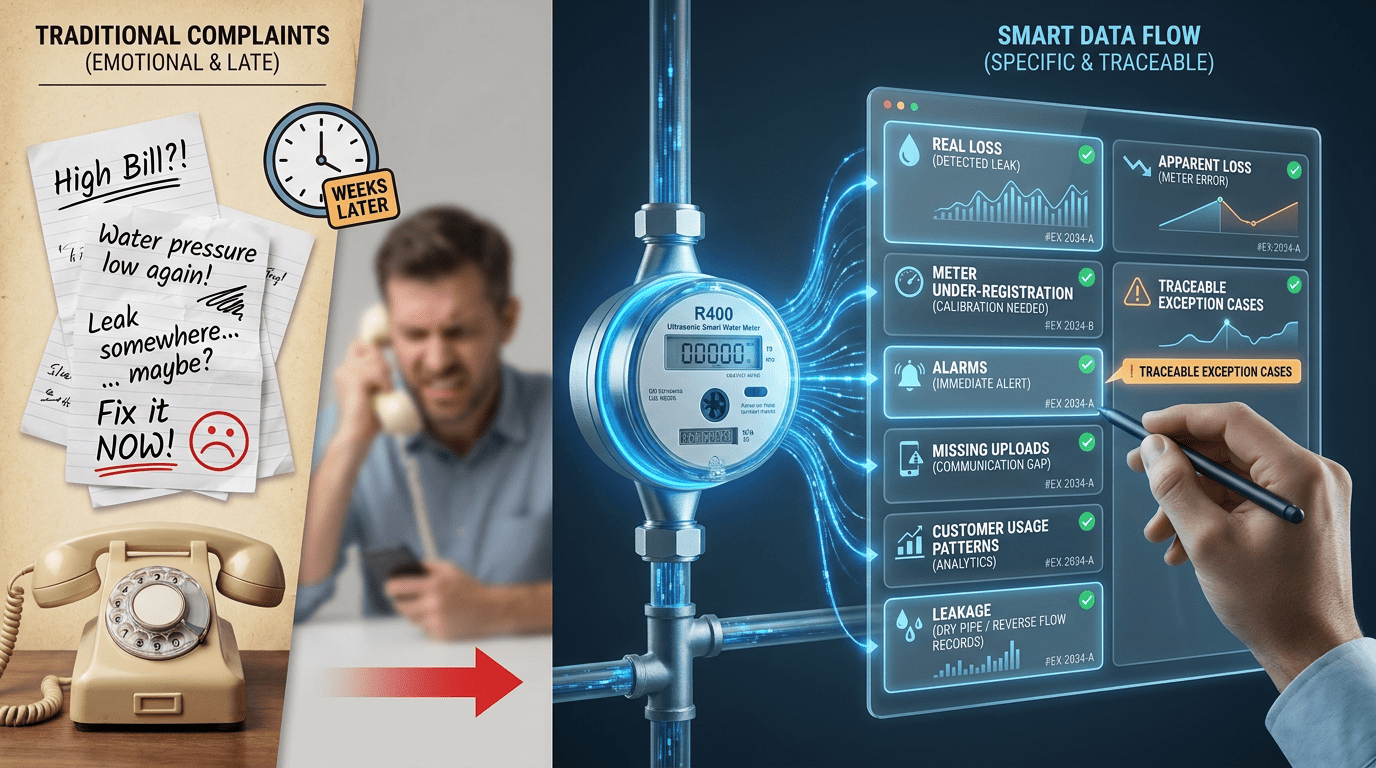
Low-flow loss is usually invisible. The customer consumes water, but the old meter may not register it. I look for this blind zone.
Extra billing revenue comes mainly from connections with continuous low flow between the old meter’s Q1 and the new meter’s Q1. It does not come equally from every connection in the network.
I Separate Billing Recovery from Network Diagnosis
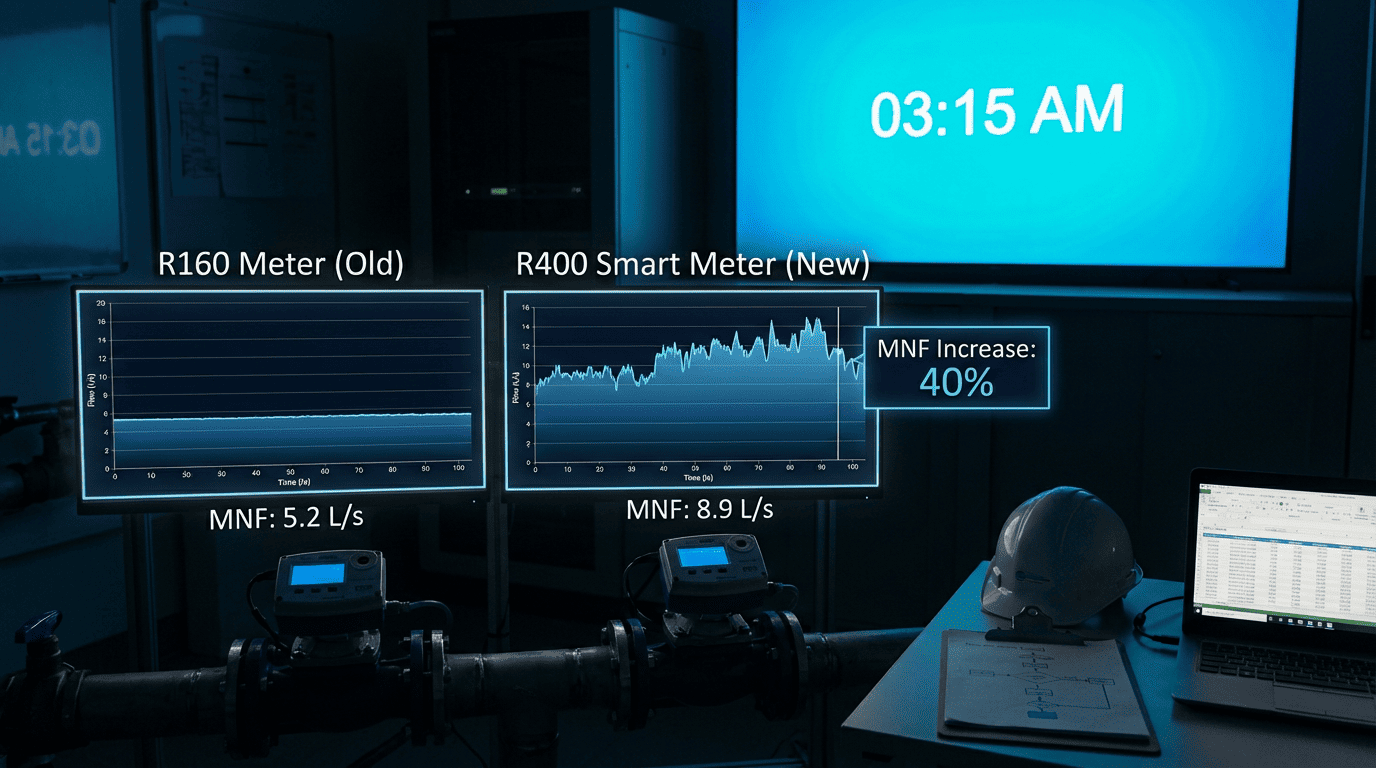
For DN15 with Q3 = 2.5 m³/h, the R80 mechanical meter has Q1 = 31.25 L/h. The R400 ultrasonic meter has Q1 = 6.25 L/h. The important zone is the flow band between 6.25 L/h and 31.25 L/h.
This zone can include a running toilet, a dripping tap, a small internal pipe leak, a worn fixture, or another continuous customer-side flow. If the old meter does not measure this flow within its declared range, the water is consumed but not billed correctly. In NRW language, this is apparent loss. It is different from real leakage in the distribution network.
I do not say the mechanical meter is bad. Mechanical meters are widely used and can be suitable in stable, low-loss areas. But moving parts can face friction, wear, particles, and scale over time. These effects may increase low-flow under-registration risk, especially in older service conditions.
The ultrasonic meter has no moving measuring parts. It can support a wider measuring range when R is higher and Q3 is fixed. It can also support remote data and event records when the communication system is configured. But it does not repair pipes or fix billing databases by itself.
| Revenue Mechanism | Applies To | Meter Role |
|---|---|---|
| Low-flow billing recovery | connections with continuous low flow between 6.25 and 31.25 L/h | improves registered consumption on affected connections |
| Minimum Night Flow correction | DMA-level analysis | makes hidden consumption more visible |
| Leak response value | zones with field crews and repair process | supports earlier targeting, but does not repair leaks |
| Data quality value | AMR/AMI or smart billing systems | improves reading availability if communication works |
I keep these mechanisms separate when talking with utilities. The meter can directly support billing recovery on affected customer connections. The wider NRW result still needs pressure management, leak repair, illegal connection control, customer data cleaning, and field action.
How Should Buyers Calculate Payback for DN15 Ultrasonic Meters in a Malaysia NRW Program?
A single payback number is risky. It depends on affected connections and recovered flow. I show the formula instead.
Payback should be calculated from affected connections, average recovered low flow, operating hours, water tariff, and incremental capital cost. The result changes sharply between low-loss and high-loss zones.
I Use Scenarios Instead of a Promise
For planning, I use the following assumptions. These are example assumptions for calculation. They should be replaced by the utility’s own tariff, connection count, and pilot data.
| Input | Example Value |
|---|---|
| DN15 residential connections | 10,000 |
| Price differential | USD 20/unit |
| Total incremental capital | USD 200,000 |
| Illustrative water tariff | USD 0.30/m³ |
| Operating time for continuous low flow | 24 h/day |
| Days per year | 365 |
The formula is:
```text Recovered volume (m³/year) = affected connections × average recovered flow (L/h) × 24 h/day × 365 days ÷ 1,000
Recovered revenue (USD/year) = recovered volume (m³/year) × tariff (USD/m³)
Payback period (years) = total incremental capital ÷ recovered revenue per year ```
Now I calculate three scenarios.
| Scenario | Affected Connections | Avg. Recovered Flow | Recovered Volume/year | Recovered Revenue/year | Indicative Payback |
|---|---|---|---|---|---|
| Conservative | 10% = 1,000 | 3 L/h | 26,280 m³ | USD 7,884 | ~25.4 years |
| Moderate | 20% = 2,000 | 6 L/h | 105,120 m³ | USD 31,536 | ~6.3 years |
| Higher-loss zone | 30% = 3,000 | 10 L/h | 262,800 m³ | USD 78,840 | ~2.5 years |
This table does not guarantee a Malaysia project result. It shows sensitivity. The same meter investment can look weak in a newer, well-maintained area and much stronger in an older, higher-NRW DMA.
I also avoid applying one average to the whole country or whole utility. A selective deployment into suspected high-loss zones is more defensible than a blanket rollout. The buyer should first identify zones with older meters, high Minimum Night Flow, frequent low-flow complaints, old internal plumbing, or poor historical billing data.
I would verify this in a pilot before full rollout.
How Do Mechanical and Ultrasonic DN15 Meters Compare Beyond Price and Q1?
Price and Q1 are not the whole decision. A utility also needs durability, data, maintenance, battery planning, and installation control.
Mechanical meters are simple and cost-effective. Ultrasonic meters support wider low-flow measurement, no moving measuring parts, and smart data functions, but they require battery, electronics, communication, and field setup control.
I Compare the Full Lifecycle, Not Only the Purchase Price
Mechanical meters remain a practical choice in many projects. They do not require battery power for basic measurement. They are familiar to installers. They can be cost-effective for stable areas with low apparent loss and limited smart data requirements.
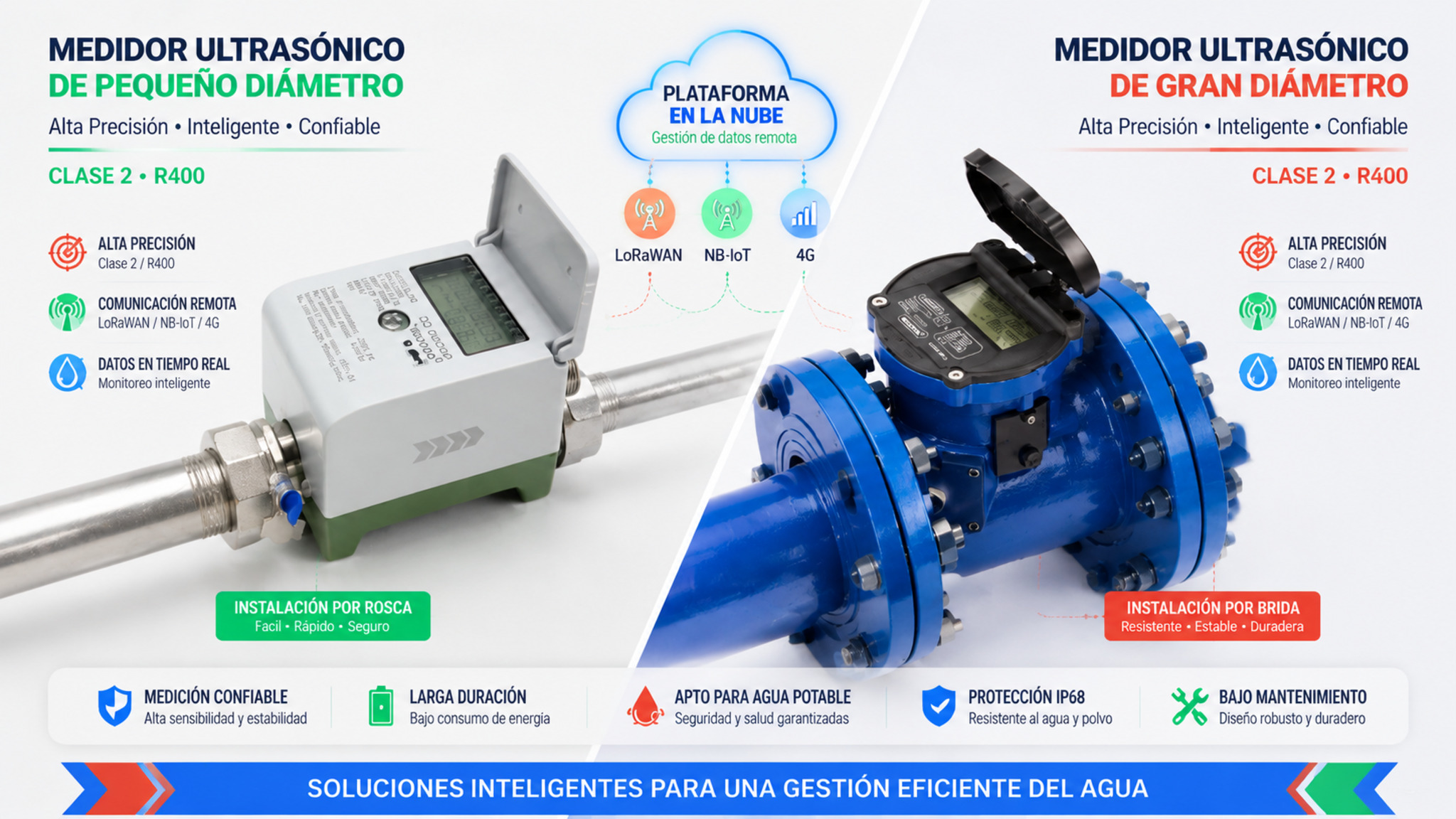
Ultrasonic meters change the value profile. They use transit-time measurement and have no moving measuring parts. This can reduce wear-related under-registration risk. They can also support smart functions when equipped with communication modules. These may include remote reading, event records, low battery alerts, reverse flow records, dry pipe alarms, or leakage alarms depending on the product and platform configuration.
But ultrasonic meters are not free from project risk. They need correct installation, full-pipe operation, suitable water temperature, suitable pressure, stable electronics, battery planning, and communication coverage if smart reading is required.
| Criterion | DN15 Mechanical Meter | DN15 Ultrasonic Meter |
|---|---|---|
| Measuring principle | impeller, piston, or other mechanical movement | ultrasonic transit-time |
| Moving measuring parts | yes | no moving measuring parts |
| Example Q1 at Q3 = 2.5 | 31.25 L/h for R80 | 6.25 L/h for R400 |
| Low-flow value | suitable when loss risk is low | stronger in low-flow capture |
| Water quality sensitivity | particles, scale, and wear may affect parts | less mechanical wear, but still needs proper hydraulic condition |
| Power dependency | none for basic reading | battery required |
| Communication | pulse or add-on options in some models | NB-IoT, LoRa, LoRaWAN, M-Bus, RS485, pulse, or other options by model |
| Alarm support | limited in standard mechanical meters | supported if meter and platform are configured |
| Maintenance planning | replacement or recalibration cycle | battery and electronics lifecycle also matter |
| Best-fit area | budget-driven stable zones | high-NRW zones, DMA pilots, remote reading projects |
I do not attack mechanical meters. I select them where they fit. I also do not oversell ultrasonic meters. An R400 ultrasonic meter supports low-flow capture and data visibility. It does not remove illegal connections, repair mains, or guarantee NRW reduction without utility action.
The best comparison is not “old versus new.” The best comparison is “which meter matches this connection, this zone, and this operating model?”
What Field Conditions Can Change the Result of a Mechanical vs Ultrasonic Meter Decision?
A lab result is not the field. Bad installation can damage the business case. I check conditions before trusting numbers.
Field performance depends on installation direction, full-pipe condition, hydraulic stability, water quality, pressure, temperature, protection level, communication signal, battery profile, and maintenance access.
I Treat Installation and Communication as Part of the Meter Selection
For DN15 ultrasonic meters, full-pipe operation matters. Air bubbles, partially filled pipes, reverse installation, strong turbulence, or wrong installation class can affect measurement. The installer must follow the flow arrow direction and the required installation position.
For mechanical meters, installation also matters. Sediment, scale, incorrect direction, pipe stress, and poor straightness can reduce service life or create complaints. Water quality is especially important where hardness or particles are common.
Malaysia projects may include dense residential clusters, landed houses, apartment buildings, rural connections, and mixed DMAs. I do not assume one communication method fits all sites.
NB-IoT may be suitable when carrier coverage is available across dispersed areas. But coverage must be tested at the meter position, not only at street level. Underground boxes and metal covers can reduce signal. LoRa or LoRaWAN may fit dense residential clusters if the project can install gateways or concentrators with stable power and good placement. M-Bus may fit buildings where wiring is available.
| Field Check | Why I Verify It |
|---|---|
| Flow arrow direction | prevents reverse installation |
| Full-pipe condition | supports ultrasonic measurement stability |
| Water pressure | must match rated working conditions |
| Water temperature | must match temperature class |
| Ambient humidity | affects electronics and sealing |
| Protection level | important for pits and flooded boxes |
| Battery life assumption | depends on reporting cycle and signal quality |
| Wireless signal | affects upload success and battery consumption |
| Platform compatibility | data must be decoded and used |
| Maintenance access | meter must be removable and readable |
Communication is a system. A smart meter can measure, store, and transmit data. But the project also needs network coverage, SIM card or gateway setup, platform integration, alarm rules, data storage, billing system connection, and field response.
If a meter reports leakage alarms but no team checks them, the data has limited value. If a meter sends data but the platform cannot decode the payload, the communication feature is not useful. If the reporting cycle is too frequent for the battery plan, lifecycle cost changes.
I would include these field checks in the pilot scope, not after mass installation.
What Should a 90-Day DMA Pilot in Malaysia Measure Before Full Rollout?
A pilot should not only prove that meters can be installed. It should prove the financial case with local data.
A 90-day DMA pilot should measure baseline Minimum Night Flow, post-replacement consumption, low-flow recovery, alarm events, communication success, battery assumptions, customer complaints, and actual billing change.
I Prefer Pilot Data Before Fleet-Wide Approval
For a Malaysia NRW program, I would not begin with a whole-fleet replacement. I would select one representative DMA with known or suspected high NRW. A good pilot zone may have 500 to 2,000 connections, boundary metering, older residential meters, available billing history, and clear customer records.
I would run the pilot in stages.
| Pilot Stage | Action | Output |
|---|---|---|
| Stage 1 | select one DMA | defined boundary and connection list |
| Stage 2 | record 30-day baseline | Minimum Night Flow and consumption profile |
| Stage 3 | replace meters | DN15 R400 ultrasonic units installed correctly |
| Stage 4 | monitor 60 days | registered consumption, alarms, communication |
| Stage 5 | compare pre/post data | local recovered volume and billing change |
| Stage 6 | calculate ROI | utility-specific financial model |
The pilot should separate three results.
First, did registered customer consumption increase? This is the direct billing recovery part.
Second, did Minimum Night Flow change? This helps the utility understand previously invisible low-flow consumption and possible real leakage.
Third, did alarms or data help field crews act faster? This depends on utility workflow, not only the meter.
I would also record failed uploads, weak signal locations, battery status, reverse flow records, dry pipe records, and customer complaints. These items help the project team refine installation and communication rules before scaling.
A pilot is not only a sales demonstration. It is a risk-control tool. It protects the utility, the distributor, and the manufacturer from making a large decision with weak assumptions.
What Should the Tender Specify for Mechanical or Ultrasonic DN15 Meter Procurement?
A tender that only says “DN15 smart meter” is incomplete. Missing details create disputes. I specify measurable requirements.
The tender should specify meter size, Q3, R value, Q1, starting flow rate, installation class, temperature class, pressure class, protection level, battery, communication method, reporting cycle, alarms, platform compatibility, and certificates.

I Write the Specification So the Buyer Can Verify It
A good specification should make performance testable. It should not rely on broad descriptions. For DN15 residential ultrasonic meters, I would specify Q3 = 2.5 m³/h if that is the required project boundary. I would specify R400 if the project needs Q1 = 6.25 L/h under the selected standard. I would also list starting flow separately.
| Specification Item | What to State |
|---|---|
| Meter size | DN15 |
| Q3 | 2.5 m³/h, if required by project |
| R value | R400 for ultrasonic option |
| Q1 | 6.25 L/h for Q3 = 2.5 and R400 |
| Starting flow rate | separate from Q1, based on datasheet |
| Standard | ISO 4064 or OIML R49 where applicable |
| Accuracy class | based on declared measuring range |
| Installation position | horizontal, vertical, or approved class |
| Protection level | suitable for pit or indoor installation |
| Battery | rated life with reporting cycle assumptions |
| Communication | NB-IoT, LoRa, LoRaWAN, M-Bus, RS485, or pulse |
| Reporting cycle | daily, hourly, or custom |
| Alarm functions | leakage, dry pipe, reverse flow, low battery if supported |
| Platform | payload, API, head-end compatibility |
| Documents | datasheet, test report, certificate, manual |
For Malaysia, communication should be selected by deployment scenario. NB-IoT may fit wider coverage if the carrier signal is proven. LoRa or LoRaWAN may fit dense residential clusters where gateways can be installed and maintained. M-Bus may fit buildings with cable routes.
I would also require pilot test acceptance criteria. This may include reading success rate, communication logs, installation inspection records, pre/post billing comparison, and alarm review.
YOUNIO can provide DN15 ultrasonic water meters and mechanical meters for different project conditions. Product approvals such as ISO 4064, OIML R49, MID, CE, ACS, NSF/ANSI, or other certificates depend on the specific product range and target market. I always confirm the certificate scope before tender submission.
How Should YOUNIO Position Mechanical and Ultrasonic Options for Malaysia NRW Projects?
A serious proposal should not force one product everywhere. Different zones need different meters. I match the meter to the loss profile.
YOUNIO can support Malaysia NRW programs with mechanical meters for stable zones and R400 ultrasonic smart meters for high-loss DMAs, low-flow recovery, remote reading, and data-driven pilot verification.
I Recommend a Selective Deployment Strategy
For Malaysia, I would not suggest replacing every DN15 meter with ultrasonic units on day one. I would segment the network.
Stable, newer, low-loss zones may remain suitable for mechanical meters. These areas may need cost control more than advanced data. High-NRW zones, older residential areas, unclear Minimum Night Flow, and remote reading requirements may justify R400 ultrasonic meters first.
This selective approach makes the financial case stronger. It also allows the utility to build internal confidence from real pilot data.
| Zone Type | Meter Strategy |
|---|---|
| newer low-loss residential area | mechanical meter may remain cost-effective |
| older high-NRW DMA | pilot R400 ultrasonic meters |
| dense residential cluster | LoRa or LoRaWAN if gateway plan is strong |
| dispersed residential area | NB-IoT if carrier coverage is proven |
| apartment building | M-Bus or wired reading may fit |
| utility pilot zone | ultrasonic with detailed data tracking |
| budget-limited rollout | mixed mechanical and ultrasonic strategy |
YOUNIO has metering roots dating back to 1983. The dedicated water meter subsidiary was founded in 2011 in Wenling, Zhejiang, China. YOUNIO provides mechanical water meters, ultrasonic water meters, smart AMR/AMI water meters, NB-IoT water meters, LoRa and LoRaWAN water meters, M-Bus meters, RF meters, 4G Cat.1 meters, prepaid meters, and OEM/ODM cooperation.
For a Malaysia pilot, I would prepare the technical proposal around DN15, Q3 = 2.5 m³/h, R400, Q1 = 6.25 L/h, communication method, battery assumption, installation rules, platform interface, and acceptance criteria. I would also run the ROI table again using the utility’s actual tariff and estimated affected-connection share.
The meter supports NRW reduction. It does not replace pressure management, pipe repair, illegal connection investigation, or billing data correction. That honest boundary makes the proposal more credible to utility engineers and procurement teams.
Conclusion
Specify DN15, Q3, R, Q1, starting flow, communication, battery assumptions, and pilot acceptance before choosing mechanical or ultrasonic meters for Malaysia NRW. ```
Related YOUNIO products: Smart Volumetric Water Meter · Smart Multi Jet Water Meter
Need help applying this to your project?
Send your meter size, target market, and certification requirement. YOUNIO will reply with a technical checklist.