

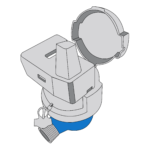

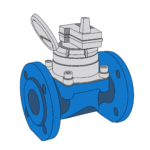

Smart metering projects often fail for simple reasons. I have seen problems start with wrong flange drilling, wrong temperature class, weak signal in chambers, bad sealing, rushed commissioning, and poor record keeping. I wrote this checklist to help teams avoid those avoidable mistakes and build a cleaner deployment process from day one.
This version is built as a practical field guide. I use it as a control list before ordering, before installation, during activation, and during handover. I also align it with what YOUNIO product documents and system manuals already confirm, such as T30/T50 temperature classes, 1.6MPa pressure rating, IP68 protection, up to 10-year battery life, NB-IoT communication workflow, and ultrasonic meter features like leakage detection, dry pipe detection, event display, and data logging.
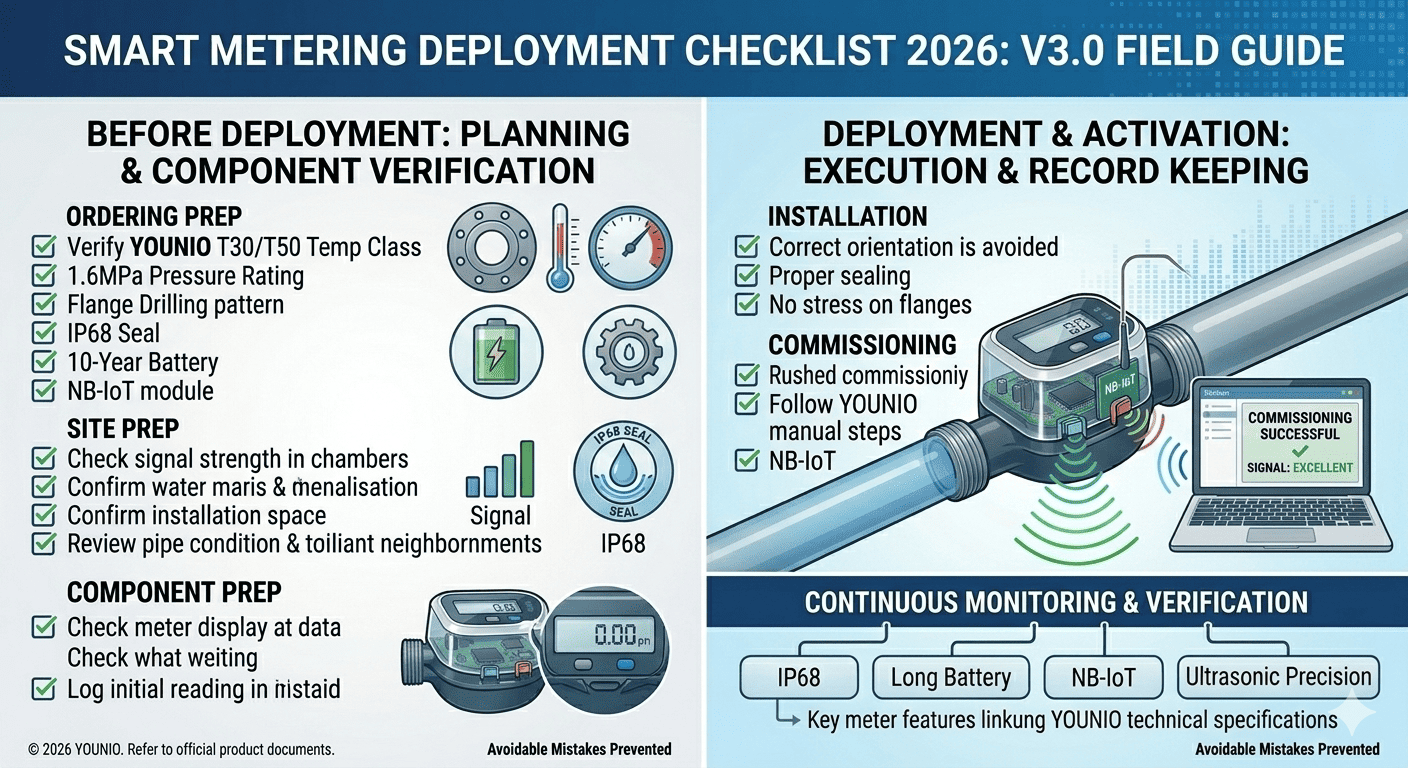
Phase 1: Precision Ordering Check
Goal: Remove international return and replacement risk caused by specification mismatch.
I always start with ordering discipline. Many deployment failures do not begin in the field. They begin in the quotation stage. If the technical schedule is vague, the project team pays later in delay, freight, disputes, and site rework.
Physical connection specification
- [ ] Confirm flange standard: ANSI 150RF, Пн10, PN16, or JIS.
- [ ] Confirm drilling pattern: Recheck bolt hole quantity and flange drilling for each size, especially large-diameter models.
- [ ] Confirm thread type: BSP or NPT where threaded ends apply.
I recommend that every purchase order include a signed dimensional approval sheet. I also recommend attaching mark-up drawings to avoid assumptions between buyer, contractor, and manufacturer.
Metering and technical parameters
- [ ] Confirm temperature class: T30/T50 for cold water, or project-specific hot water requirement where applicable. YOUNIO ultrasonic residential models are listed with T30/T50 in the reference materials.
- [ ] Confirm range ratio (Ведущий): Define whether the project needs R160, R250, or ultrasonic R400. YOUNIO ultrasonic smart meters are listed with a wide measuring range of Q3/Q1 = R400.
- [ ] Confirm starting flow sensitivity: If the project targets leak detection or low-flow billing fairness, confirm ultralow starting flow down to 0.001 m³/h.
- [ ] Confirm dial or LCD marking needs: Logo, project code, utility name, asset ID, barcode, or special marking format.
- [ ] Confirm communication interface: M-Bus, RS485, Pulse, or NB-IoT based on project architecture. YOUNIO documents list these communication options for the ultrasonic smart meter range.
Material requirement
- [ ] Confirm body material: Solid brass, нержавеющая сталь, ductile iron, or composite according to project scope. The cited YOUNIO residential ultrasonic model is listed with solid brass construction.
- [ ] Confirm seal and wetted material compatibility: Match the water quality and local regulations.
- [ ] Confirm enclosure protection level: If the site has flooding risk, require IP68. YOUNIO ultrasonic smart meters are listed as submersible IP68.
Ordering file control
- [ ] Attach final datasheet to PO
- [ ] Attach approved drawing
- [ ] Attach communication protocol requirement
- [ ] Attach platform onboarding scope
- [ ] Attach acceptance criteria
I treat ordering as the first quality gate. If this gate is weak, all later controls become more expensive.
Phase 2: Site & Signal Audit
Goal: Keep IoT devices online in complex field conditions.
Before installation, I audit the site. I do not assume the meter will perform well just because the product is correct on paper. Smart meters depend on environment, signal, and installation position.
Communication coverage test
- [ ] Nb-iot: Confirm there is usable NB-IoT signal before installation. YOUNIO’s operating instructions explicitly say to make sure the site is covered by NB-IoT signal before installation.
- [ ] Check network quality threshold: Record signal level, upload stability, and heartbeat success rate.
- [ ] Confirm whether a private APN is needed: This depends on utility IT and telecom policy.
- [ ] Лораван: Confirm gateway location, antenna height, interference sources, and realistic urban radius.
Installation environment assessment
- [ ] Check chamber depth: If the chamber is deep, assess whether signal attenuation will require an external antenna or revised placement.
- [ ] Check flood risk: If long-term immersion is possible, enforce IP68. YOUNIO ultrasonic smart meters are specified as IP68 submersible.
- [ ] Check humidity and fogging risk: YOUNIO ultrasonic models mention a vacuumed electronic cavity to prevent glass fogging.
- [ ] Check water quality: If the line contains sand, scale, or debris, record the risk and plan filtration or cleaning.
- [ ] Check pressure condition: YOUNIO residential ultrasonic reference data lists 1.6MPa pressure class.
- [ ] Check ambient temperature: YOUNIO reference data lists -25°C to +55°C ambient range.
Application fit review
- [ ] Confirm nominal size: DN15, DN20, DN25, or other project size.
- [ ] Confirm meter type selection: Use ultrasonic where low-flow capture, stability, and data visibility are important.
- [ ] Confirm feature need: Leakage detection, dry pipe detection, bi-directional flow monitoring, pressure detection option, and alarm visibility are available in the ultrasonic product references.
- [ ] Confirm power strategy: Battery-powered meters with up to 10 years of life are suitable for low-maintenance deployments.
I always document the site audit with photos, signal screenshots, and a risk note for each meter batch area. This saves arguments later.
Phase 3: Standardized Installation Process
Goal: Prevent leakage, inaccurate reading, and structural damage.
Installation quality decides whether the smart meter works like an asset or becomes a complaint source. I prefer a short and strict installation checklist rather than a long and vague method statement.
Sealing system
- [ ] Use approved gaskets only
- [ ] Do not substitute sealing parts with thinner low-cost alternatives
- [ ] Keep thread seal tape away from the meter interior
- [ ] Inspect flange faces or threaded ends before tightening
Even the best ultrasonic meter can fail in practice if debris enters the measuring path or if poor sealing causes leakage and later tamper suspicion.
Installation orientation and piping condition
- [ ] Check flow direction arrow
- [ ] Confirm inlet and outlet alignment
- [ ] Provide recommended straight pipe lengths based on meter type and installation practice
- [ ] Remove trapped air before full opening
- [ ] Open water slowly during first filling to avoid water hammer
- [ ] Verify no reverse installation
YOUNIO ultrasonic smart meters support bi-directional flow measurement to prevent water tamper, but I still treat reverse flow as a field risk that must be prevented physically, not just detected digitally.
Mechanical fastening check
- [ ] Check all cover and terminal fasteners
- [ ] Check union tightness or flange bolt sequence
- [ ] In vibration areas, apply reinforced fastening practice
- [ ] Record final installation photo
Meter condition at installation
- [ ] Check LCD visibility
- [ ] Check body for transport damage
- [ ] Check serial number against installation list
- [ ] Check communication label or IMEI/EUI tag readability
YOUNIO ultrasonic models are described as having a friendly big LCD that displays cumulative volume, instantaneous flow, and alarm information. I use that display as a field verification tool during installation.
Phase 4: Commissioning
Goal: Ensure field device data and platform data are fully synchronized.
I see commissioning as the difference between “installed” and “usable.” A meter is not really deployed until the field reading, system ID, and cloud data all match.
On-site activation
- [ ] Wake up the device according to project procedure
- [ ] Run full LCD screen check
- [ ] Confirm alarm icons, reading display, and response
Data consistency check
- [ ] Record initial reading
- [ ] Check LCD reading against installation form
- [ ] Check serial number, asset number, and room number
- [ ] Check communication identity such as IMEI or EUI if used
Cloud-side confirmation
- [ ] Log in to the ADDUNION platform
- [ ] Create community, building, and room records as required
- [ ] Register the NB-IoT meter using the Mobile CRM app
- [ ] Confirm the first reported data arrives correctly
These steps are directly supported by the YOUNIO NB-IoT operating instructions, which state that installers should ensure signal coverage, manage the platform, create room numbers, register the NB-IoT water meter with the mobile CRM app, and check meter readings on the management platform.
Functional verification
- [ ] Check whether consumption value updates normally
- [ ] Check whether alarm and error fields are readable
- [ ] Check data logging status
YOUNIO reference materials state that the meters can log errors, сигналы тревоги, и измерения значений, and can store up to 14×24 hourly records, 366 ежедневные значения, и 72 ежемесячные значения. I treat this as a major commissioning advantage because it gives the team a traceable baseline from the first day.
Phase 5: Long-Term Maintenance & Service
Goal: Extend service life to 10–15 years with stable data quality.
Long-term service starts at handover. If no one owns the maintenance routine, even a good product will lose value.
Routine inspection
- [ ] Inspect meter chamber condition annually
- [ ] Clean inlet filter or upstream strainer where installed
- [ ] Check for flooding, condensation, corrosion, or vibration
- [ ] Check reading stability and communication continuity
YOUNIO ultrasonic smart meters are battery powered with up to 10 years of life, and they are designed with no wearing parts and strong long-term stability. Even so, I still recommend annual field review because environment usually causes more failures than the meter core.
Alarm monitoring
- [ ] Set abnormal flow alarm
- [ ] Set low battery alarm
- [ ] Track dry pipe alarms
- [ ] Track leakage alarms
- [ ] Track reverse flow events where relevant
Leakage detection and dry pipe detection are listed as standard feature points in the ultrasonic references. Bi-directional flow measurement is also listed, which helps identify tamper or reverse flow conditions.
Documentation archive
- [ ] Take three standard photos per meter point: connection detail, display reading, and full installation environment
- [ ] Save commissioning record
- [ ] Save signal test result
- [ ] Save serial number and platform mapping file
- [ ] Save maintenance history
Service continuity review
- [ ] Review battery replacement plan if applicable
- [ ] Review communication uptime
- [ ] Review exception trends from hourly, daily, and monthly logs
- [ ] Review complaint cases against event and reading history
Because YOUNIO meters support hourly, daily, and monthly data logging, I use those records to separate real field issues from billing misunderstandings.
Final Pre-Handover Control Summary
Before I close a deployment batch, I ask five simple questions:
- [ ] Did we order the correct meter and connection standard?
- [ ] Did we verify signal and environment before installation?
- [ ] Did we install with correct sealing, direction, and field discipline?
- [ ] Did we activate, зарегистрироваться, and verify the device in the cloud platform?
- [ ] Did we leave behind a maintenance file that the operator can actually use?
If the answer to any one of these is no, I do not call the deployment complete.
Заключение
A zero-defect smart metering project does not depend on luck. It depends on disciplined ordering, realistic site audits, clean installation, proper commissioning, and steady maintenance. That is why I use this checklist as both a technical control tool and a project management tool. It helps turn smart meters from shipped products into reliable long-term infrastructure.