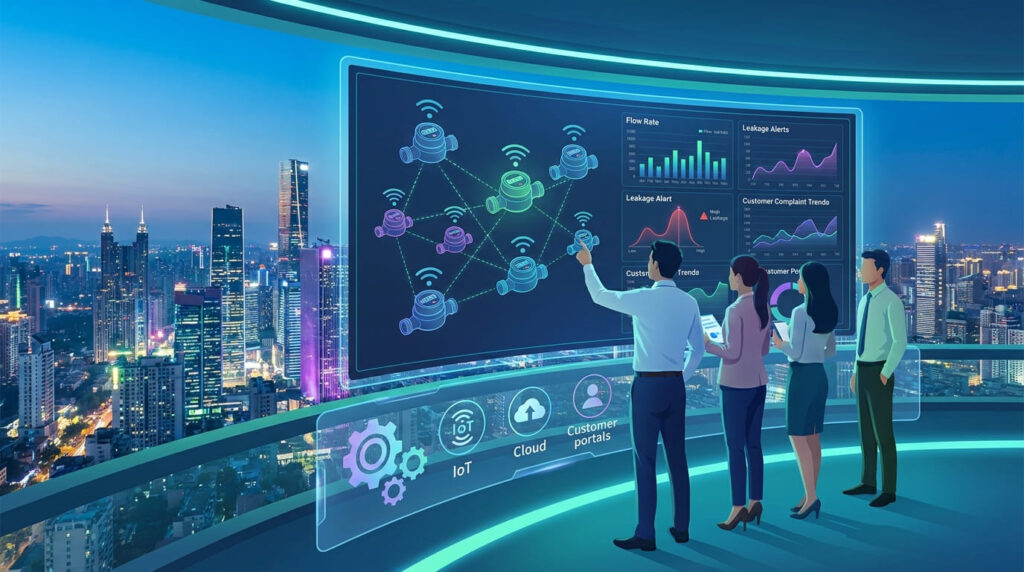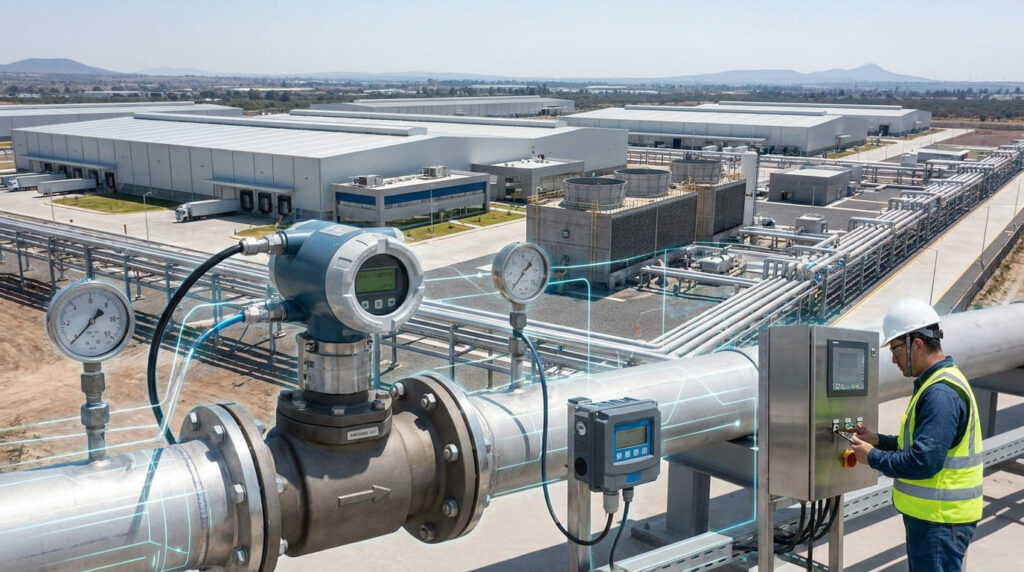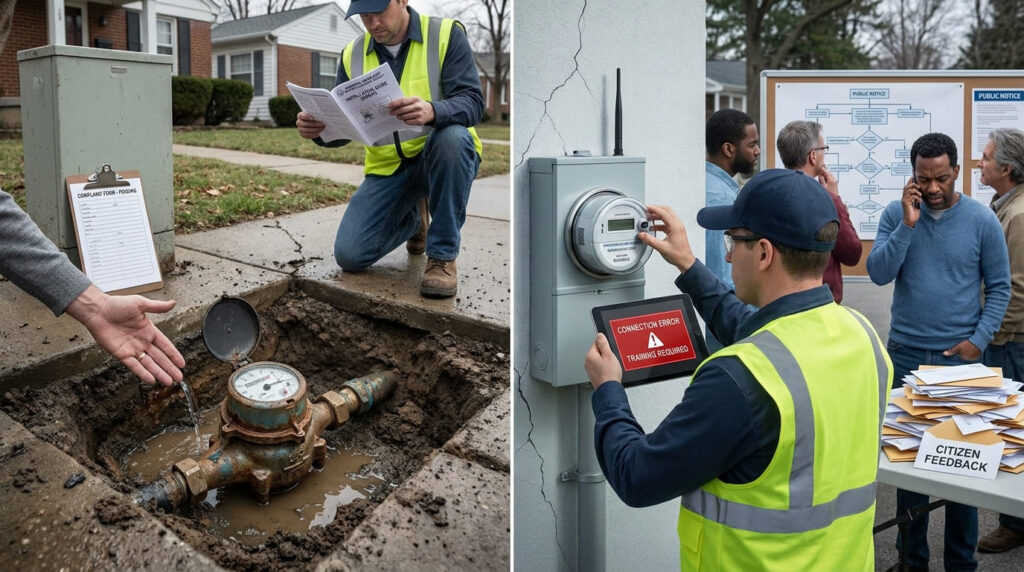
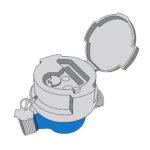
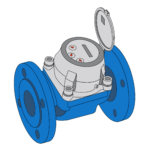
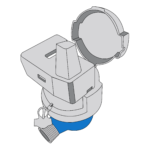
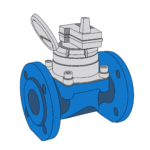

全球需求的创新水表解决方案

R400 超声波水表可减少无收益水: 起始流量, Q1 准确度, 及现场条件说明: 低流量精度解释

的图片 莱昂

莱昂

你好, I'm Leon —
YOUNIO Metering 业务发展经理, 和 20+ 从事国际公用事业水表项目多年, 经销商, 和基础设施招标.
关于采购的问题, 认证, 或项目规格? Let's talk.

目录

Water utilities lose revenue every year to flows that were delivered but never billed. I do not see this problem only in the pipe network. I often see it at the meter’s low-flow measurement boundary.

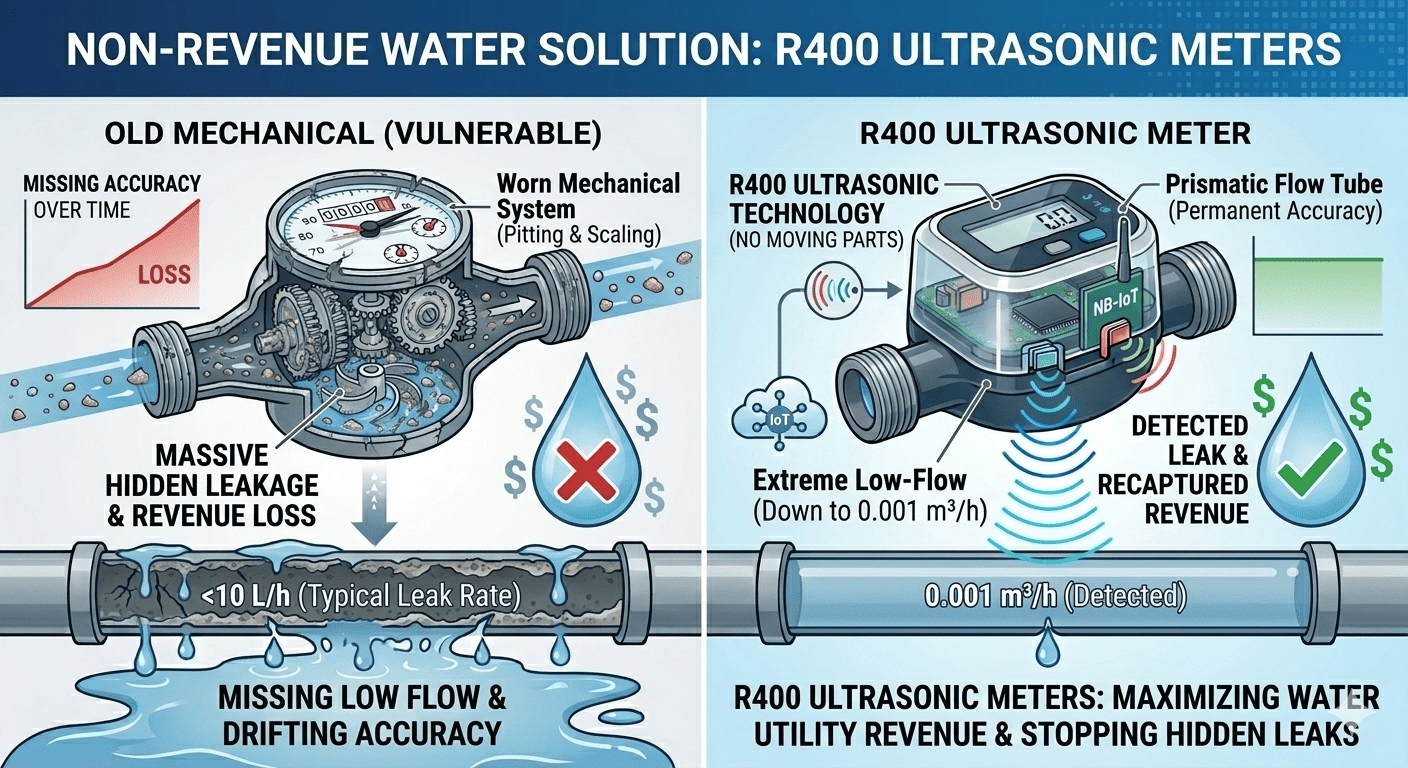
R400 ultrasonic water meters can support non-revenue water reduction because they lower the measurable low-flow range. For a DN15 meter with Q3 = 2.5 立方米/小时, R80 gives Q1 = 31.25 升/小时, while R400 gives Q1 = 6.25 升/小时. The comparison must be made under the same meter size and Q3 value.

R400 ultrasonic water meter DN15 for non-revenue water reduction — starting flow rate and Q1 accuracy

Many people first look at pipe replacement, pressure zoning, or repair crews when they discuss NRW. I agree that these actions matter. I also think meter selection must be checked earlier. A pipe can deliver water correctly, but the utility may still lose revenue if the meter cannot register or accurately measure low flows.

The first boundary is the starting flow rate. This is the minimum flow at which a meter begins to respond at all. Below this point, the meter records zero. The second boundary is Q1. Under the ISO 4064 / OIML R49 metrology framework, Q1 is the minimum flow rate of the certified measuring range, and the meter must meet the required error rules within its rated zones.

For this article, I use a DN15 residential meter as the comparison base. The YOUNIO product specification table lists DN15 with Q3 = 2.5 m³/h in the performance parameters. Once Q3 is fixed, the R value becomes meaningful.

Why Do Standard Mechanical Meters Miss So Much Hidden Low-Flow Consumption?

A mechanical meter needs enough water force to move its measuring parts. If the flow is too small, the meter may not start or may work outside its certified accuracy range.

For a DN15 R80 mechanical meter with Q3 = 2.5 立方米/小时, there are two different low-flow boundaries. The starting flow rate is the absolute floor. Below this threshold, the mechanical movement does not respond and the meter records zero. The Q1 boundary is different. It marks the lowest flow rate within the defined metrological range.

For DN15 with Q3 = 2.5 立方米/小时:

Parameter R80 Mechanical Meter R400 Ultrasonic Meter
第三季度 2,500 升/小时 2,500 升/小时
R value 80 400
Q1 = Q3 ÷ R 31.25 升/小时 6.25 升/小时
Difference in Q1 boundary 25 L/h lower

This means the R400 meter does not need a vague claim to show its value. The math is enough. Under the same DN15 and Q3 = 2.5 m³/h condition, the R400 meter moves the Q1 boundary from 31.25 L/h down to 6.25 升/小时.

The Starting Flow Rate and Q1 Are Not the Same Thing

I do not mix starting flow rate and Q1 in technical discussions. They describe different points.

Indicator Meaning 为什么它很重要
Starting flow rate The point where the meter starts to register any volume Below this point, consumption can occur while the meter records zero
Q1 The minimum flow rate of the certified measuring range Below this point, the meter may not be inside its declared accuracy range
R value Q3 divided by Q1 A higher R value means a lower Q1 when Q3 is the same

The YOUNIO residential ultrasonic smart water meter is described as a static water meter using ultrasonic measurement technology for residential applications. The same product materials state that it has a wide measurement range of Q3/Q1 = R400. The materials also describe ultralow starting flow down to 0.002 立方米/小时, which equals 2 升/小时, depending on product configuration and test condition.

In field comparison, I still anchor the discussion to one meter size. For DN15, the published performance table gives Q3 = 2.5 立方米/小时. With R400, Q1 becomes 2.5 ÷ 400 = 0.00625 立方米/小时, 或者 6.25 升/小时. With R80, Q1 becomes 31.25 升/小时. This is the low-flow accuracy gap that matters in NRW work.

The Math Behind Recoverable Billing Revenue

I do not promise that a meter alone can remove NRW. A meter cannot repair a pipe leak. A meter cannot stop illegal use by itself. A meter can only make more low-flow consumption visible, if the installation and data system support it.

Here is a simple example for a utility with 50,000 DN15 residential connections:

Assumption Value
Previously unrecorded low-flow consumption per connection 5 升/小时
Low-flow period per day 8 小时
Number of residential connections 50,000
Annual volume 50,000 × 5 × 8 × 365 ÷ 1,000 = 730,000 m³/year
Water tariff $0.50/立方米
Potential recoverable billing revenue $365,000/year

This is an illustrative calculation. Actual recovery depends on the network flow profile, connection age, pressure conditions, meter age, user behavior, and tariff structure. I use this example only to show the method. The business case should be built from local night-flow data and meter test results.

How Does Ultrasonic Measurement Reduce Wear-Related Under-Registration?

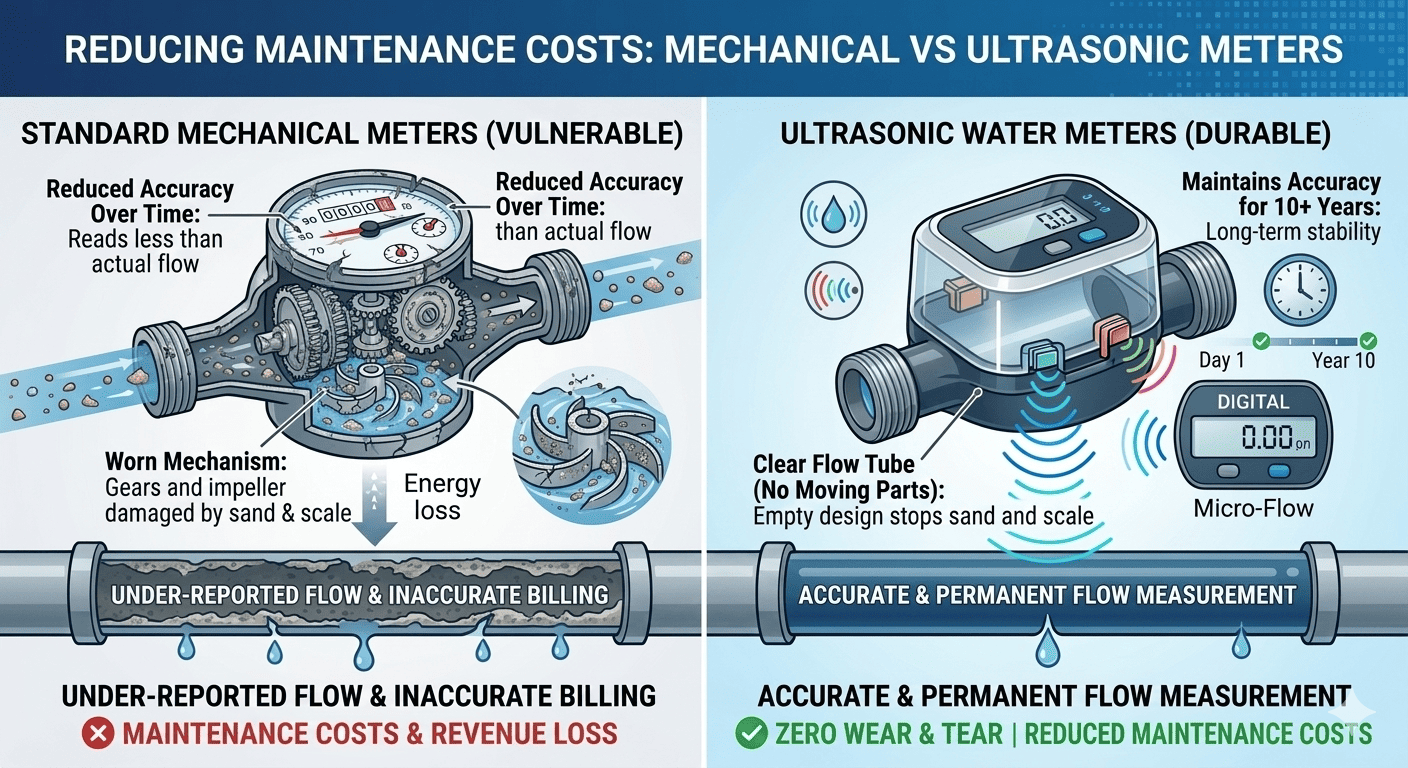
Mechanical meters contain moving parts. These parts can wear, slow down, or jam when water contains sand, 规模, 或其他颗粒. I do not treat this only as a maintenance issue. I treat it as a long-term revenue risk.

An ultrasonic meter uses static measurement technology. The YOUNIO residential meter is described as a static water meter that operates on ultrasonic measurement technology. The product materials also state that it has no wearing parts and provides excellent long-term stability and reliability.

Ultrasonic water meter no moving parts — long-term accuracy without mechanical wear

The Practical Problem With Dirty Water

I often see mechanical meters face difficult water conditions. Sand can enter the meter. Scale can build up. Small particles can affect the measuring chamber or impeller. 随着时间的推移, this can reduce meter sensitivity, especially at low flow.

Ultrasonic measurement reduces this mechanical wear path because the measurement does not depend on a spinning wheel. The meter measures flow using ultrasonic signals through the water path. This does not mean the meter can ignore all site problems. 水质, pipe condition, installation position, and full-pipe operation still matter. But the absence of wearing measuring parts removes one major cause of long-term mechanical degradation.

The YOUNIO product materials also describe a vacuuming electronic cavity to prevent glass fogging. I see this as useful in humid meter pits and outdoor environments, where display readability and electronic protection can affect field service quality.

降解因子 Mechanical Meter Risk Ultrasonic Meter Advantage
Sand or particles Moving parts may wear or jam No wearing measuring parts
Scale formation Measuring parts may slow down Static ultrasonic measurement reduces mechanical friction risk
Long service period Accuracy may drift due to mechanical wear Product materials state long-term stability and reliability
Humid pit condition Register visibility may decline Vacuuming electronic cavity helps prevent glass fogging

How Does IoT Data Help Utilities Act Earlier?

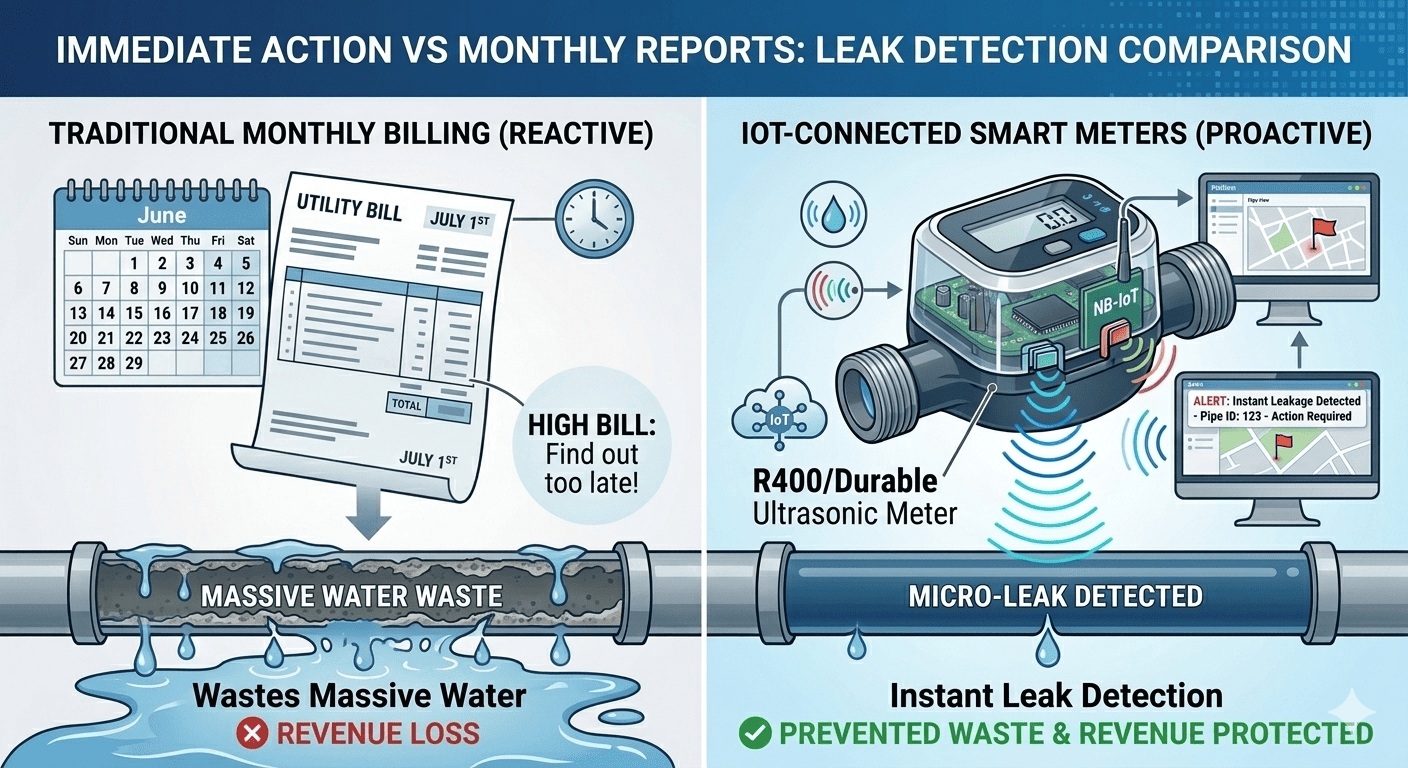
Manual reading gives a delayed view of the network. A leak may begin today, but the utility may only see the result at the next billing cycle. I use smart meters to shorten this delay.

YOUNIO residential ultrasonic smart water meters are described as being integrated with a wide range of IoT technologies for different application scenarios. The product materials also list communication options such as M-BUS, RS485, pulse, and NB-IoT. This makes the meter useful not only as a measuring device, but also as a field data point in an AMR or AMI system.

Real-time IoT data from ultrasonic water meters for leak detection and NRW monitoring

From Late Discovery to Earlier Warning

A smart ultrasonic meter can support leakage detection and dry pipe detection, based on the product materials. It can also support bi-directional flow measurement to help identify abnormal reverse-flow or tamper-related conditions.

I do not call this “instant problem solving.” The meter sends data. The utility still needs a platform, alarm rules, field crews, and a response process. But better data can reduce the time between abnormal flow and operational action.

The product materials also state that the LCD can display cumulative volume, 瞬时流量, and rich alarm information. This matters because field technicians may still need to check a local display during commissioning, 维护, or complaint investigation.

数据特征 Traditional Manual Metering Smart Ultrasonic Metering
Leak visibility Often found after reading cycle Leakage detection supported
Dry pipe condition Hard to identify remotely Dry pipe detection supported
Reverse flow or tamper Usually needs site inspection Bi-directional flow measurement supported
Data access 手动读数 M-BUS, RS485, pulse, and NB-IoT options listed
Local display Basic register LCD with volume, 流动, 和报警信息

Why Should Procurement Look Beyond the Purchase Price?

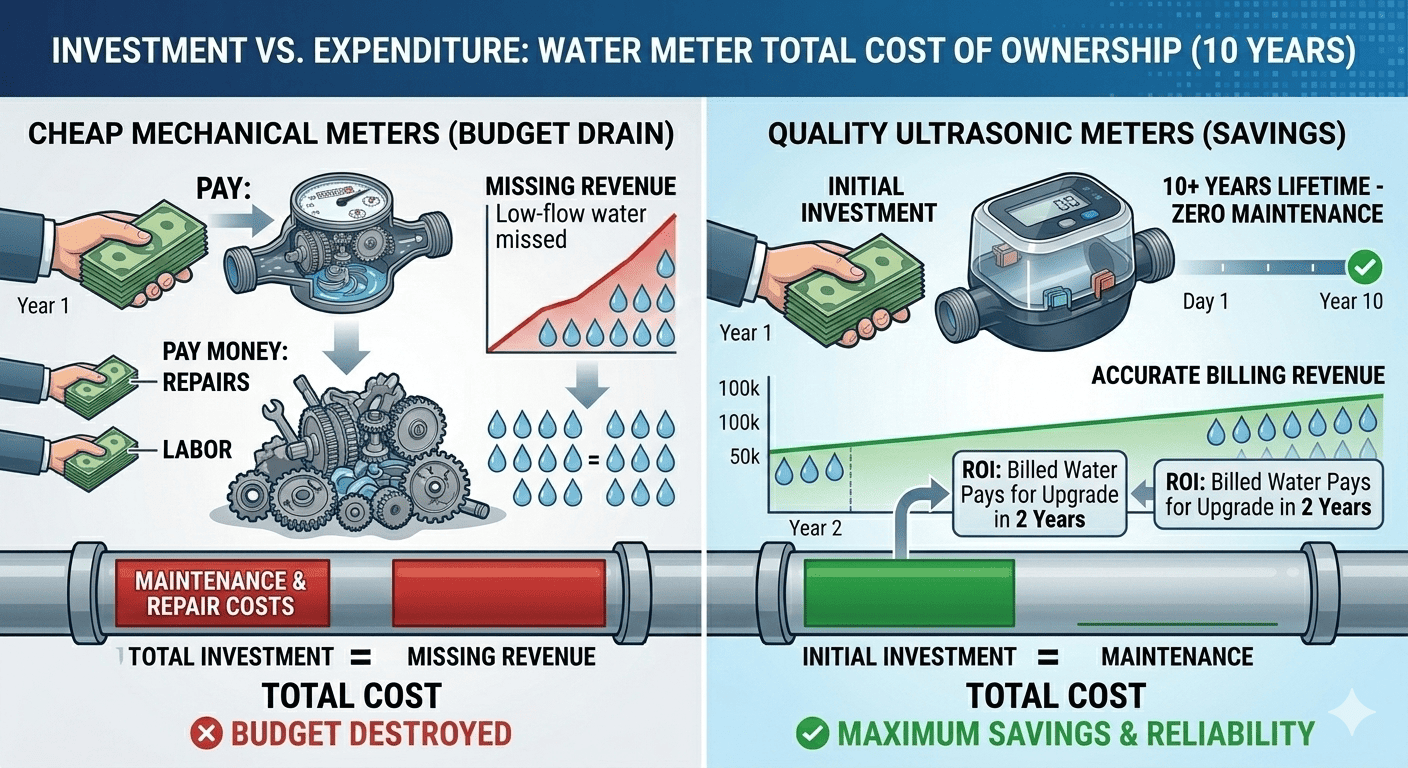
A low purchase price can look attractive during tender evaluation. I understand this pressure. But I also know that the lowest unit price does not always mean the lowest lifecycle cost.

A meter replacement program should consider purchase price, accuracy at low flow, field lifetime, battery performance, 防护等级, communication cost, truck rolls, 投诉处理, and data platform readiness.

The YOUNIO product materials describe the residential ultrasonic meter as battery powered with a lifetime of more than 10 年. The product materials also state a submersible IP68 protection level. These two points matter because many residential meters work in humid chambers, outdoor pits, or places where battery replacement is expensive.

Water meter total cost of ownership comparison — mechanical R80 vs ultrasonic R400

Total Cost of Ownership Needs Local Data

I avoid saying that every R400 ultrasonic meter project pays back within a fixed time. The ROI timeline depends on the local tariff, the number of low-flow events, meter age, pressure profile, leakage behavior, communication cost, and labor cost.

A good business case should start with a pilot. I would test a sample group of DN15 connections. I would compare old meter readings, new meter readings, night-flow patterns, 警报, 客户投诉, and lab verification data. Then I would scale the project based on measured results, not on a general claim.

成本类别 Mechanical Meter Risk R400 Ultrasonic Meter Consideration
Low-flow billing Higher risk of under-registration at low flow R400 lowers Q1 when Q3 is fixed
Mechanical wear Moving parts may degrade No wearing parts stated in product materials
Battery service Depends on meter type 多于 10 years battery lifetime stated
Chamber flooding Protection level varies IP68 submersible protection stated
Data value Manual or limited data IoT integration and communication options supported
投资回报率 Depends on site data Must be calculated from local flow and tariff conditions

What Field Conditions Must Be Checked Before Using R400 Meters in an NRW Program?

R400 is not a magic label. I check the field conditions before I expect results.

第一的, I check meter size and Q3. I do not compare R80 and R400 in the abstract. I select one meter size first. For DN15, I use Q3 = 2.5 m³/h as the base when this specification is selected.

第二, I check Q1. If the meter is R400 and Q3 = 2.5 立方米/小时, then Q1 is 6.25 升/小时. If the meter is R80 and Q3 = 2.5 立方米/小时, then Q1 is 31.25 升/小时. This is the fair comparison.

第三, I check starting flow rate. The YOUNIO materials describe ultralow starting flow down to 0.002 立方米/小时, equal to 2 升/小时, in the product features. If a project uses another internal or field-tested starting flow value, I would publish that value together with the test condition.

第四, I check installation class and pipe condition. A high-accuracy meter still needs correct installation. The pipe should remain full during measurement. Dry pipe detection can help identify abnormal conditions, but it cannot replace correct hydraulic design.

第五, I check the communication and head-end system. A smart meter can produce richer alarm data, but the utility needs a platform that can receive, store, classify, and act on that data. Otherwise, alarm functions become unused features.

结论

R400 ultrasonic meters address NRW at the metrological level. For DN15 with Q3 = 2.5 立方米/小时, they reduce Q1 from 31.25 L/h under R80 to 6.25 L/h under R400. The technology is strongest when the tender specifies meter size, 第三季度, Q1, starting flow rate, 安装条件, 电池寿命, 通讯方式, and alarm data handling.

Facebook
叽叽喳喳
LinkedIn

相关帖子

立即联系我们,
明天得到回复

我是莱昂, Younio水表的销售经理, 我和我的团队很乐意认识您并了解您的业务, 要求和期望.

得到 2025 电子录制

请输入您的电子邮件地址,并收到一个PDF,并为我们的 50+ 流行的水表.