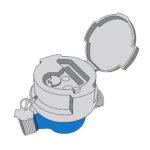

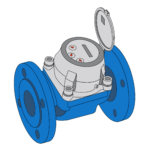

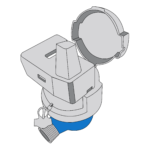

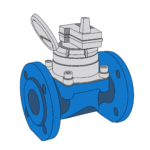

La sustitución de contadores en toda la ciudad parece sencilla sobre el papel. comprar metros, intercambiar metros, enviar facturas. en la vida real, Veo ciudadanos enojados, horarios tardíos, y titulares que ninguna utilidad quiere.
Veo siete riesgos ocultos al reemplazar los medidores de agua municipales: especificaciones débiles, contratistas no capacitados, mala comunicación ciudadana, errores de instalación, alarmas ignoradas, débil manejo de quejas, y líneas de base de datos faltantes. Las ciudades sin formación clara y flujos de trabajo de quejas a menudo enfrentan una presión combinada de los medios y la técnica..
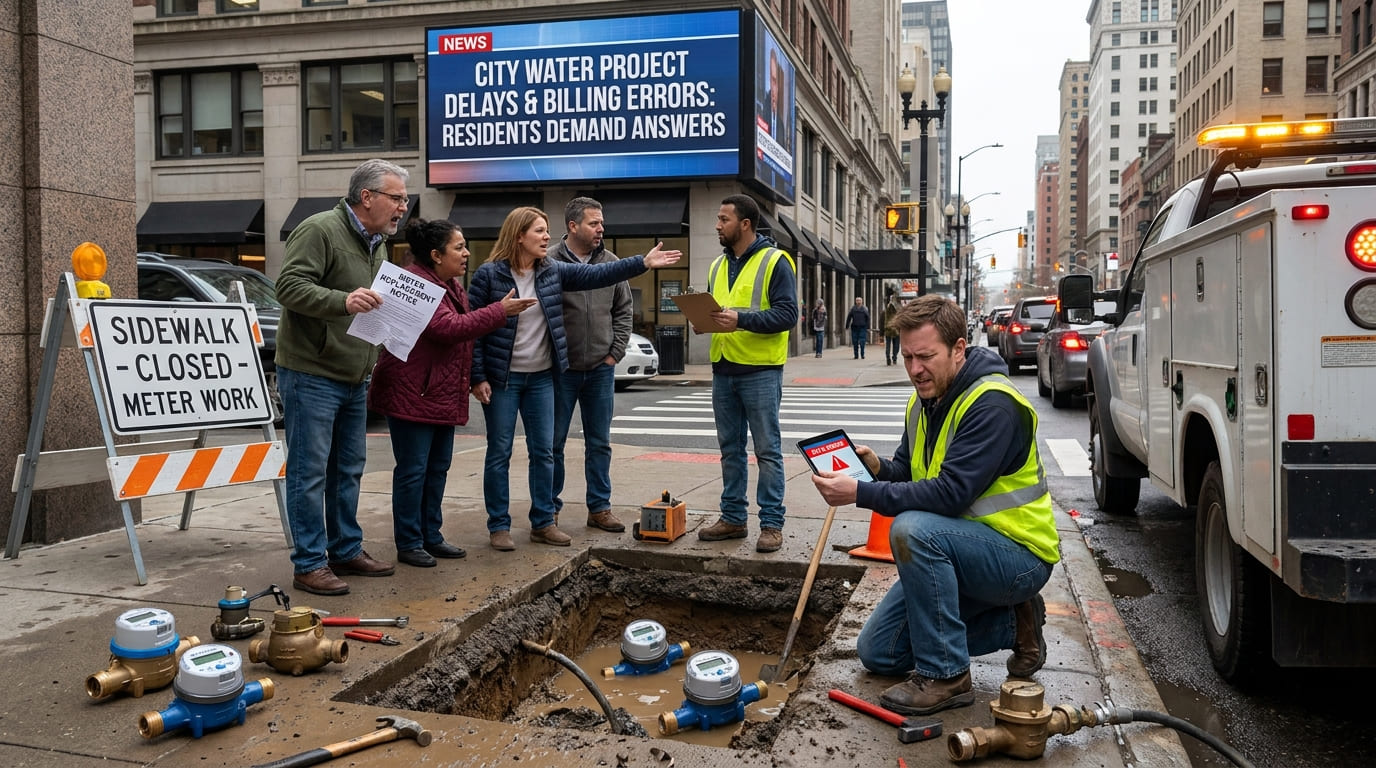
He revisado expedientes de quejas de muchos proyectos de la ciudad.. Se repiten los mismos patrones. La parte técnica casi nunca es el peor problema.. El peor problema es la brecha entre la realidad técnica y las expectativas ciudadanas, y la falta de un plan real para manejar las quejas cuando aumentan. en esta publicación, Comparto lo que aprendo de esos archivos., y doy una lista de verificación práctica que las empresas de servicios públicos pueden usar antes, durante, y después del lanzamiento.
Por qué las ciudades lanzan programas de reemplazo de medidores?
Metros antiguos sub leídos. Los medidores viejos fallan. Los medidores antiguos no pueden comunicarse con un sistema. Veo que las ciudades reemplazan los medidores para solucionar los tres problemas a la vez.
Veo cuatro impulsores principales para el reemplazo en toda la ciudad: flotas mecánicas envejecidas, Reducción de ANR objetivos, equidad de facturación, y transformación digital hacia sistemas de agua inteligentes con lectura remota y alarmas activas.
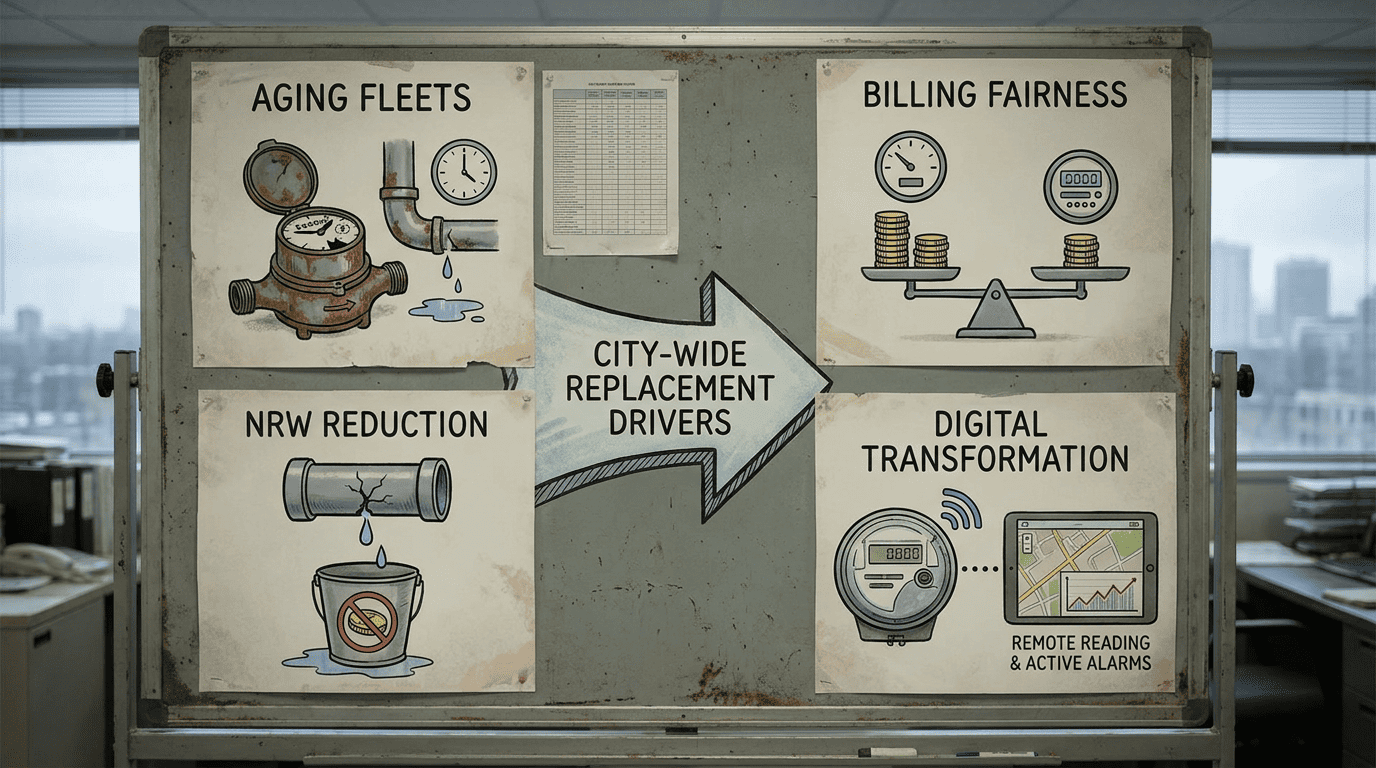
Lo que las ciudades quieren de la nueva flota
Hago la misma pregunta a todas las empresas de servicios públicos.: ¿Qué quieres de la nueva flota?? Las respuestas suelen superponerse. Quieren mediciones precisas bajo estándares modernos, con verificación basada en JJG 162-2009 para contadores de agua fría o ISO 4064:2014 / OIML R49-2013 para medidores ultrasónicos. Quieren lectura remota. El medidor ultrasónico inteligente se relaciona con un recolector de datos inalámbrico GSM y utiliza la red pública móvil GSM para formar un sistema de monitoreo inalámbrico., Fácil de gestionar y ahorra costes operativos.. Quieren datos del evento: el sistema informa activamente información anormal de la red de tuberías, incluyendo fugas, ráfagas, dirección equivocada, y eventos sin flujo. Quieren un camino hacia la integración de las ciudades inteligentes, que es exactamente lo que NB-IoT medidor de agua inteligente Apoyo a proyectos como nodo para IoT y construcción de ciudades inteligentes.. La nueva flota no es sólo hardware. es una plataforma de datos.
| Conductor | Lo que espera la ciudad | Fuente |
|---|---|---|
| Flota envejecida | Clase de precisión moderna | ISO 4064 / jjg 162 |
| NRW | Alarmas activas de fuga/explosión | Informes de eventos |
| Equidad de facturación | Lecturas confiables | Menú de medidor inteligente |
| ciudad digital | Integración de IoT | Medidor inteligente NB-IoT |
Siete riesgos ocultos que vemos en proyectos reales?
Los riesgos rara vez tienen que ver con el medidor en sí.. Se sientan en especificaciones, gente, y comunicación.
Veo siete riesgos ocultos: especificaciones vagas, errores de instalación, alarmas ignoradas, contratistas no capacitados, débil comunicación ciudadana, sin flujo de trabajo de quejas, y sin datos de referencia. Cada uno por si solo es manejable; juntos crean una crisis pública.
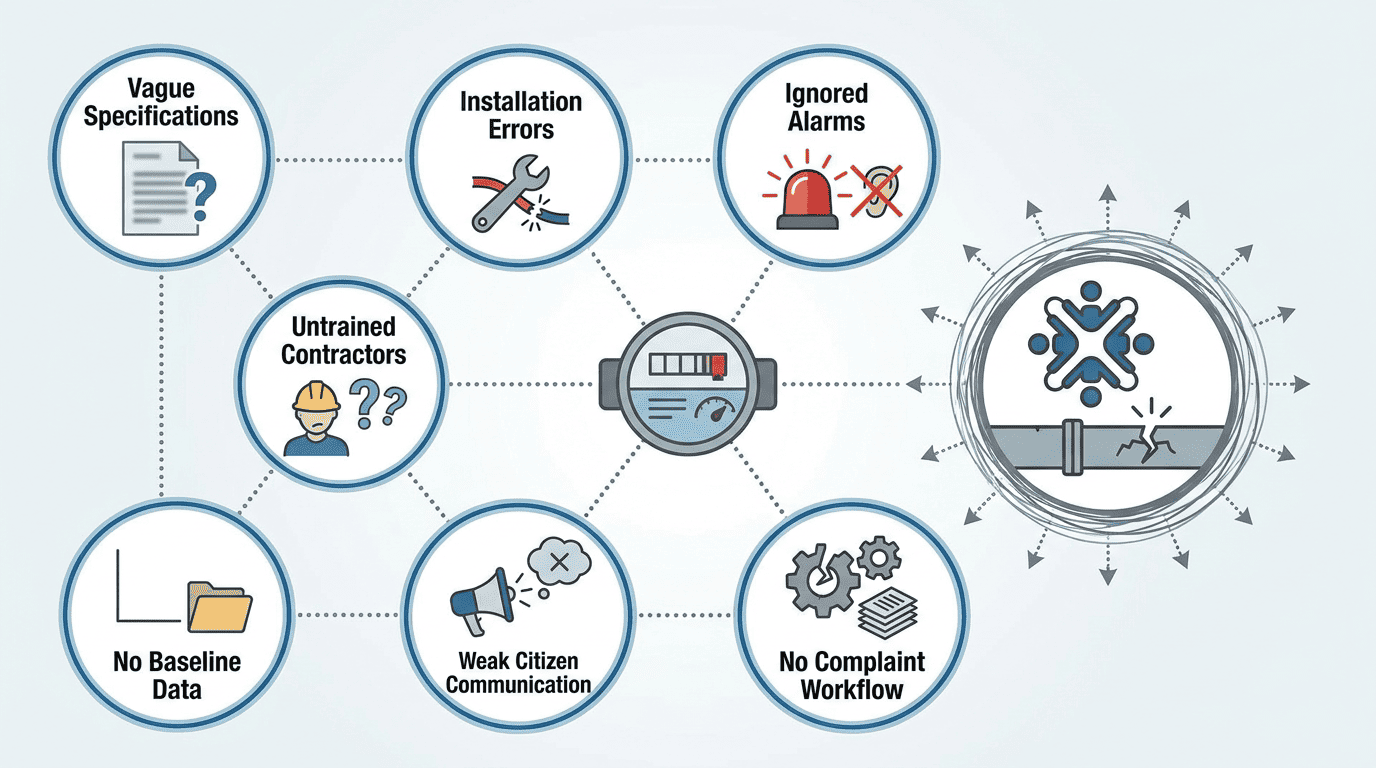
Los siete riesgos en palabras sencillas
Enumero cada riesgo en palabras sencillas.. Riesgo uno: especificaciones de adquisición vagas que ignoran la calidad real del agua. Riesgo dos: errores de instalación, como dirección de flujo incorrecta o tramos rectos cortos, que causan lecturas negativas o datos aleatorios. Riesgo tres: alarmas ignoradas, como eventos de fuga o explosión, el sistema informa activamente pero nadie lee. Riesgo cuatro: contratistas no capacitados que se saltan pasos y rompen la regla de que la instalación debe seguir el diseño de ingeniería profesional del sitio, sin alteración sin permiso del ingeniero. Riesgo cinco: comunicación ciudadana débil antes de que cambien los proyectos de ley. Riesgo seis: sin flujo de trabajo de quejas, para que cada llamada se convierta en una emergencia. Riesgo siete: sin datos de referencia, por lo que la empresa de servicios públicos no puede demostrar que un medidor nuevo lee correctamente en comparación con el anterior.. Cities that miss these risks face technical issues and media pressure at the same time.
| Riesgo | Typical sign | Mitigation |
|---|---|---|
| Vague specs | Mixed product quality | Reference ISO 4064 / MEDIO |
| Install errors | Lectura negativa [3] | Engineer-led design |
| Ignored alarms | Late leak repairs | Active reporting system |
| Untrained contractors | Wrong direction, bad position | Capacitación + audit |
| Weak comms | Citizen anger | Pre-launch information |
| No workflow | Long disputes | Defined complaint script |
| No baseline | "New meter reads high" | Old vs. new comparison data |
Procurement Specs vs Real-World Conditions?
A spec written in an office is not a spec for a real city pipe. I see this gap in every problem project.
I close the gap by writing specs that name standards, opciones de comunicacion, alarm features, and storage rules. ISO 4064:2014, OIML R49-2013, and JJG 162-2009 give a defensible base, plus event reporting and battery rules from the meter itself.
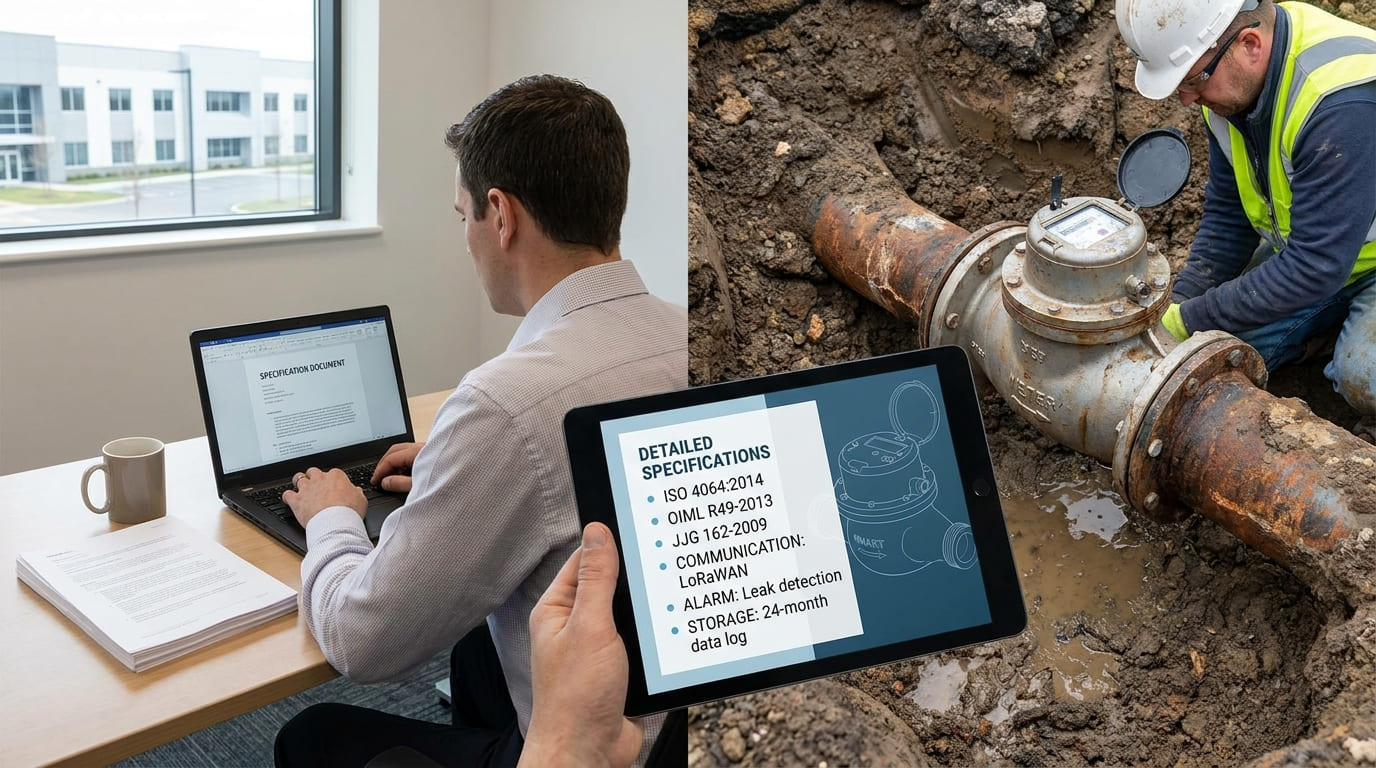
What I Put in a Strong Spec
I put four blocks in a strong spec. Block one is metrology: meters must comply with ISO 4064:2014 and OIML R49-2013, with R250 or R400 ratios and clear Q1, Q2, Q3, Q4 values for each diameter. For Chinese projects, jjg 162-2009 verification regulation for cold-water meters is the legal reference. Block two is communication and events: the meter must support remote reading and actively report leak (long flow over 24h), explosión (large flow for set time), dirección equivocada, no-flow, and low-battery events. Block three is environment: protection class, medium temperature, storage temperature, and battery life ≥ 8 years for ultrasonic meters. Block four is logistics and storage: meter stored in original package at 5–40°C, en aire libre de gases corrosivos, with stacking no more than 5 boxes. With these blocks, the spec matches reality, not a brochure.
| Spec block | Key content | Fuente |
|---|---|---|
| Metrology | ISO 4064 / Oiml / jjg 162 | |
| Events | Alarmas de fuga/explosión/dirección/falta de flujo | |
| Ambiente | Batería ≥8 años, clase IP | |
| Almacenamiento | 5–40°C, sin gas corrosivo, ≤5 cajas |
Buscando un proveedor confiable de medidores de agua?
YOUNIO fabrica contadores de agua mecánicos y ultrasónicos desde DN15 hasta DN500, Certificado MID y probado según ISO 4064. Muestras gratuitas e informes de pruebas de fábrica disponibles para compradores calificados.
Capacitación de contratistas y control de calidad a escala?
Una ciudad reemplaza decenas de miles de metros. Incluso las tasas de error de instalación pequeñas generan grandes oleadas de quejas.
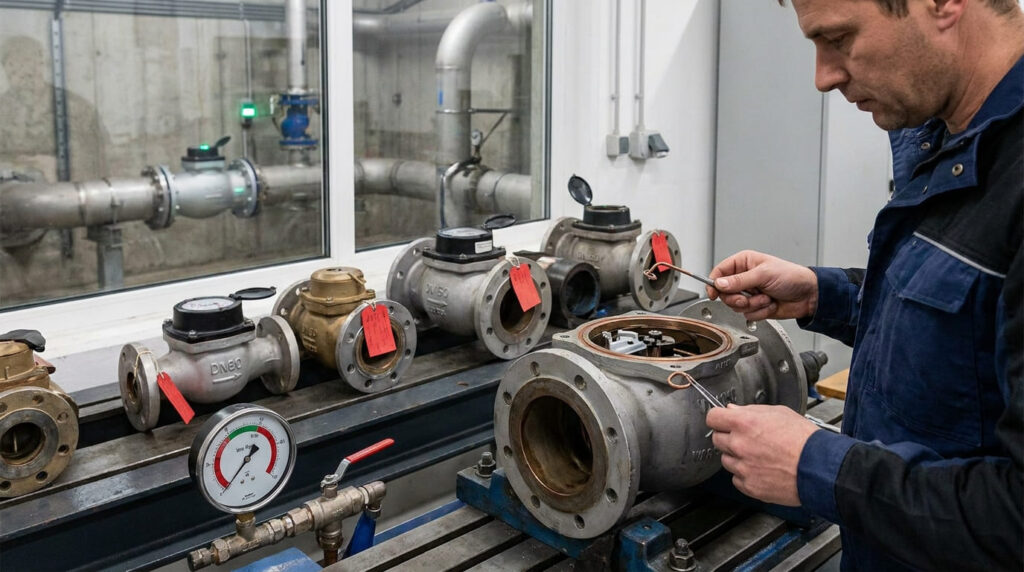
Elimino los errores de instalación con dos herramientas: corto, formación repetible para contratistas, and quality audits keyed to the meter’s own troubleshooting points — flow direction, secciones rectas, posición, y almacenamiento.
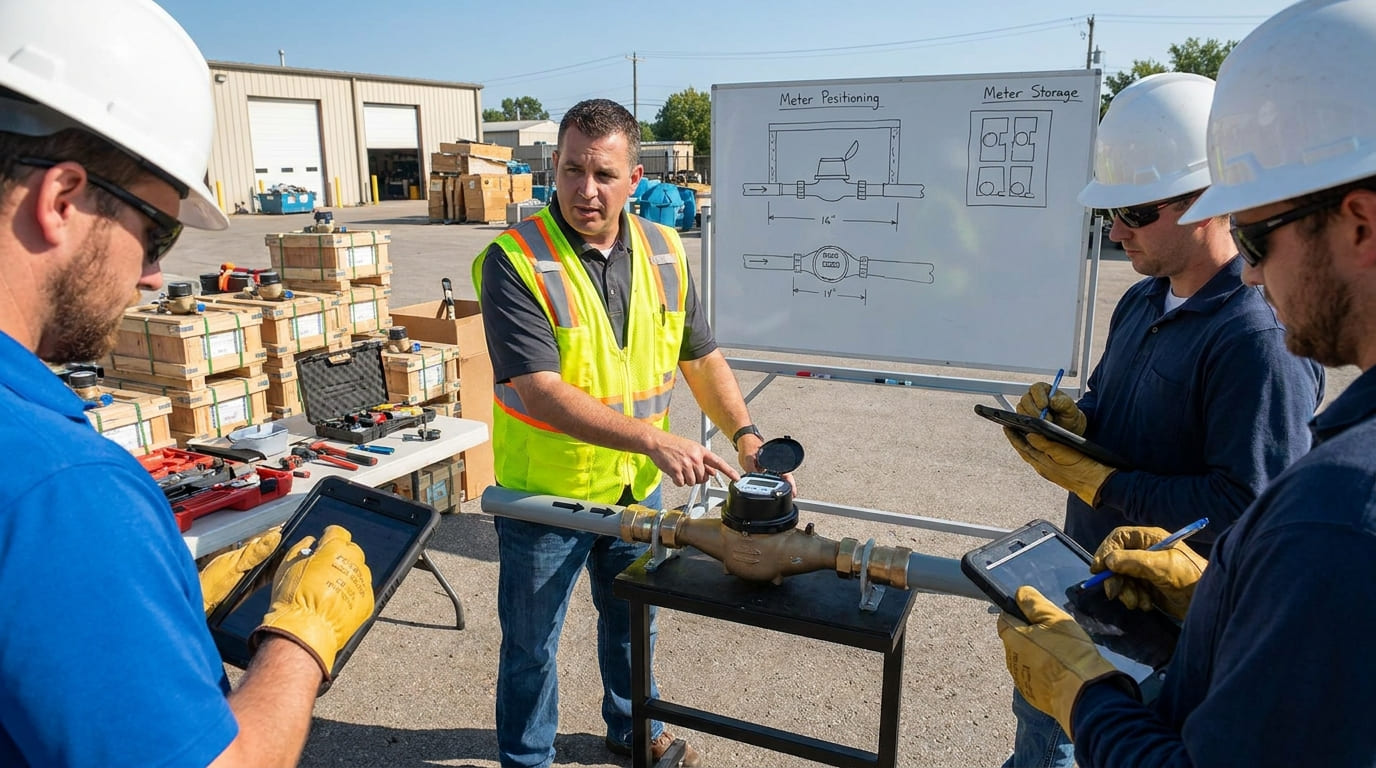
Qué entreno y qué audito
Capacito a contratistas en una pequeña cantidad de puntos y audito los mismos puntos.. Primero, La instalación debe seguir el diseño de ingeniería profesional del sitio., y la alteración sin el permiso del ingeniero está estrictamente prohibida. Segundo, La dirección del flujo debe coincidir con la flecha.; de lo contrario, el medidor indica negativo y el primer paso para solucionar el problema es verificar si la dirección está invertida. Tercero, La posición de instalación debe proporcionar una tubería llena con secciones rectas adecuadas.; un corto tramo recto, gran curva, o diámetro de tubería grande antes de que la tabla cause datos anormales o aleatorios. Cuatro, el almacenamiento in situ debe respetar una temperatura de 5 a 40 °C y condiciones libres de gases corrosivos, con apilamiento ≤ 5 boxes. Quinto, antes de energizar, Los contratistas revisan la pantalla LCD para ver si hay un símbolo de batería baja., ya que una batería baja debe reemplazarse lo antes posible. Vinculo cada punto de capacitación a una casilla de verificación de auditoría de una línea para que el control de calidad se extienda a miles de instalaciones..
| Punto de entrenamiento | verificación de auditoría | Fuente |
|---|---|---|
| diseño de ingeniería | Dibujo aprobado en sitio. | |
| Dirección del flujo | La flecha coincide con el flujo | |
| Tramos rectos | No hay curvas cortas antes del metro. | |
| Almacenamiento | 5–40°C, ≤5 cajas | |
| Batería | Icono de batería baja en la pantalla LCD |
Comunicación con los ciudadanos durante el reemplazo?
Most "meter scandals" leo son escándalos de comunicación. el medidor funciona; el mensaje no.
Planifico comunicación ciudadana en tres fases: antes (por qué reemplazamos), durante (que esperar en casa), y después (cómo leer la nueva factura). Sin este plan, Incluso las lecturas correctas provocan ira y cobertura mediática..
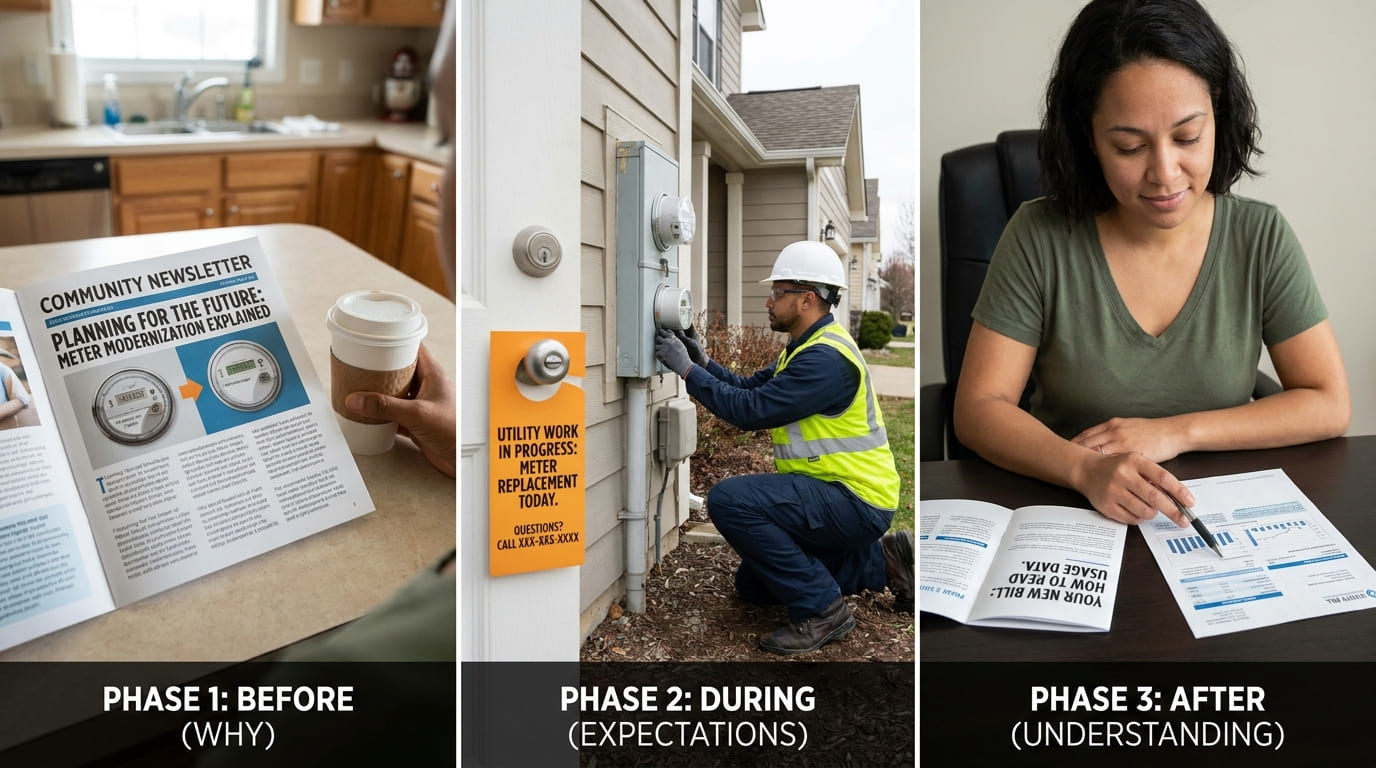
Lo que les digo a los ciudadanos en cada fase
Antes del reemplazo, Le cuento a los ciudadanos qué hace y qué no hace el nuevo contador. Les explico que el medidor inteligente reporta eventos anormales como fuga (24h corriendo) y estallar (gran flujo a lo largo del tiempo) activamente al sistema, que en realidad los protege de enormes billetes escondidos en las paredes. Durante el reemplazo, Les cuento lo que ven en casa.: un pequeño medidor ultrasónico o mecánico, Una pantalla LCD con menús que muestran el flujo instantáneo., flujo acumulativo, tiempo de trabajo, y fecha, conmutable por varilla magnética. También advierto que con el tiempo puede aparecer un ícono de batería baja y que la utilidad reemplazará la batería.. Después del reemplazo, Les explico cómo aparece la nueva lectura en las facturas., y comparto los conceptos básicos de solución de problemas: una lectura negativa significa que el equipo verifica primero la dirección del flujo. Los mensajes claros hacen que el nuevo medidor pase de ser una amenaza a convertirse en un servicio.
| Fase | Mensaje | Fuente |
|---|---|---|
| Antes | Las alarmas inteligentes te protegen | |
| Durante | Menú LCD y conceptos básicos del medidor | |
| Después | Cómo leer la factura | |
| En cualquier momento | Qué hacer ante una lectura negativa |
Lo que nos dicen los datos de quejas después del lanzamiento?
Las quejas no son ruido.. son datos. Los leo como un mapa de fallas del proyecto..
Agrupo las quejas posteriores a la implementación en cuatro grupos: quejas por facturas altas, quejas de baja lectura, instalar quejas, y quejas de comunicación. Los registros de eventos de medidores inteligentes y los datos almacenados convierten cada grupo en un problema solucionable, no es un argumento.
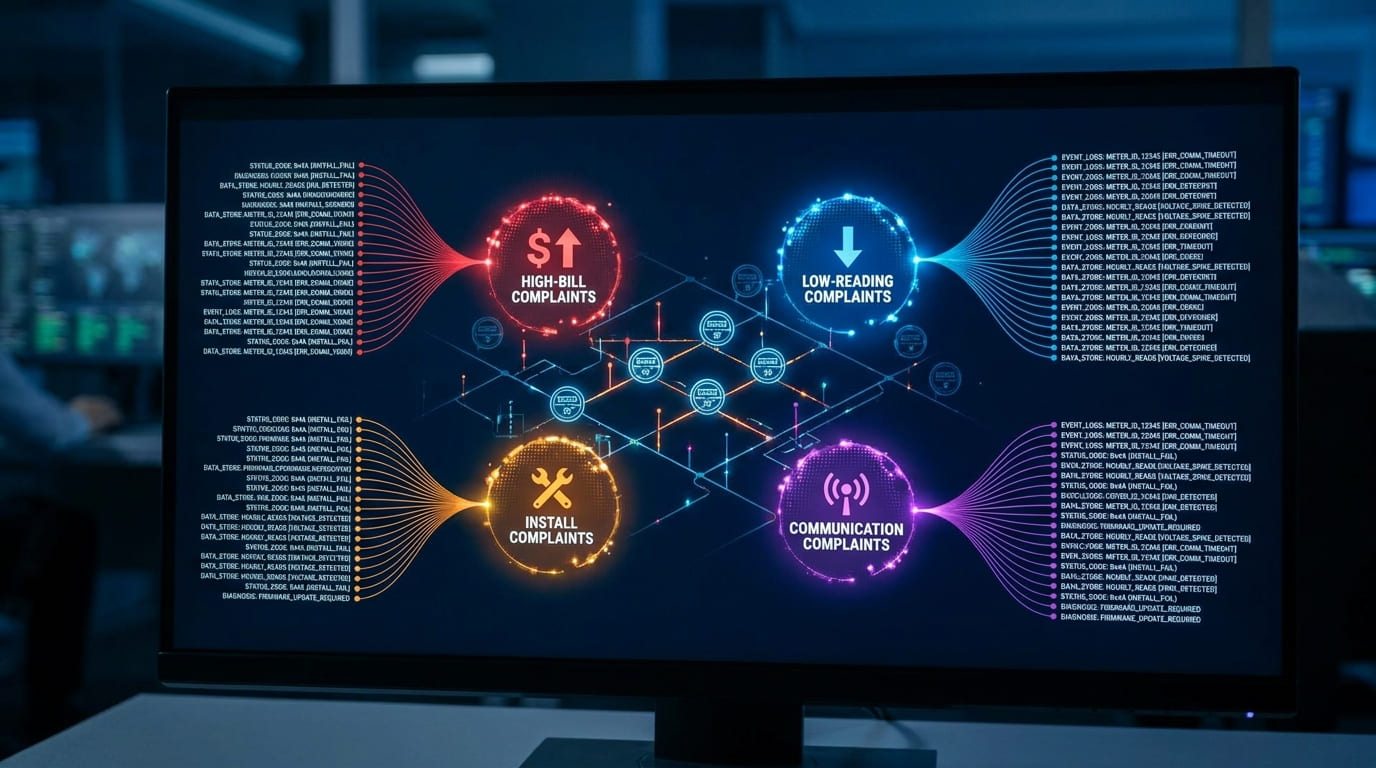
Cómo uso los datos de quejas
I use complaint data with the meter’s own records. Para quejas por facturas elevadas, Compruebo la alarma de flujo largo: si el medidor reportó flujo continuo las 24 horas, el usuario tiene una fuga real, no es un error de medidor. Para quejas de lectura baja, Verifico la alarma de dirección y la nota de flujo invertido de la solución de problemas; si el medidor está instalado en la dirección incorrecta, el sistema informa y almacena activamente el error. Para quejas de instalación (datos aleatorios, deriva), I check the troubleshooting notes for incorrect installation position, low water level, short straight sections, gran curva, or large pipe diameter before the meter. For communication complaints, I check whether the citizen received the pre-launch message and the bill explanation. I also rely on stored data: the smart ultrasonic meter shows cumulative flow, tiempo de trabajo, y fecha, which gives a clean timeline for any dispute. With this approach, complaint files become an improvement engine, not a public-relations crisis.
| Grupo de quejas | Data I check | Fuente |
|---|---|---|
| High bill | Alarma de flujo largo (24h) | |
| Lectura baja | alarma de dirección | |
| Install drift | Posición / straight section | |
| Batería / no data | Informe de batería baja |
A Practical Risk Mitigation Checklist for Utilities?
A long report does not help a busy utility. A short checklist does.
I give utilities a short checklist for municipal water meter replacement risks: certified specs, engineer-led installs, trained contractors, mensajes ciudadanos, operaciones impulsadas por alarma, guiones de queja, y datos almacenados como prueba. Cada elemento se asigna a una característica del medidor o a una regla documentada.
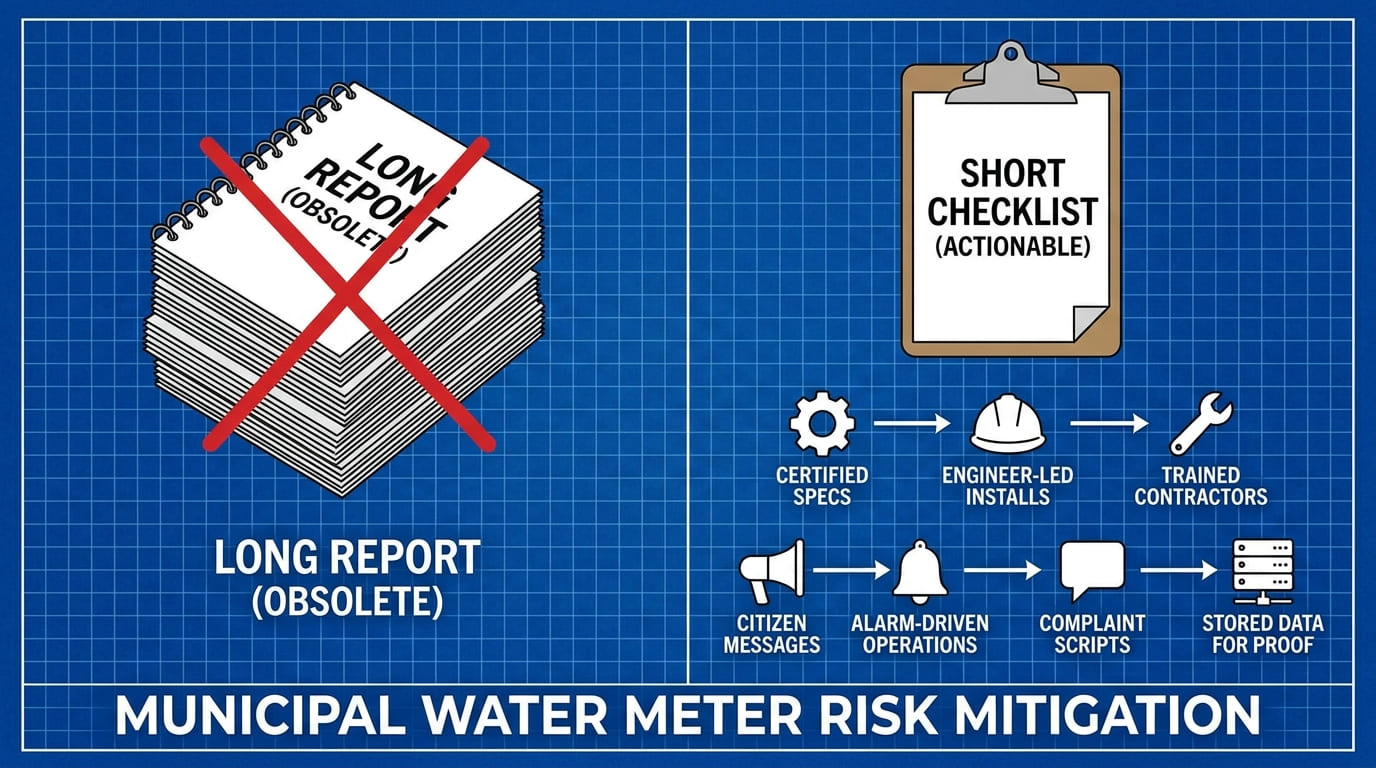
La lista de verificación que entrego a los gerentes de proyectos
Mantengo la lista de verificación corta a propósito. Artículo uno: referencia de especificaciones ISO 4064:2014, OIML R49-2013, and JJG 162-2009 donde se aplica, con valores claros Q1–Q4 por diámetro. Punto dos: instalaciones siguen el sitio diseño de ingeniería profesional, sin alteración no autorizada. Punto tres: Los contratistas están capacitados sobre la dirección del flujo., secciones rectas, posición de instalación, and storage rules (5–40°C, ≤5 cajas). Punto cuatro: los ciudadanos reciben pre-, durante-, y mensajes posteriores al reemplazo que explican el menú LCD y el significado de las alarmas. Punto cinco: Los equipos de operaciones actúan según las cuatro alarmas estándar: fuga. (flujo largo 24h), explosión (gran flujo a lo largo del tiempo), dirección equivocada, y sin flujo: informado activamente por el sistema. Punto seis: quienes manejan las quejas siguen un guión: verifique la dirección primero en lecturas negativas, verifique el ícono de la batería en caso de que falten datos, y extraiga eventos almacenados para cualquier caso de factura elevada. Punto siete: Los servicios públicos mantienen una línea de base entre lo antiguo y lo antiguo.. new readings to defend against "the new meter reads too high" reclamos.
| Elemento de la lista de verificación | fuente de verdad |
|---|---|
| Especificaciones certificadas | ISO 4064 / jjg 162 |
| Instalación dirigida por ingenieros | regla de diseño de ingeniería |
| Contratistas capacitados | Puntos de solución de problemas |
| Mensajería ciudadana | Explicación del menú LCD |
| Operaciones impulsadas por alarmas | Informes de eventos activos |
| guión de queja | Dirección + controles de batería |
| Datos de referencia | Old vs. nueva comparación |
Conclusión
El reemplazo de medidores en toda la ciudad falla en la gente, no en metros. Especificaciones sólidas, trained contractors, mensajes ciudadanos, y las operaciones impulsadas por alarmas convierten el riesgo en una posibilidad manejable., programa respaldado por datos.
Buscando un proveedor confiable de medidores de agua?
YOUNIO fabrica contadores de agua mecánicos y ultrasónicos desde DN15 hasta DN500, Certificado MID y probado según ISO 4064. Muestras gratuitas e informes de pruebas de fábrica disponibles para compradores calificados.