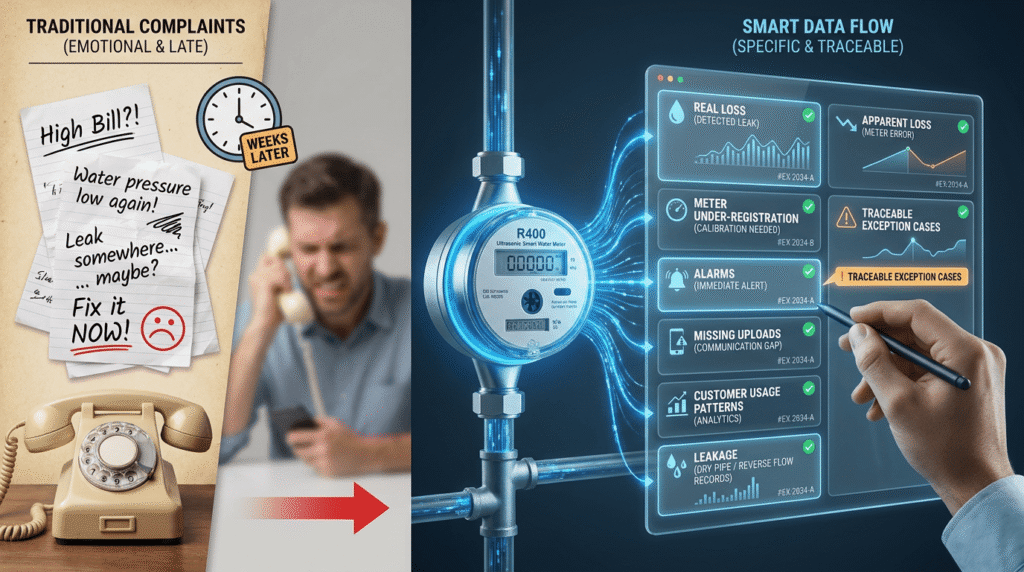




Import projects look simple on paper. Then standards, testmethoden, and documents disagree. I slow the project down before shipment.
Most importing water meters mistakes are not caused by the meter itself. They come from unmatched standards, different laboratory test methods, incomplete certificates, unclear installation requirements, and contracts that do not define which report controls acceptance.
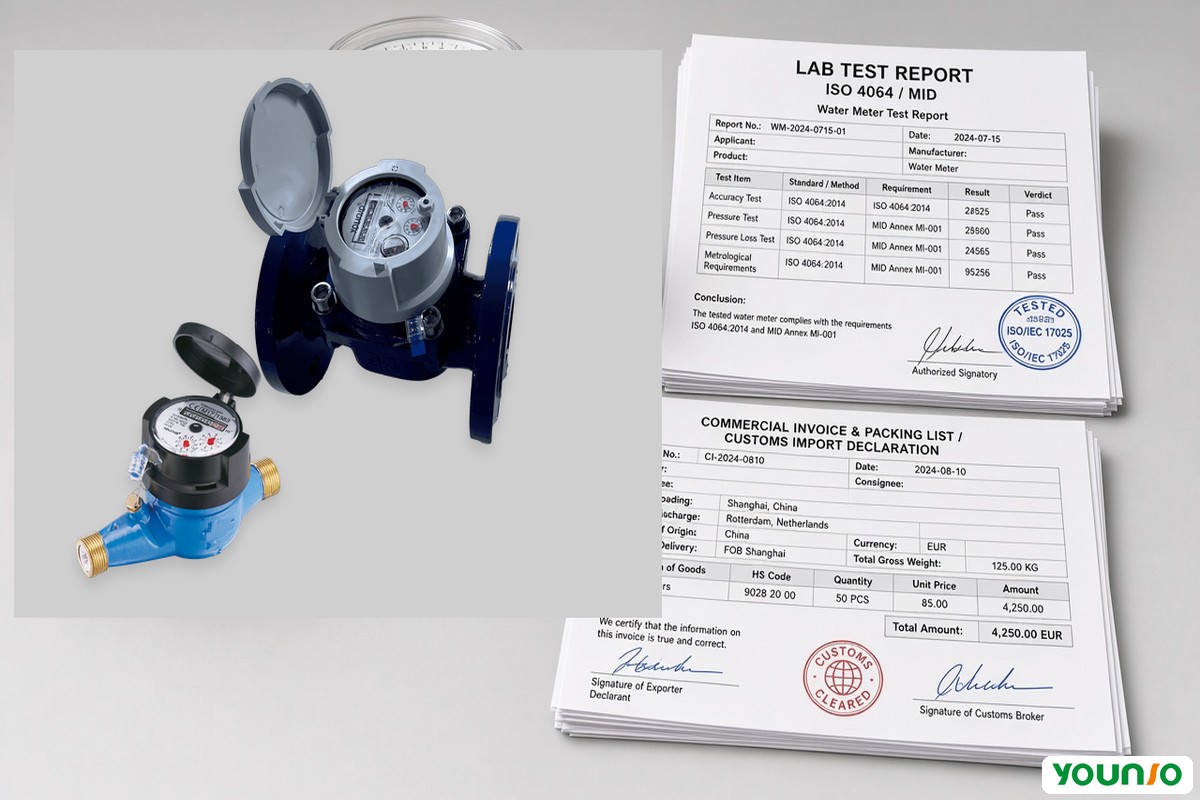
I see this often in Latin America, Europe, and Asia. The same water meter can pass one market and face rejection in another. The reason is usually not mystery. The project team did not align specifications, testomstandigheden, reports, and responsibility before the import order.
Typical Import Scenarios for Water Meters
A buyer may import meters for one project. But the hidden risks depend on the country, sollicitatie, and approval route.
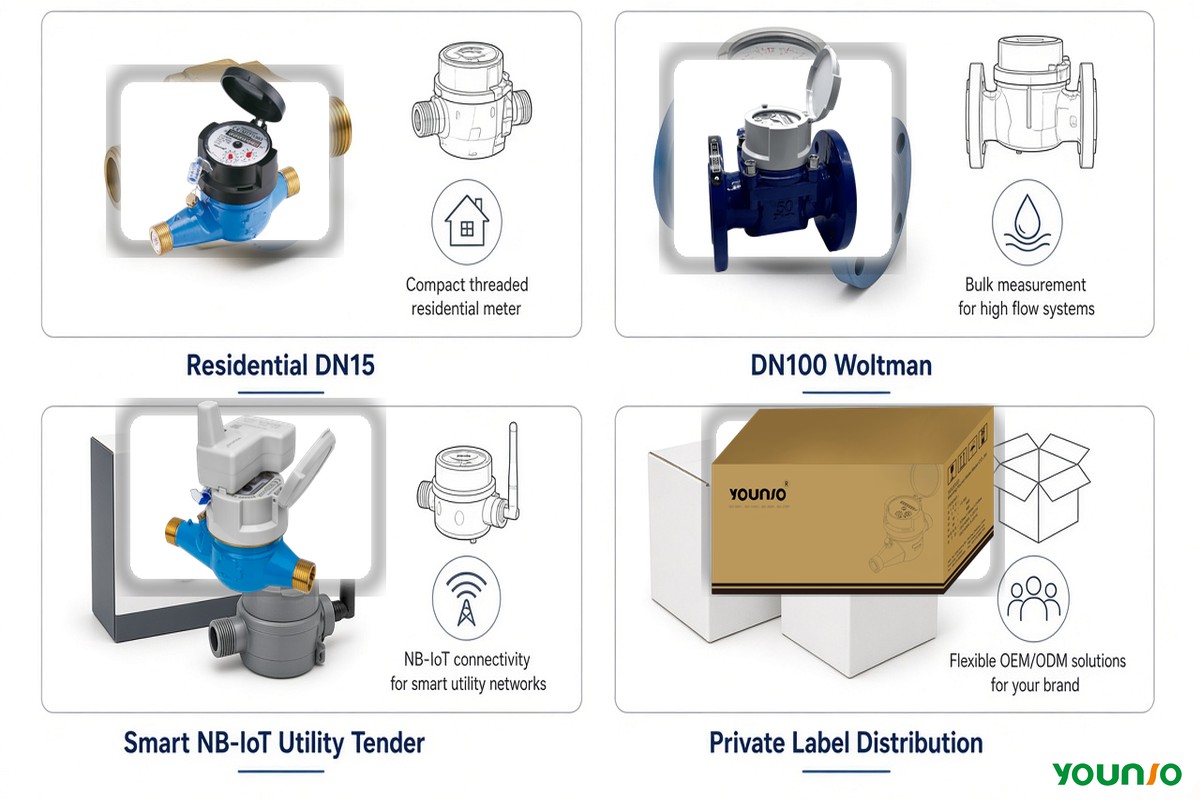
Typical water meter import scenarios include utility tenders, private-label distribution, smart city rollouts, building sub-metering, industrial metering, irrigatie projecten, and replacement programs. Each scenario needs different standards, certificaten, testrapporten, markeringen, and installation documents.
Why I First Define the Import Scenario
I do not start an import project by asking only for the best price. I first ask where the meter will be installed, who will approve it, and which document will be checked first.
A water utility tender in Europe may require a legal metrology route such as MID, plus product marking, declaration documents, and traceable type approval. A distributor in Latin America may need ISO 4064-based test reports, Spanish manuals, and local customs documents. A smart city project in Asia may require NB-IoT, Lorawan, M-bus, or RS485 integration, plus platform testing, battery conditions, and alarm configuration.
The meter type also matters. A DN15 residential mechanical meter has a different risk profile from a DN100 Woltman meter, a DN200 district meter, or a DN15 ultrasonic smart meter. If the meter includes electronic devices, the import team must also consider power supply type. ISO 4064-1 dekt de externe voeding, niet-vervangbare batterij, and replaceable battery for water meters with electronic devices. If the meter uses external power, ISO 4064-1 states that the volume indication just before power failure must not be lost and must remain accessible for at least one year.
| Import Scenario | Common Buyer | Belangrijkste risico |
|---|---|---|
| Utility tender | water company or contractor | standard and certificate mismatch |
| Private-label distribution | local brand or distributor | wrong marking or certificate ownership |
| Smart city rollout | utility and IT integrator | communication and battery assumptions |
| Building sub-metering | developer or facility company | installation space and reading access |
| Industrial metering | factory or plant operator | flow range and pressure condition |
| Replacement program | municipal utility | old pipe condition and user complaints |
I also ask whether the buyer needs complete meter testing or separate unit evidence. ISO 4064-2 includes provisions for testing the complete water meter and for testing the measurement transducer and calculator as separate units when required by national regulations. This matters when a smart meter combines a measuring body, rekenmachine, register, batterij, en communicatiemodule.
A good import scenario is not only a purchase description. It is a compliance map. The supplier side of the same risk is covered in my Selectiecriteria voor de fabrikant van watermeters.
Standards and Testing Mismatches Across Countries
A meter may pass one laboratory and fail another. This can happen when the test basis, stroom punten, temperatuur, or installation setup differs.
Standards and testing mismatches occur when countries use different acceptance rules, ISO editions, national adaptations, lab procedures, temperature classes, stroom punten, installatievoorwaarden, or certificate formats. Importers must align the test method before ordering. For the Q1, Vraag 2, Q3 and R definitions behind these tests, see our ISO 4064 water meter standard guide.

The Same Meter Is Not Tested in a Vacuum
I often remind importers that accuracy is not a slogan. It is measured under defined conditions.
ISO 4064-2 gives very specific test conditions. For some error tests, the meter can be installed singly or in series, but the lab must ensure there is no significant interaction between meters installed in series. The outlet pressure of any meter must not be less than 0.03 MPa, of 0.3 bar. The working water temperature range must also match the temperature class, zoals 20 °C ± 10 °C voor T30- en T50-meters.
The flow points matter too. Unless alternative flow rates are specified in the type approval certificate, ISO 4064-2 requires measuring errors at flow ranges including Q1 to 1.1Q1, Q2 to 1.1Q2, and 0.9Q3 to Q3. If one country tests at the declared ISO 4064 flow points and another lab uses a different national routine, the result may not be directly comparable.
Temperature testing is another source of disputes. ISO 4064-2 includes a water temperature test to measure the effect of water temperature on indication errors. The test includes measurement at Q2 with specified inlet temperatures depending on the meter temperature class. If an importer sends a meter approved for one temperature class into a market that expects another temperature behavior, the issue is not the brand. It is the mismatch.
| Test Item | Why It Can Differ by Country |
|---|---|
| Stroompunten | local lab may emphasize different points |
| Temperatuur | cold water and hot water classes differ |
| Installation setup | rechte pijp, verdeelstuk, or flow conditioning may differ |
| Pressure condition | outlet pressure and rated pressure must be controlled |
| Formaat testrapport | local authority may require specific format |
| Separate units | some markets inspect sensor and calculator separately |
I also check installation influence before accepting a test failure. ISO 4064-2 notes that some meter types may require flow conditioning when measuring indication errors, and the manufacturer’s recommended installation requirements shall be followed. These installation requirements should be reported in the type approval certificate.
This is why I prefer to align standards before sample shipment. If the buyer, seller, and laboratory do not use the same test map, the same meter may become a pass in one market and a dispute in another.
Documentation Gaps That Lead to Delays and Disputes
Customs delays and tender disputes often start with missing documents. The meter may be ready, but the file is not.
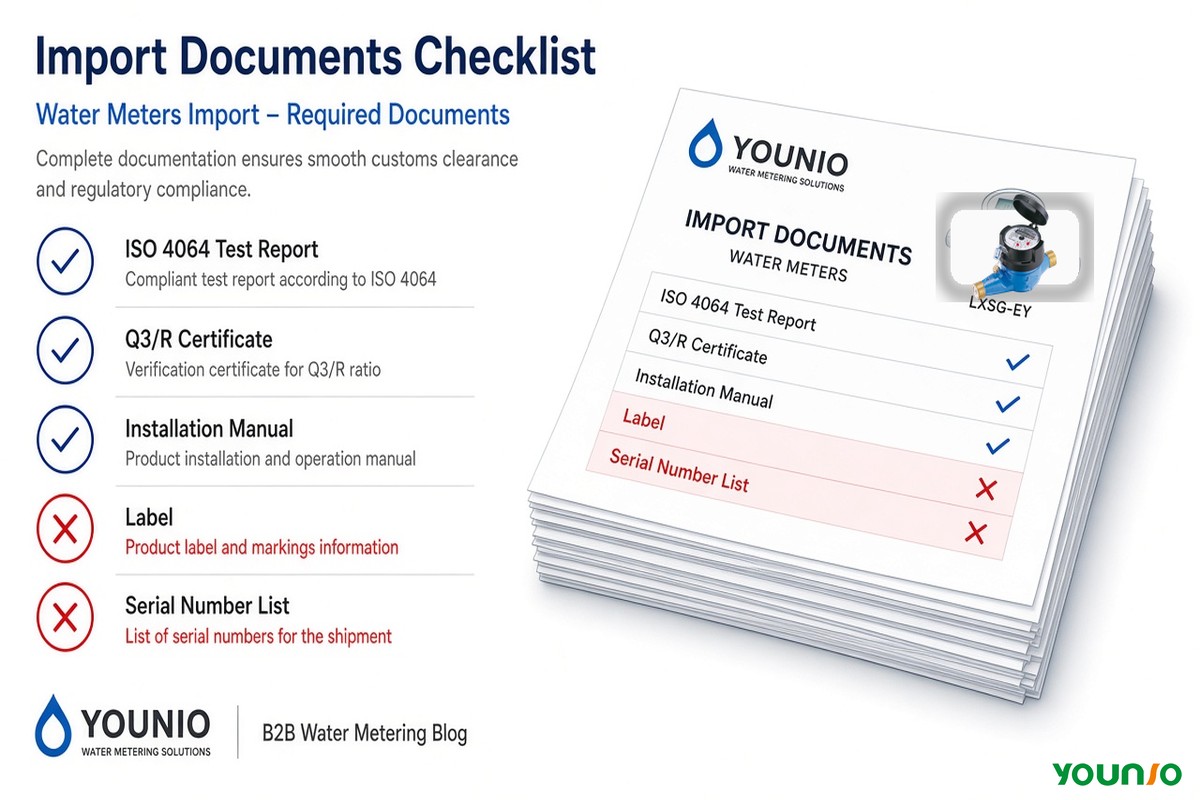
Documentation gaps include missing test reports, incomplete certificates, wrong model names, unclear Q3 or R values, inconsistent labels, missing manuals, weak battery documents, and no installation instructions. These gaps delay imports and weaken complaint defense.
I Treat the Document File as Part of the Product
In cross-border projects, the product is not only the water meter in the carton. The document file is part of the delivery.
I ask for the datasheet, certificaat, testrapport, installatiehandleiding, packing list, serial number list, label drawing, declaration documents, and communication manual if the meter is smart. Als de meter elektronische apparaten heeft, I also ask about power supply type. ISO 4064-1 recognizes external power supply, niet-vervangbare batterij, and replaceable battery as three basic power supply types for meters with electronic devices. This can affect customs classification, project acceptance, onderhoudsplanning, and warranty discussion.
One common mistake is inconsistent model naming. The invoice may show one model. The test report may show another. The carton label may use a short code. The certificate may cover a broader series but not the exact configuration. When a customs officer, consultant, or utility inspector checks the file, this mismatch creates doubt.
Another mistake is missing installation guidance. ISO 4064-2 requires precautions such as bleeding all air from interconnecting pipework and meters during testing, and taking precautions to avoid vibration and shock. It also explains that test installation should avoid hydrodynamic flow characteristics that create a discernible difference compared with undisturbed flow. If these concepts are ignored in field installation manuals, the importer may face complaints that are actually installation-related.
| Document | Wat ik controleer |
|---|---|
| Datasheet | DN, Q3, R, Q1, temperatuur, druk, installatie positie |
| Certificaat | holder, model, maatbereik, geldigheid, issuing body |
| Testrapport | standaard, stroom punten, temperatuur, laboratorium, resultaat |
| Installatiehandleiding | richting, positie, rechte pijp, lucht, trillingen, toegang |
| Label file | serienummer, flow arrow, unit, approval marking |
| Smart manual | mededeling, batterij, cyclus uploaden, platform setup |
| Packing file | carton mark, streepjescode, country language, quantity |
A document gap does not always stop the shipment immediately. Sometimes it becomes visible later, during acceptance or after complaints. That is worse. At that stage, the buyer has already paid freight, douane, opslag, and installation cost. Many document problems can be caught earlier during a water meter factory audit before you sign.
I prefer to complete the document file before mass production. It is cheaper to correct a PDF than to rework 50,000 meter labels after arrival.
Real Stories: When the Same Meter Passed Here and Failed There
Importers often ask why a meter passed in one country but failed in another. The answer is usually in the test setup.
The same water meter can pass in one country and fail in another when the second market uses different flow points, temperature classes, gevoeligheid van de installatie, test bench setup, rapportformaat, or legal acceptance rules.

Three Field Patterns I See in Global Projects
The first pattern comes from Latin America. A distributor imported residential meters that had performed well in another market. The local authority asked for a report with specific ISO 4064 flow-point evidence. The supplier had a general factory report, but it did not show the same structure expected by the local reviewer. The issue was not only the meter. The issue was the report format and acceptance basis.
The second pattern comes from Europe. A buyer selected a smart meter and focused on communication. The meter could upload data, but the legal metrology file did not match the intended regulated application. In Europe, the approval route and marking can be as important as the physical product. If the meter is claimed for legal billing, the importer must confirm the approved type, markering, declaration, and notified approval route before shipment.
The third pattern comes from Asia. A meter passed an internal test, but a local lab raised questions during retesting. The test bench arrangement, temperature condition, and flow stabilization differed from the supplier’s normal routine. ISO 4064-2 states that when meters are tested in series, there must be no significant interaction between meters. It also requires influence factors to be held within the rated operating conditions of the meter. Small differences in setup can become large disputes when nobody agreed on the method first.
| Regiopatroon | What Went Wrong | What Should Have Been Aligned |
|---|---|---|
| Latijns-Amerika | report did not match local expectation | ISO 4064 report content and flow points |
| Europe | legal approval route unclear | MID or local legal metrology requirement |
| Asia | lab setup differed | installatie, temperatuur, druk, stroom punten |
I have also seen installation-related failures. Some meters are sensitive to flow disturbance. ISO 4064-2 says some meter types may require flow conditioning when measuring indication errors, and the manufacturer’s recommended installation requirements shall be followed. If a local lab tests with one arrangement and the supplier tested with another, the discussion should start with the setup, not with blame.
The practical lesson is simple. A passed test in one country is useful evidence, but it is not always complete evidence for another country. Importers should ask the target lab or authority what they will accept before the purchase order.
How Can Importers Align Specifications, Labs and Reports?
Alignment sounds boring. But it is the cheapest way to prevent rejection, opnieuw testen, and payment disputes.
Importers can align specifications, laboratoria, and reports by defining the applicable standard, edition, metermodel, DN-bereik, Q3, R, Q1, stroompunten testen, temperatuur klasse, installation setup, and report format before shipment.
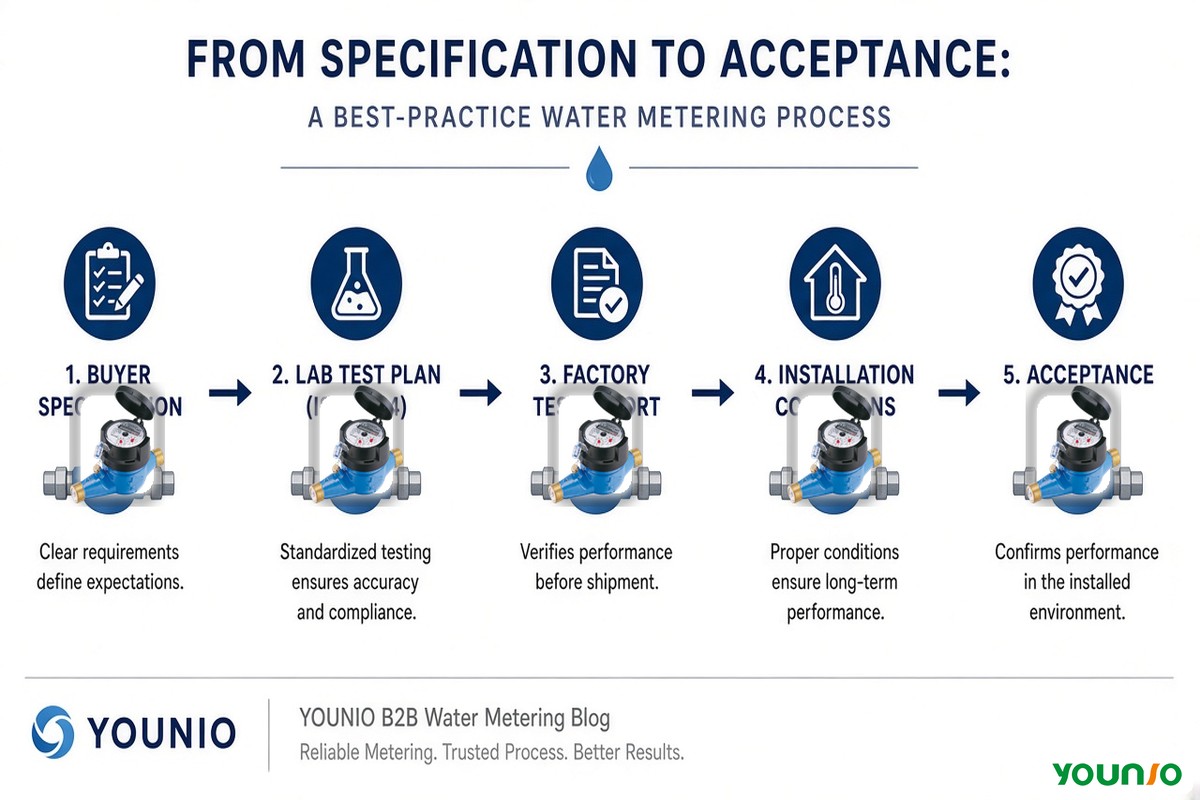
My Alignment Method Before Shipment
I start with a one-page technical boundary. It lists the meter type, DN-maat, Q3, R-waarde, Q1, accuracy class if applicable, temperatuur klasse, drukklasse, installatie positie, communicatie methode, and target standard. If the buyer compares R values, I calculate Q1 from Q3 and R.
Bijvoorbeeld, for a DN15 residential meter with Q3 = 2.5 m³/h and R = 160:
| Parameter | Voorbeeld Waarde |
|---|---|
| Metermaat | DN15 |
| Q3 | 2.5 m³/u |
| R-waarde | 160 |
| Formule | Q1 = Q3 ÷ R |
| Q1 | 2.5 ÷ 160 = 0.015625 m³/h = 15.625 L/u |
This is only a calculation example. The actual tender must use the selected meter datasheet.
Then I ask the laboratory what test flow points and conditions it will use. ISO 4064-2 lists flow ranges such as Q1 to 1.1Q1, Q2 to 1.1Q2, and 0.9Q3 to Q3 unless alternative flow rates are specified in the type approval certificate. I want the buyer, leverancier, and lab to agree on this before the sample is sent.
I also ask about temperature. ISO 4064-2 includes a water temperature test to measure the effects of water temperature on indication errors. If the target country has hot climate conditions, hot water applications, or a local temperature class requirement, the meter selection must match it.
| Alignment Item | Question I Ask |
|---|---|
| Standaard | ISO 4064, OIML R49, MIDDEN, or national rule? |
| Editie | Which version is accepted? |
| Meter model | Exact model or broad family? |
| Stroombereik | What Q3, R, and Q1 are required? |
| Test points | Which flow points will the lab use? |
| Temperatuur | Which temperature class applies? |
| Installatie | Any straight pipe or flow conditioning requirement? |
| Rapport | What format will the authority accept? |
Voor slimme meters, I add one more layer. I check whether the complete meter must be tested or whether separate units such as the measurement transducer and calculator need evidence. This is important when communication modules, displays, or calculators are customized for the importer.
Alignment does not remove all risk. But it makes the risk visible before money is spent on production, vracht, and installation.
What Contract Clauses Protect Importers and Utilities?
A weak contract says “standard water meter.” A strong contract says exactly which standard, test, document, and responsibility apply.
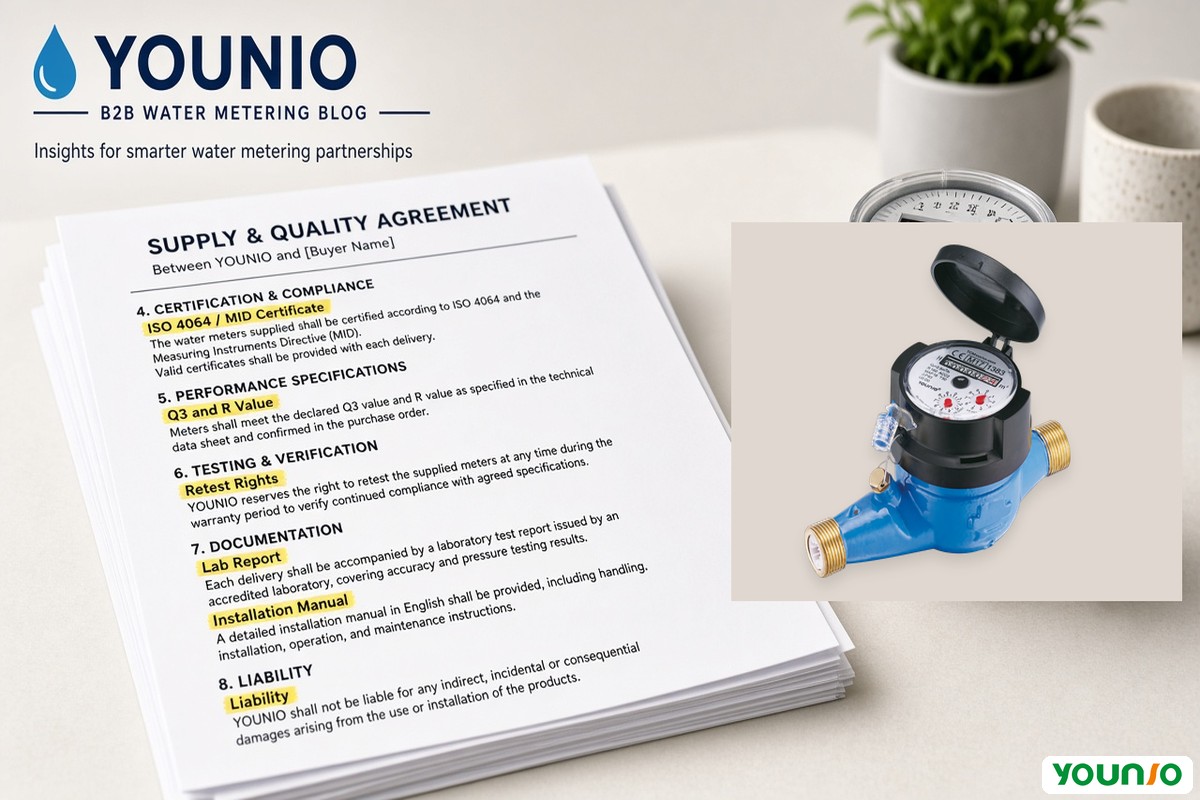
Protective contract clauses should define product parameters, toepasselijke normen, testmethoden, accepted reports, certificaatomvang, installatievereisten, retesting rules, documentation delivery, traceerbaarheid van batches, smart meter conditions, and complaint investigation responsibilities.
I Write the Dispute Rules Before the Dispute Exists
I do not like vague import contracts. Vague wording saves time at the beginning and creates cost at the end.
The contract should state the exact meter size range, Q3, R-waarde, Q1, drukklasse, temperatuur klasse, installatie richting, beschermingsniveau, materiaal, communicatie methode, and required approvals. If the buyer needs ISO 4064 evidence, the contract should state which parts or test basis apply. ISO 4064-2 normatively references ISO 4064-1 voor metrologische en technische eisen en ISO 4064-3 voor het testrapportformaat. This means the report structure should not be treated casually.
The contract should also define the acceptance laboratory. If the importer will retest in the destination country, the clause should state whether the local lab uses ISO 4064 flow points and conditions. ISO 4064-2 requires outlet pressure not less than 0.03 MPa during specified tests and requires other influence factors to remain within the rated operating conditions of the meter. If a dispute happens, both sides need to know whether the retest followed the agreed method.
For installation-sensitive meters, I require an installation clause. ISO 4064-2 says manufacturer-recommended installation requirements shall be followed when certain meter types require flow conditioning, en deze eisen moeten worden vermeld in het typegoedkeuringscertificaat. If the utility installs outside these conditions, the complaint analysis must include field conditions.
| Clause | Waarom het ertoe doet |
|---|---|
| Standard clause | avoids unclear compliance claims |
| Certificate clause | confirms model and size coverage |
| Test method clause | controls retest disputes |
| Report clause | defines accepted evidence |
| Installation clause | separates product and site issues |
| Smart meter clause | defines battery, uploaden, and platform conditions |
| Traceability clause | links serial numbers to batch records |
| Complaint clause | requires joint root-cause analysis |
Voor elektronische meters, I add power and data clauses. ISO 4064-1 states that for external power supply failure, the meter indication just before failure must not be lost and must remain accessible for at least one year. If a project uses battery-powered smart meters, I also define reporting cycle, aannames over de batterij, storage behavior, and communication responsibility.
A contract cannot prevent every problem. But it prevents unclear blame. That is the main value.
What Is a Pre-Import Checklist for New Markets?
A new market can hide old problems. The importer should test documents, normen, and acceptance rules before the container moves.
A pre-import checklist should cover market rules, standard edition, certificaatomvang, model marking, Q3, R, Q1, laboratory method, rapportformaat, installatievereisten, communicatie instelling, customs documents, en klachtenverantwoordelijkheid.
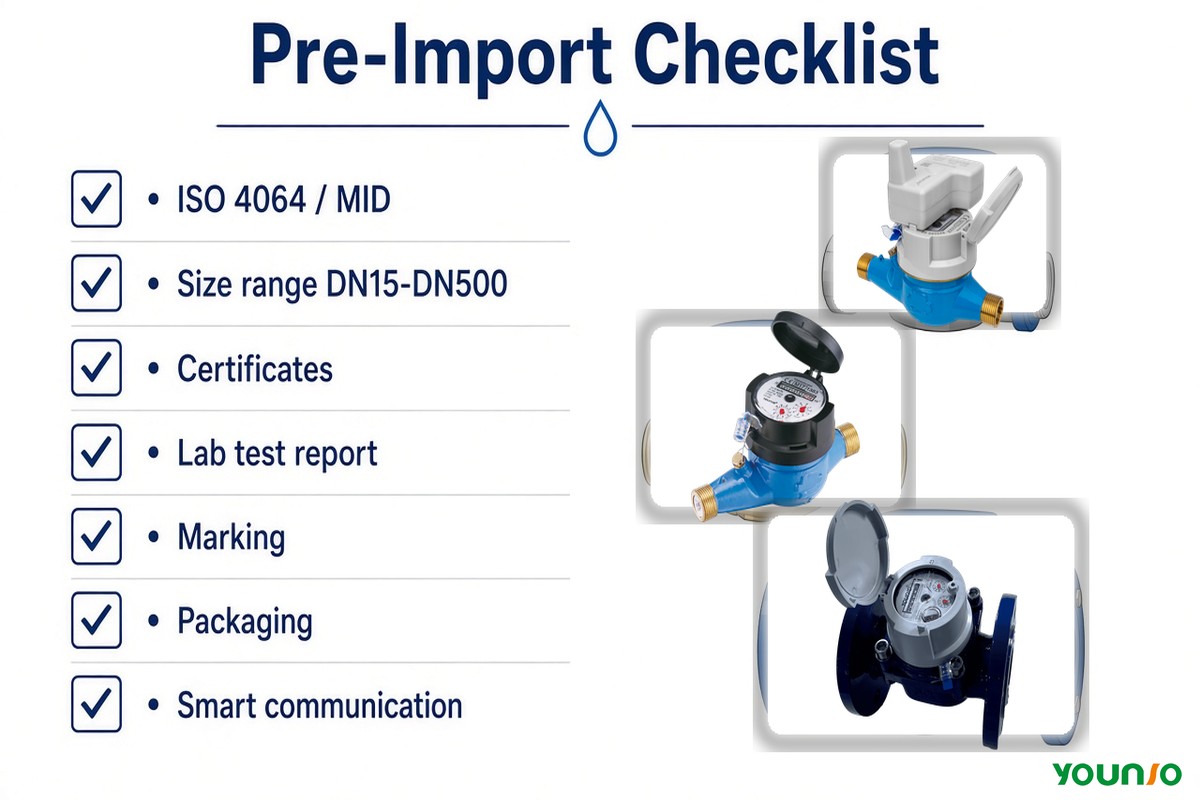
My Practical Checklist Before Opening a New Country
I use a checklist because memory is not enough in cross-border projects.
Eerst, I check the target market rule. Does the country accept ISO 4064 reports? Does it require OIML, MIDDEN, national approval, local laboratory testing, or importer registration? Does the certificate need to be under the manufacturer name, importer name, or local applicant name?
Seconde, I check the meter boundary. I list DN size, Q3, R, Q1, starting flow rate if relevant, temperatuur klasse, drukklasse, installatie positie, drukverlies, materiaal, beschermingsniveau, and application. I do not compare meters without a fixed boundary.
Derde, I check the lab method. ISO 4064-2 requires defined test procedures, controlled outlet pressure, nominale bedrijfsomstandigheden, and specified flow ranges unless the type approval certificate states alternatives. It also includes temperature testing to evaluate the effect of water temperature on indication errors.
Vierde, Ik controleer de installatie. ISO 4064-2 warns about erroneous measurements and the need for test installation conditions where hydrodynamic flow characteristics do not create a discernible difference from undisturbed flow. It also requires air bleeding and precautions against vibration and shock during test preparation. In field projects, these points translate into correct installation direction, full-pipe werking, stable hydraulics, access for maintenance, and suitable site conditions.
| Controlelijst gebied | Wat ik verifieer |
|---|---|
| Market approval | ISO 4064, Oiml, MIDDEN, local type approval |
| Product scope | exact model, DN, Q3, R, Q1 |
| Certificaat | holder, geldigheid, maatbereik, configuratie |
| Testmethode | stroom punten, druk, temperatuur, installatie |
| Rapport | lab name, standaard, resultaat, meter identification |
| Markering | serienummer, flow arrow, unit, approval marks |
| Handmatig | taal, installatie, operatie, onderhoud |
| Slim systeem | SIM-kaart, poort, platform, cyclus uploaden, batterij |
| Customs | HS code, invoice, packing list, declaration |
| Contract | opnieuw testen, garantie, complaint responsibility |
For smart water meters, I also check how data leaves the meter. NB-IoT may need operator coverage and SIM management. LoRa of LoRaWAN hebben mogelijk gateways nodig, stroom, tegenslag, en signaaltesten. M-Bus or RS485 may need cable design and concentrator setup. De meter ondersteunt gegevensverzameling op afstand, but it does not replace network planning, platformintegratie, of veldreactie.
If the checklist is incomplete, I prefer to delay shipment. A delayed shipment before production is a schedule issue. A rejected shipment after arrival is a financial and legal issue.
Conclusie
Before importing water meters, align the standard, testmethode, rapportformaat, certificaatomvang, installatie regels, and contract responsibility. Most mistakes are preventable.
Gerelateerde YOUNIO-producten: Multi jetwatermeter · Smart Multi Jet Water Meter
What usually causes costly mistakes when importing water meters?
Most mistakes are not caused by the meter itself. They come from unmatched standards, different laboratory test methods, incomplete certificates, unclear installation requirements, and contracts that do not define which report controls acceptance.
Why can the same water meter pass in one country and fail in another?
Countries may use different acceptance rules, ISO editions, lab procedures, temperature classes, stroom punten, installatievoorwaarden, or certificate formats. If buyer, seller, and laboratory do not share the same test map before ordering, results may not be comparable.
Which documents should importers treat as part of the product delivery?
Ask for the datasheet, certificaat, testrapport, installatiehandleiding, packing list, serial number list, label drawing, declaration documents, and a communication manual if the meter is smart. Inconsistent model names across invoice, report, karton, and certificate often create customs or tender disputes.
How can importers align specifications, laboratoria, and reports before shipment?
Define the applicable standard and edition, exact meter model, DN-bereik, Q3, R, Q1, stroompunten testen, temperatuur klasse, installation setup, and report format on one technical boundary page before samples ship. Voor slimme meters, also confirm whether the complete meter or separate transducer and calculator units need evidence.
What should a protective import contract include?
Protective clauses should define product parameters, toepasselijke normen, testmethoden, accepted reports, certificaatomvang, installatievereisten, retesting rules, documentation delivery, traceerbaarheid van batches, smart meter conditions, and complaint investigation responsibilities. Vague wording such as “standard water meter” often creates cost at acceptance time.
Need help screening a water meter import project?
Send your market, DN-bereik, certificeringsvereiste, and target shipment date. YOUNIO will reply with a document checklist.