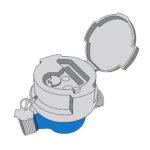

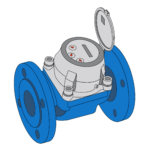

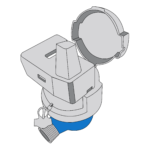

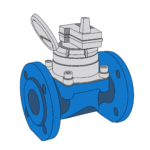

許多OEM項目都是從價格開始的. 然後投訴暴露職責不明確. 我更喜歡定義標準, 文件, 品牌推廣, 和生產前的責任.
An OEM ODM water meter brand succeeds when the partner and manufacturer agree on product scope, standard requirements, certificate ownership, customization limits, test evidence, 包裝, and complaint responsibility before the order starts.
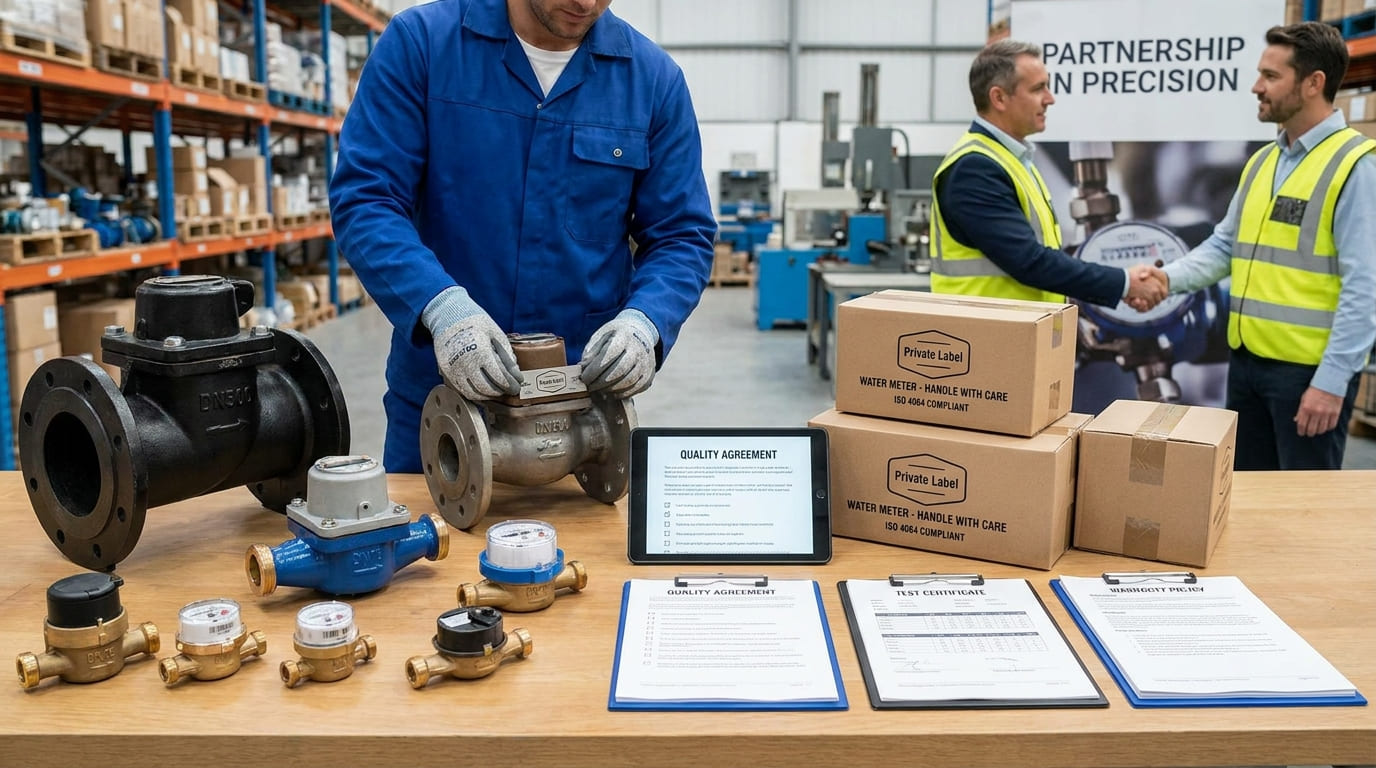
I have seen strong private-label water meter projects grow for years. I have also seen projects fail because both sides talked about unit price but avoided responsibility. The difference is usually not luck. It is project discipline.
What Do OEM and ODM Mean in the Water Meter Industry?
OEM and ODM sound simple. But unclear meanings create wrong expectations, wrong documents, and later disputes between buyer, brand owner, and factory.
In water meters, OEM usually means producing under the customer’s brand and defined specification. ODM usually means the manufacturer provides more product design support, structure options, module selection, and technical documentation.
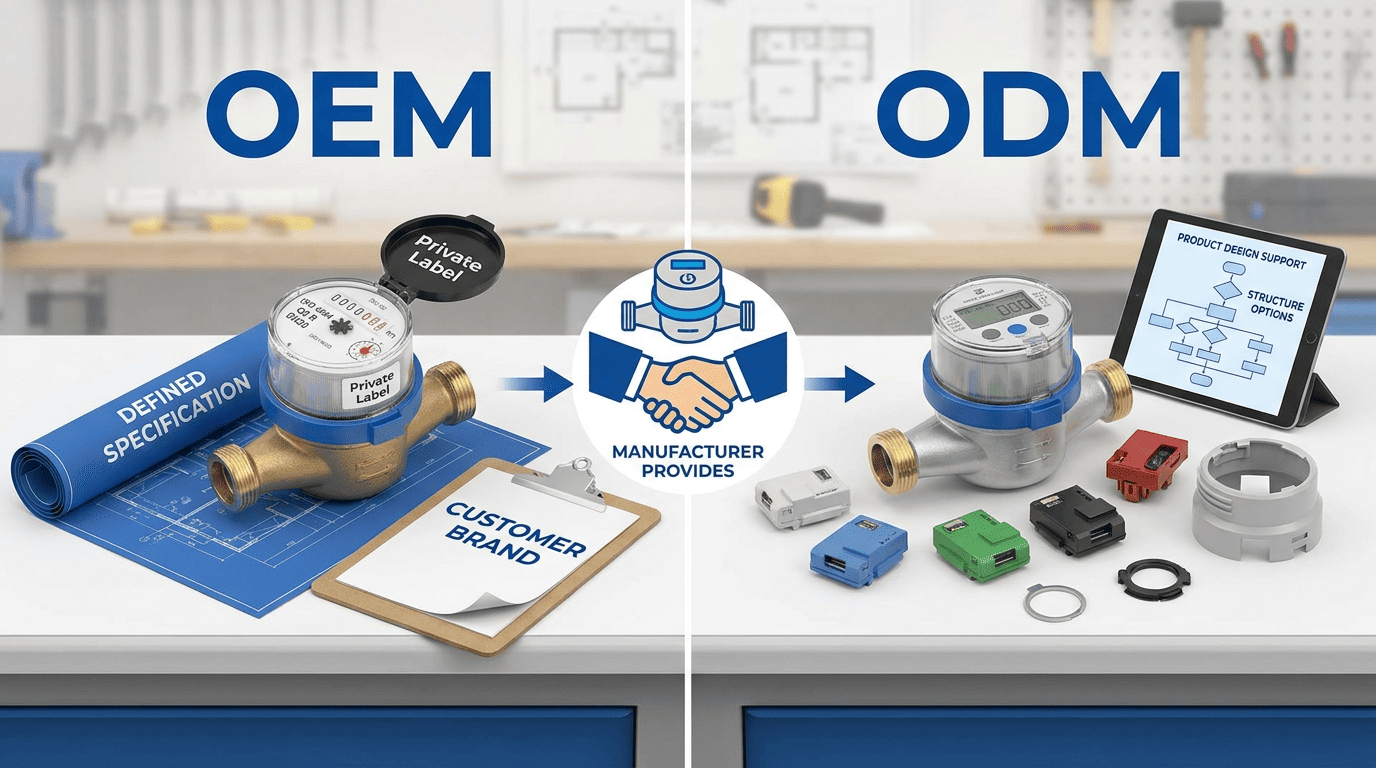
The Real Difference Is Responsibility Scope
I do not define OEM and ODM only by logo printing. In water meter projects, the real difference is who controls the specification, who owns the design decision, and who accepts the field risk.
For OEM, the partner often has an existing brand, sales channel, utility relationship, or tender requirement. The manufacturer produces the meter according to an agreed technical specification. This may include the meter size, 第三季, R值, 安裝位置, dial design, body material, 通訊方式, packing method, and required certificates.
For ODM, the partner may need deeper technical support. The manufacturer may recommend the measuring principle, mechanical structure, ultrasonic platform, NB-IoT module, LoRaWAN module, valve option, enclosure design, or software communication interface. ODM can help a new water meter brand enter the market faster, but it also requires clearer written approval for design choices.
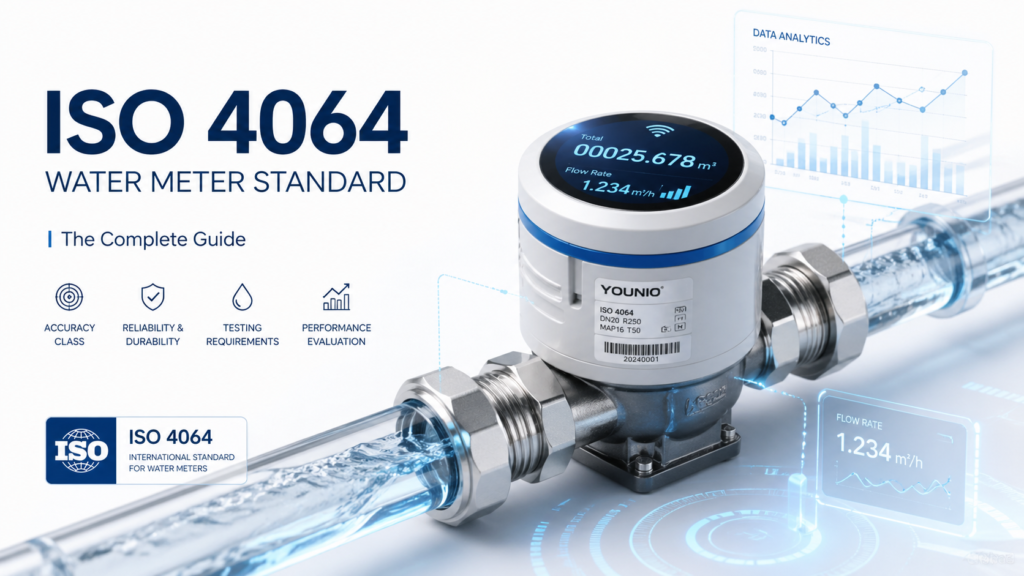
ISO 4064 defines a water meter as an instrument intended to measure continuously, memorize, and display the volume of water passing through the measurement transducer at metering conditions. It also states that a water meter includes at least a measurement transducer, a calculator, and an indicating device, and these devices can be in different housings. This matters in OEM and ODM work because a “water meter” is not only a body with a logo. It is a metrological system.
| Cooperation Type | Typical Customer Role | Manufacturer Role | Main Risk |
|---|---|---|---|
| OEM | Defines brand and specification | Produces and tests agreed product | unclear certificate and liability scope |
| 原始設計製造商 | Defines market target and brand | Supports design and configuration | unclear design approval responsibility |
| Private label | Defines logo and packaging | Supplies existing approved model | wrong assumption about certification |
| Joint project | Shares tender and field data | Supports technical package | slow decision and document gaps |
I always tell partners that an OEM ODM water meter brand is built on repeatable specifications, not only on a good-looking dial. The brand promise must match the product marking, test evidence, installation manual, and after-sales process.
Who Typically Needs OEM/ODM Cooperation?
Not every buyer needs OEM or ODM. Some need standard supply. Others need brand control, local documents, and long-term project identity.
OEM/ODM cooperation is useful for distributors, 公用事業, metering service companies, construction suppliers, smart city integrators, and local brands that need private-label meters, technical documents, and stable production support.
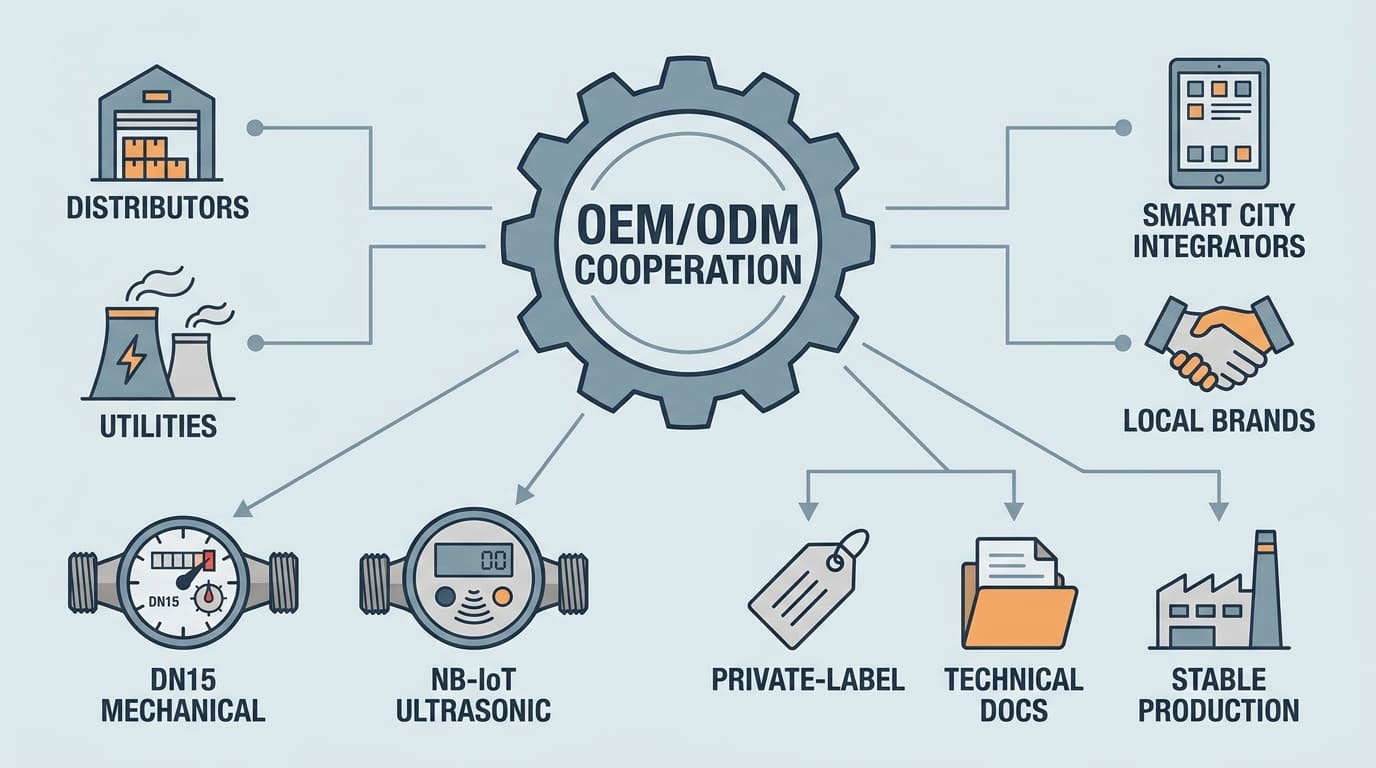
I Look at the Customer’s Business Model First
I usually ask one question before discussing customization: “What role do you play in the project?” The answer decides the cooperation model.
A trading company may need logo printing, packaging localization, datasheets, and stable delivery. A local water meter brand may need a complete product family under its own identity. A utility contractor may need documents for tender submission. A smart city integrator may need NB-IoT, 洛萬, M-總線, or pulse output meters that can connect with a platform. A developer may need packaged metering sets for apartments, commercial buildings, 學校, hospitals, or industrial parks.
The wrong cooperation model creates problems. If a partner only needs a private-label existing model, ODM development may waste time and cost. If a partner needs a special communication protocol, but buys a standard OEM meter, the platform integration may fail. If a partner needs local legal approval, but only asks for a factory test report, the project may be blocked.
ISO 4064 includes requirements for complete water meters and for separate units such as the measurement transducer, flow or volume sensor, 計算機, and indicating device when required. This is important for smart meter OEM/ODM work because the communication and calculator part may affect approval, 測試, and responsibility.
| Customer Type | Common Need | What I Clarify |
|---|---|---|
| Distributor | private label and packaging | brand files, 量, 文件 |
| Local meter brand | long-term product family | exclusivity, design ownership, certificate scope |
| Utility contractor | tender documents | 標準, 測試報告, installation manual |
| Smart city integrator | data and communication | 協定, 平台, gateway, upload cycle |
| Developer supplier | project delivery package | meter size, 安裝, 後勤, labels |
| Service company | replacement and maintenance | 備用零件, 批次追溯, warranty rules |
YOUNIO supports OEM and ODM partners across mechanical water meters, 智能水錶, AMR/AMI solutions, and private-label cooperation. But I still prefer to match the service depth with the partner’s actual project role. Too much customization can create unnecessary approval risk. Too little customization can weaken the partner’s brand position.
What Is a Typical OEM/ODM Project Timeline?
OEM/ODM delays rarely come from production alone. They come from late decisions on standards, 樣品, 證書, 包裝, and approvals.
A typical OEM/ODM water meter project moves through requirement review, model selection, document confirmation, sample production, 測試, branding approval, pilot order, mass production, 檢查, shipment, and after-sales tracking.
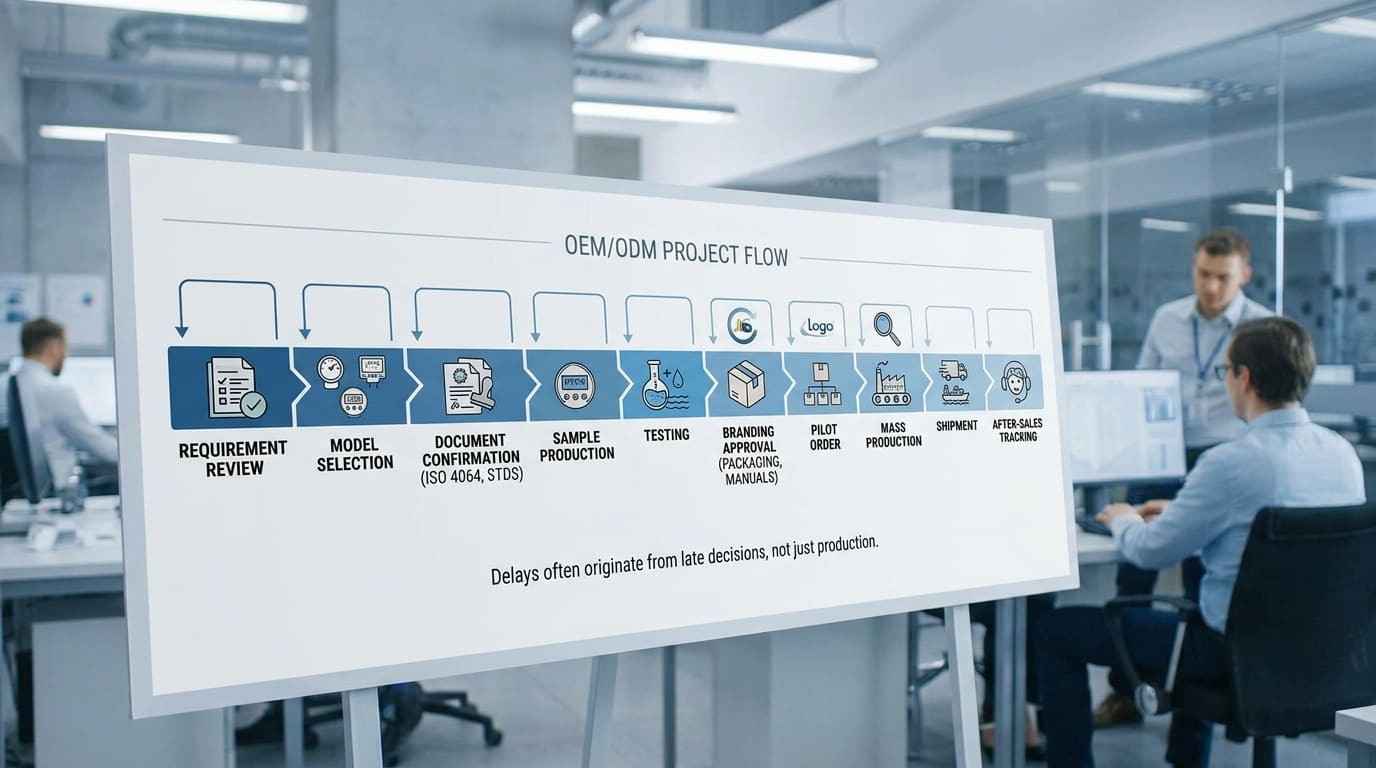
I Prefer a Stage-Gate Process
I do not like starting mass production after only a price confirmation. A water meter project needs stage gates. Each gate should close one risk.
The first gate is requirement review. I ask for market, application, meter size range, 第三季, R值, 安裝位置, 溫度等級, pressure requirement, 通訊方式, and certification target. If the meter has electronic devices, I also ask about battery type, reporting cycle, 平台, signal environment, and alarm requirements.
The second gate is model selection. For a DN15 residential meter, the technical logic is very different from a DN100 Woltman meter or a DN200 district meter. I do not compare meter models without defining application and flow range.
The third gate is documentation. ISO 4064-2 references ISO 4064-1 for metrological and technical requirements and ISO 4064-3 for the test report format. This reminds me that a serious OEM/ODM project should prepare more than a catalogue page. It should prepare datasheets, 圖紙, 測試報告, 手冊, packaging artwork, label files, and certificate files.
The fourth gate is sample approval. I check the dial, logo, 登記, 序號, arrow direction, unit marking, 包裝, and manual. ISO 4064 requires the indicated volume of water to be expressed in cubic metres, and the symbol m³ shall appear on the dial or immediately adjacent to the numbered display. This detail is small, but it can stop a shipment if the local inspector rejects the marking.
| Project Stage | Main Output | Risk If Skipped |
|---|---|---|
| Requirement review | technical boundary | wrong model selection |
| Model selection | approved product platform | unsuitable meter for application |
| Document confirmation | datasheet and certificates | tender rejection |
| Sample production | physical approval sample | logo or marking error |
| 測試 | internal or third-party evidence | hidden performance issue |
| Packaging approval | carton, label, 手動的 | customs or brand complaint |
| Pilot order | field feedback | mass rollout risk |
| Mass production | batch supply | inconsistency |
| After-sales tracking | complaint records | repeated failure |
I prefer a pilot order before full rollout. It gives the partner time to test installation, reading, customer reaction, and document acceptance. The pilot also gives both sides a realistic view of complaint handling.
What Branding, Packaging and Product Customization Options Matter?
Customization attracts partners. But uncontrolled customization can damage compliance, production stability, and after-sales traceability.
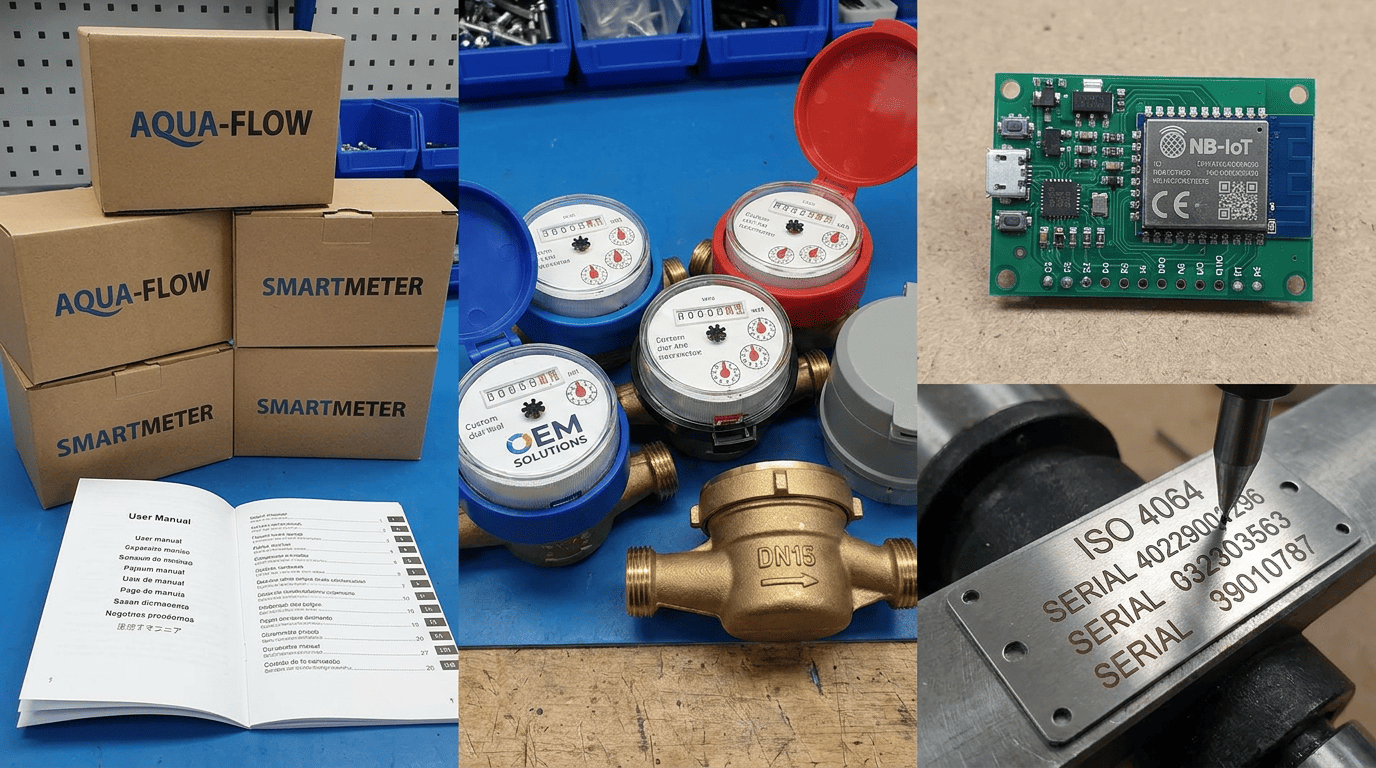
Useful customization includes logo, dial, nameplate, housing color, 包裝, manual language, 通訊模組, 脈衝輸出, valve option, and documentation. Each change should be checked against standards, 證書, and production feasibility.
Brand Identity Must Not Break the Meter Identity
I like strong branding. A clear OEM ODM water meter brand helps local partners build trust with utilities and installers. But I never allow branding to hide the required technical identity of the meter.
A water meter must remain readable and traceable. ISO 4064 shows marking examples that include Q3, R值, 安裝方向, 流動方向, 序號, year of manufacture, and manufacturer identification. These markings are not decorative. They help the buyer, installer, and investigator confirm what meter was supplied and how it should be used.
The indicating device must provide an easily read, 可靠的, and unambiguous visual indication of the indicated volume. This matters when a partner wants a dark dial, special color, small logo, or unusual register window. If branding makes the display hard to read, the project creates future complaints.
Packaging customization also needs control. I ask partners to approve inner box, outer carton, 條碼, serial number label, installation notice, warranty card, pallet label, and manual language. If a shipment includes thousands of meters, a small label error can become a large warehouse problem.
Product customization is more sensitive. Changing the body material, 暫存器類型, 通訊模組, 電池, 閥門, 感應器, or firmware can affect testing and approval. ISO 4064 recognizes that meter constituents such as the measurement transducer, 計算機, and indicating device are part of the meter system. If these parts change, the approval boundary may also change.
| Customization Area | Usually Low Risk | Needs Technical Review |
|---|---|---|
| 標識 | dial logo, carton logo | logo blocking display |
| Packaging | label and carton design | wrong serial or certificate claim |
| 手動的 | language localization | missing installation warning |
| 身體 | color or coating | material or pressure change |
| 登記 | design and readability | unit marking and calibration access |
| 溝通 | protocol label | 模組, 電池, upload behavior |
| 韌體 | display and alarm rules | metrology or data integrity impact |
I ask partners to freeze artwork and configuration before samples. Late changes after testing are dangerous. They create confusion about which version was approved, which version was tested, and which version was shipped.
Who Owns Standards, Certificates and Liability?
This is where many OEM/ODM projects become uncomfortable. Price is easy to discuss. Liability is harder.
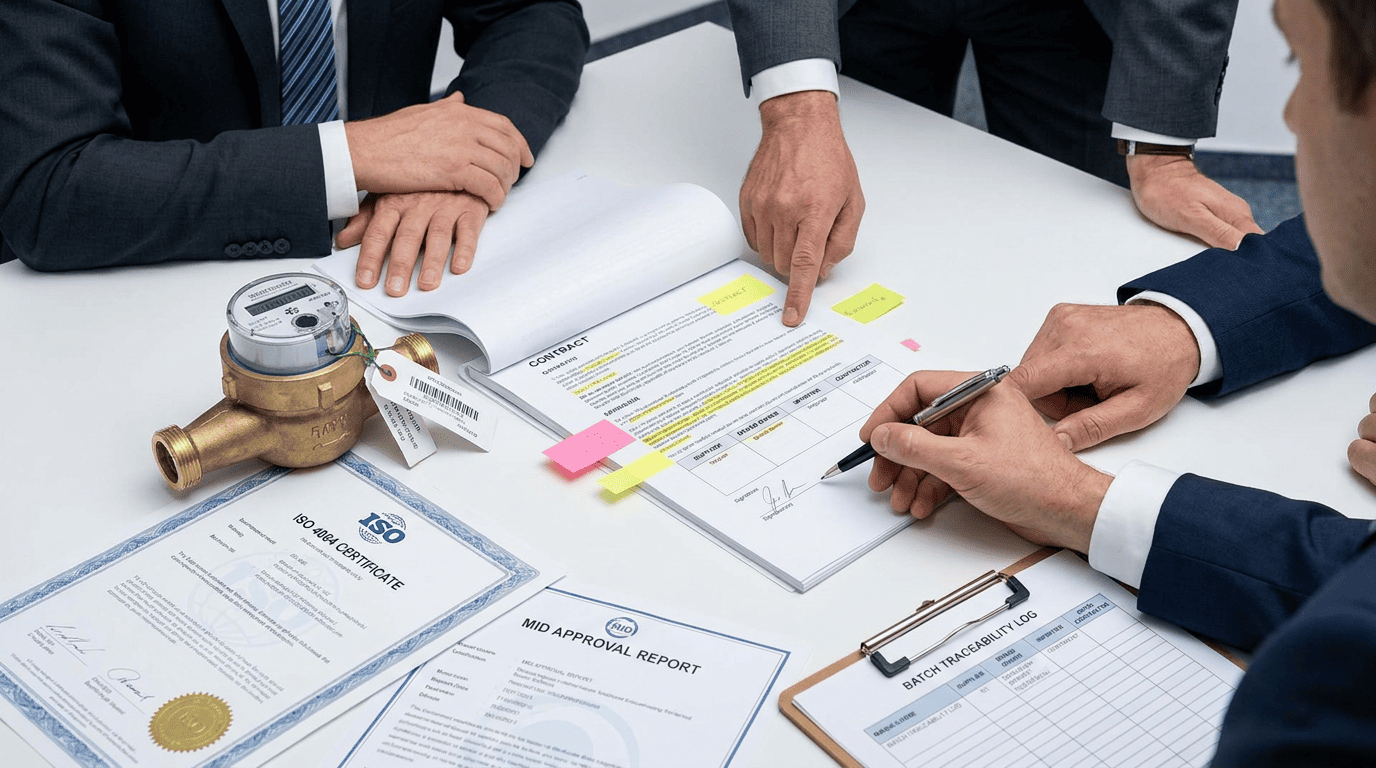
標準, 證書, and liability should be assigned in writing. The supplier, brand owner, importer, and project contractor may each hold different responsibilities for compliance, 索賠, 安裝, warranty, and field complaints.
I Define Responsibility Before the First Order
I have learned that certificate ownership must be clear. A partner may sell under its own brand, but the test report may belong to the manufacturer. A certificate may cover one model, but the partner may market another configuration. A national approval may require local applicant responsibility. These details should be defined before samples.
ISO 4064-2 states that provisions include testing the complete water meter and testing the measurement transducer and calculator as separate units when required by national regulations. This sentence matters for liability because some projects involve mechanical bodies from one approval scope and electronic modules from another scope. If the project mixes parts without approval review, both sides may face risk.
Electronic meters need special attention. ISO 4064 covers external power supply, non-replaceable battery, and replaceable battery as basic power supply types for water meters with electronic devices. It also states that when external power supply fails, the meter indication of volume just before failure shall not be lost and shall remain accessible for a minimum of one year. If a smart OEM project changes power design, battery behavior, or data storage rules, liability cannot be left vague.
| Responsibility Area | 製造商 | OEM/ODM Partner |
|---|---|---|
| Product design | provides approved design or ODM proposal | approves market fit |
| 標準合規性 | supplies test evidence for agreed scope | verifies local acceptance |
| Brand claims | confirms technical wording | controls marketing and sales claims |
| 證書 | provides valid documents where applicable | checks target market requirement |
| Installation manual | provides technical instructions | translates and trains installers |
| Field complaints | supports root-cause analysis | collects site data and customer evidence |
| Legal liability | depends on contract and market role | depends on importer and brand role |
MID or other national legal metrology approvals add another layer. I do not assume that every product has every certificate. I ask which approval is required for the target country, which model is covered, and who is the legal applicant or importer.
A successful OEM/ODM project does not hide liability. It defines it. That protects the manufacturer, the partner, the utility, and the final user.
What Common Pitfalls Have We Seen in Real Projects?
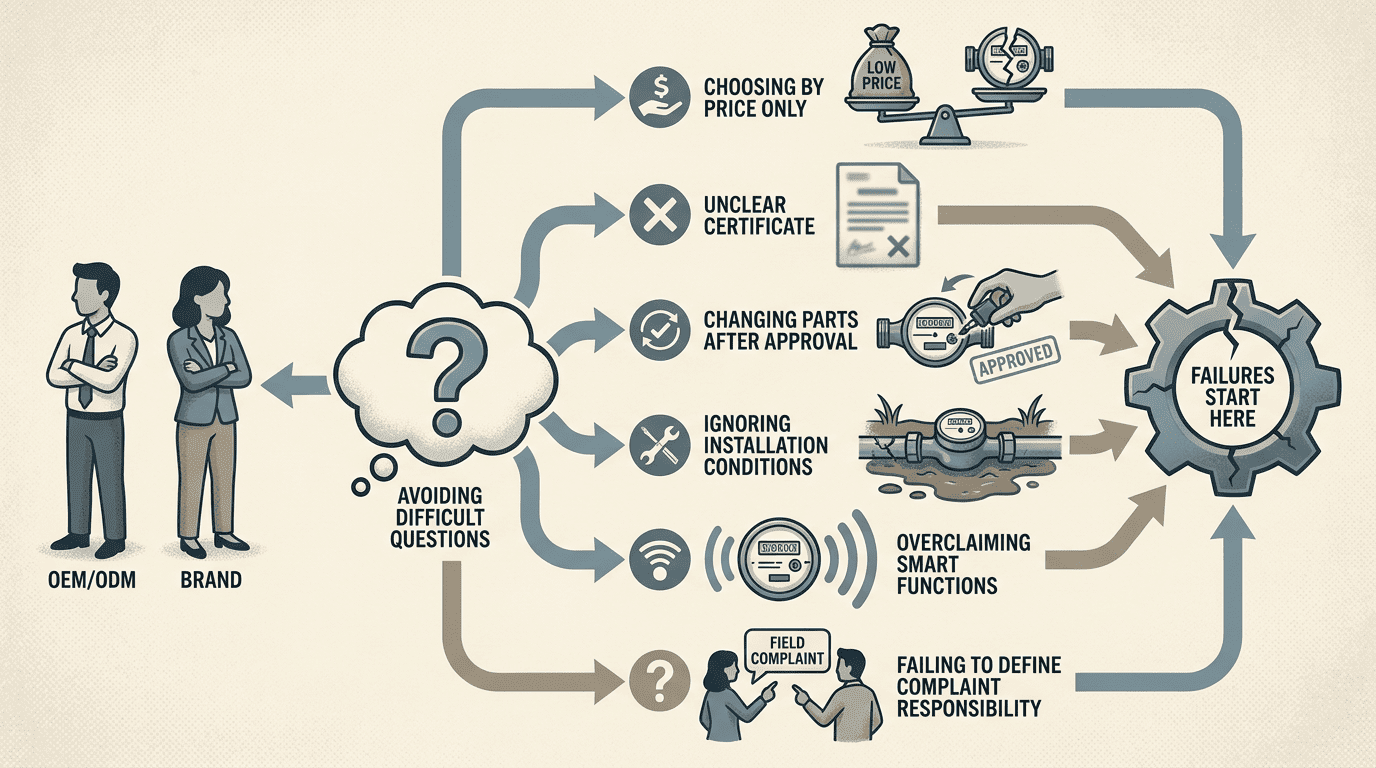
Most failures do not start in the factory. They start when both sides avoid difficult questions at the beginning.
Common OEM/ODM pitfalls include choosing by price only, using unclear certificates, changing parts after approval, ignoring installation conditions, overclaiming smart functions, and failing to define complaint responsibility.
Realistic Stories I See Often
I will describe common patterns, not confidential customer names.
The first story is the low-price tender. The partner asks only for the cheapest DN15 meter with logo. Nobody confirms Q3, R值, 安裝位置, certificate requirement, or local marking rules. The shipment arrives. The utility inspector asks for standard documents and marking consistency. The partner then discovers that the price was low because the specification was incomplete.
The second story is the certificate misunderstanding. The partner receives a certificate for one model and assumes it covers all related models. 之後, a tender requires the exact size range, 第三季, R值, and configuration. The document does not match the supplied meter. The brand loses credibility. This is why I always check model coverage and certificate scope.
The third story is the beautiful dial problem. The partner requests a strong brand design. The logo and color are attractive, but the register becomes harder to read. ISO 4064 requires the indicating device to provide an easily read, 可靠的, and unambiguous visual indication of volume. A private-label design must respect this basic requirement.
The fourth story is the smart meter overpromise. The partner sells “remote reading” but does not prepare SIM cards, gateway placement, platform settings, signal testing, upload cycle, or installer training. The meter may be able to transmit data, but the system is not ready. The complaint becomes “the meter is bad,” even though the project architecture was incomplete.
| 陷阱 | Real Cause | Better Control |
|---|---|---|
| Only discussing price | no technical boundary | confirm specification first |
| Wrong certificate claim | scope not checked | verify model and size range |
| Late design change | no version control | freeze sample before production |
| Poor readability | branding overrules function | protect display and markings |
| Smart data failure | system not prepared | test signal and platform |
| Warranty dispute | liability not assigned | define complaint process |
The fifth story is a battery or power misunderstanding. For meters with electronic devices, power supply type and data retention matter. ISO 4064 identifies external power supply, non-replaceable battery, and replaceable battery as basic power supply types. If the partner changes reporting frequency or communication behavior, battery life and field maintenance assumptions may change.
These pitfalls are avoidable. They are not solved by a lower price. They are solved by written requirements, sample approval, standard alignment, and responsibility allocation.
How Should You Start an OEM/ODM Project the Right Way?
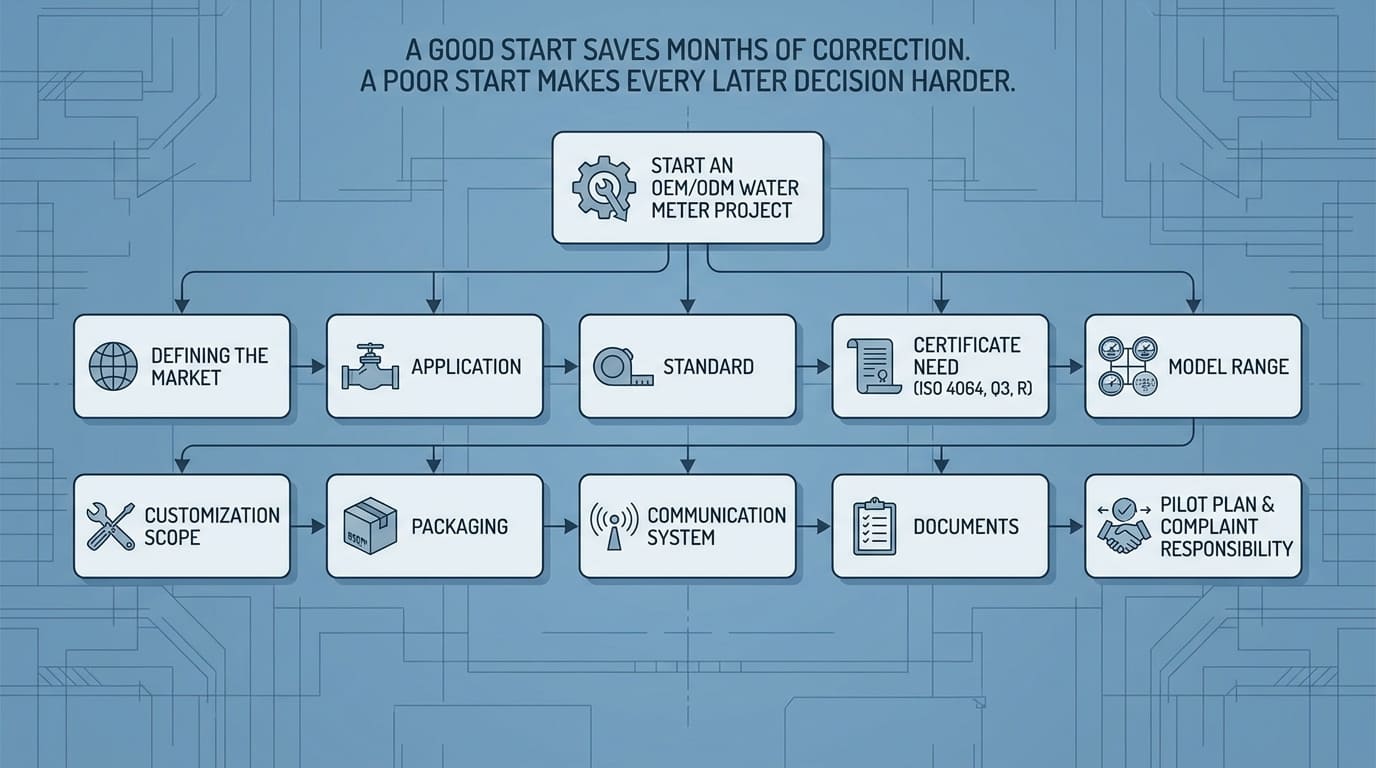
A good start saves months of correction. A poor start makes every later decision harder.
Start an OEM/ODM water meter project by defining the market, application, 標準, certificate need, model range, customization scope, 包裝, communication system, 文件, pilot plan, and complaint responsibility.
My Practical Starting Checklist
I start with the market. The target country decides many things: legal metrology rules, 語言, 包裝, unit display, certification route, and installer habits. A meter for a European utility project may require different approval evidence from a meter for a private building sub-metering project in another region.
Then I define the product range. I ask for DN sizes, Q3 values, R values, 溫度等級, pressure class, 安裝方向, body material, 通訊方式, valve need, battery expectation, and application scene. I do not accept “normal water meter” as a specification.
下一個, I define the standard basis. ISO 4064 is a key reference for cold potable water and hot water meters, including metrological and technical requirements, 測試方法, test report format, non-metrological requirements, and installation requirements. For electronic devices, I also check environmental and electromagnetic conditions because ISO 4064-2 refers to mechanical, climatic, and electromagnetic environmental classifications for water meters with electronic devices.
Then I define the brand package. This includes logo file, dial artwork, nameplate, carton, 手動的, installation notice, 條碼, serial number format, pallet label, and document language. I check that the dial still shows required information clearly, including cubic metre indication where applicable.
最後, I define the complaint process. The partner should collect installation photos, serial numbers, 批次記錄, site pressure, water quality notes, reading history, communication logs, and customer complaint details. The manufacturer should support technical analysis, test records, replacement judgment, and corrective action where required.
| Starting Item | What I Ask For |
|---|---|
| Target market | country, utility type, legal approval need |
| 應用 | 住宅, 商業的, 工業的, 市級, 灌溉 |
| Meter scope | DN, 第三季, r, Q1, 壓力, 溫度 |
| 標準 | ISO 4064, OIML R49, 中, or local rules |
| Branding | logo, dial, carton, 手動的, label |
| Smart system | 溝通, 平台, gateway, upload cycle |
| Documents | datasheet, drawing, test report, certificate, 手動的 |
| Pilot | sample quantity, test site, acceptance criteria |
| Liability | warranty, complaint process, root-cause duties |
YOUNIO can support OEM and ODM partners with mechanical meters, smart meters, AMR/AMI systems, 文件, packaging localization, and project coordination. But I still believe the most important starting point is not the product catalogue. It is agreement on who does what, which standard applies, and who owns each responsibility.
結論
Build the OEM ODM water meter brand around clear standards, approved samples, traceable documents, and defined liability. Do not let price replace responsibility.