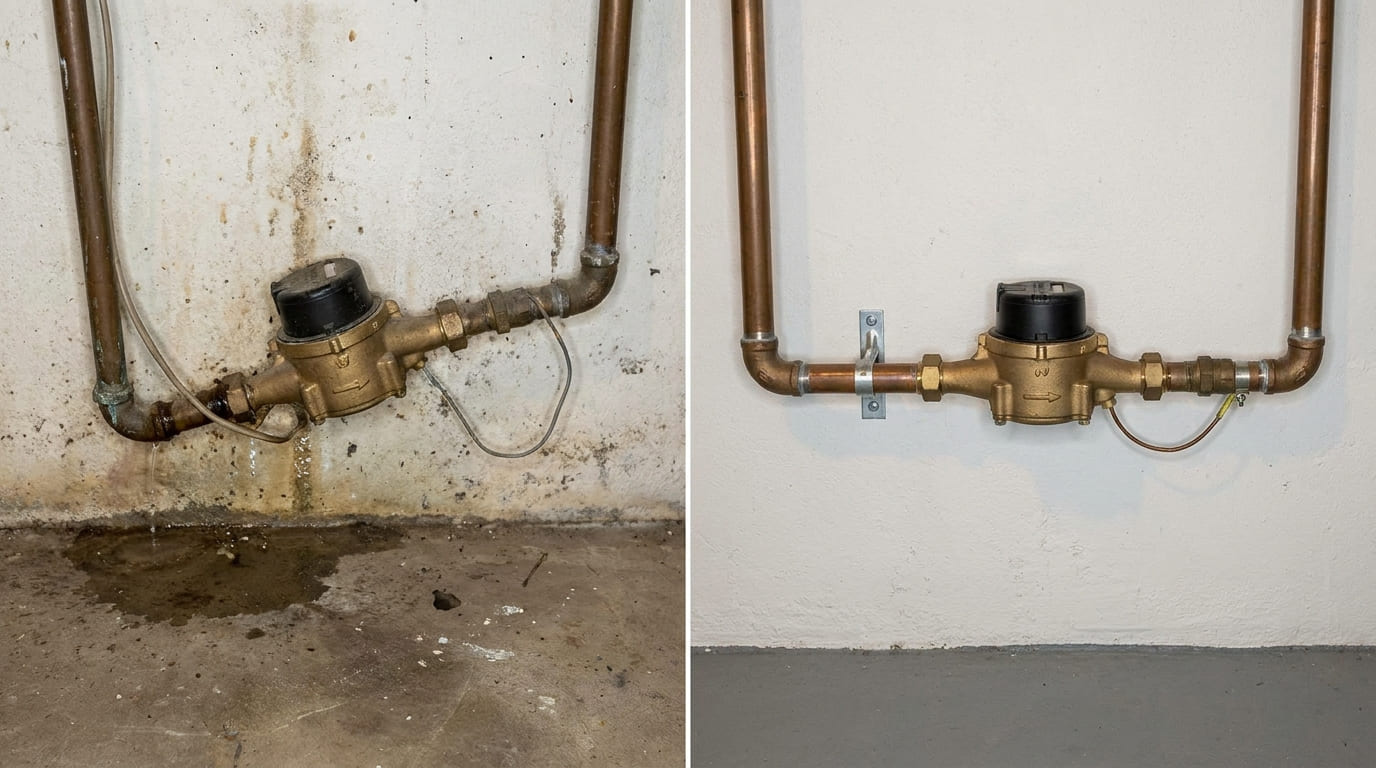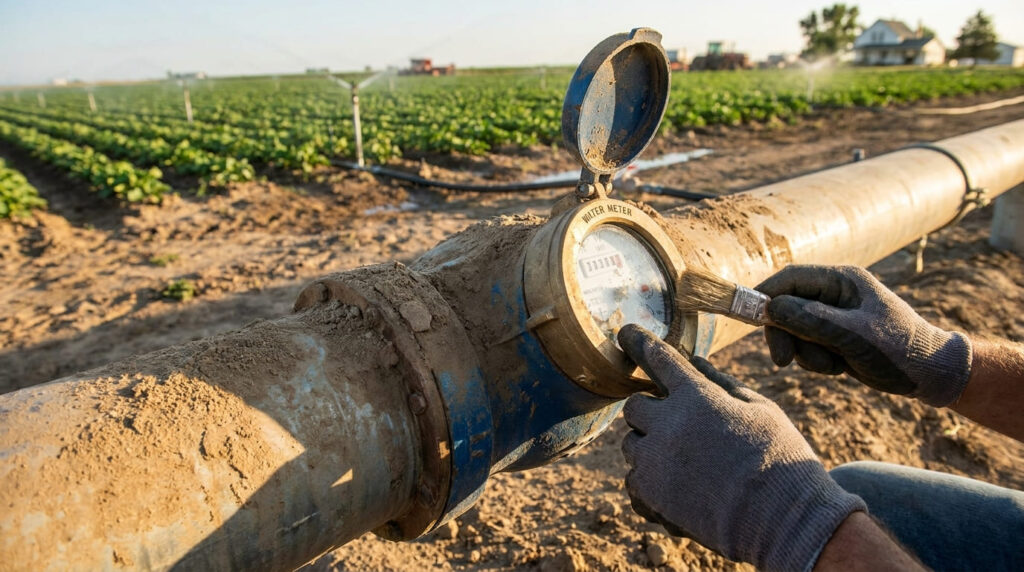
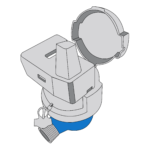
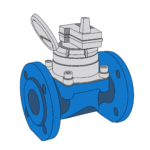

我处理过太多并非电表缺陷的“电表不良”投诉. 真正的问题通常是管道应力, 空气, 热, 或者安装不良.
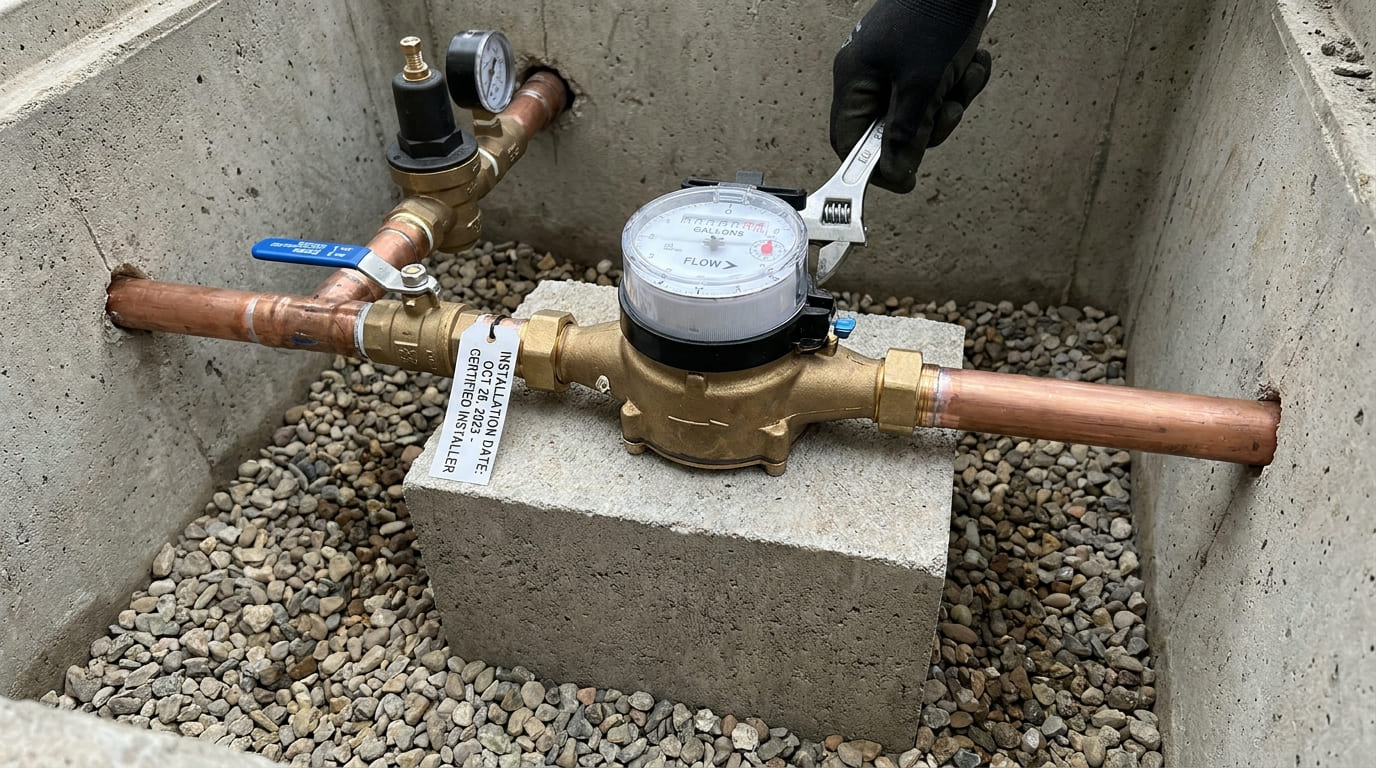
Water meter installation best practices mean installing the meter full of water, in the correct direction and orientation, with enough straight pipe, stable support, clean upstream pipework, controlled pressure, dry pits, and trained installers. These steps reduce 泄漏, jamming, wrong readings, and repeat complaints.

I wrote this guide after reviewing hundreds of field complaints. I learned one hard lesson. A water meter can leave the factory as a qualified product and still fail in the field because the installation condition is wrong. I also learned that customers often call every failure a product quality problem first. I do not blame them. They see water leaking. They see the counter stuck. They see a cracked register. But I have to look deeper. In many projects, the installation condition is the real cause.
Why does installation quality dominate water meter complaint statistics?
I have seen factories, 公用事业, and installers argue over the same complaint. The meter was blamed first, but the pipe condition told the real story.
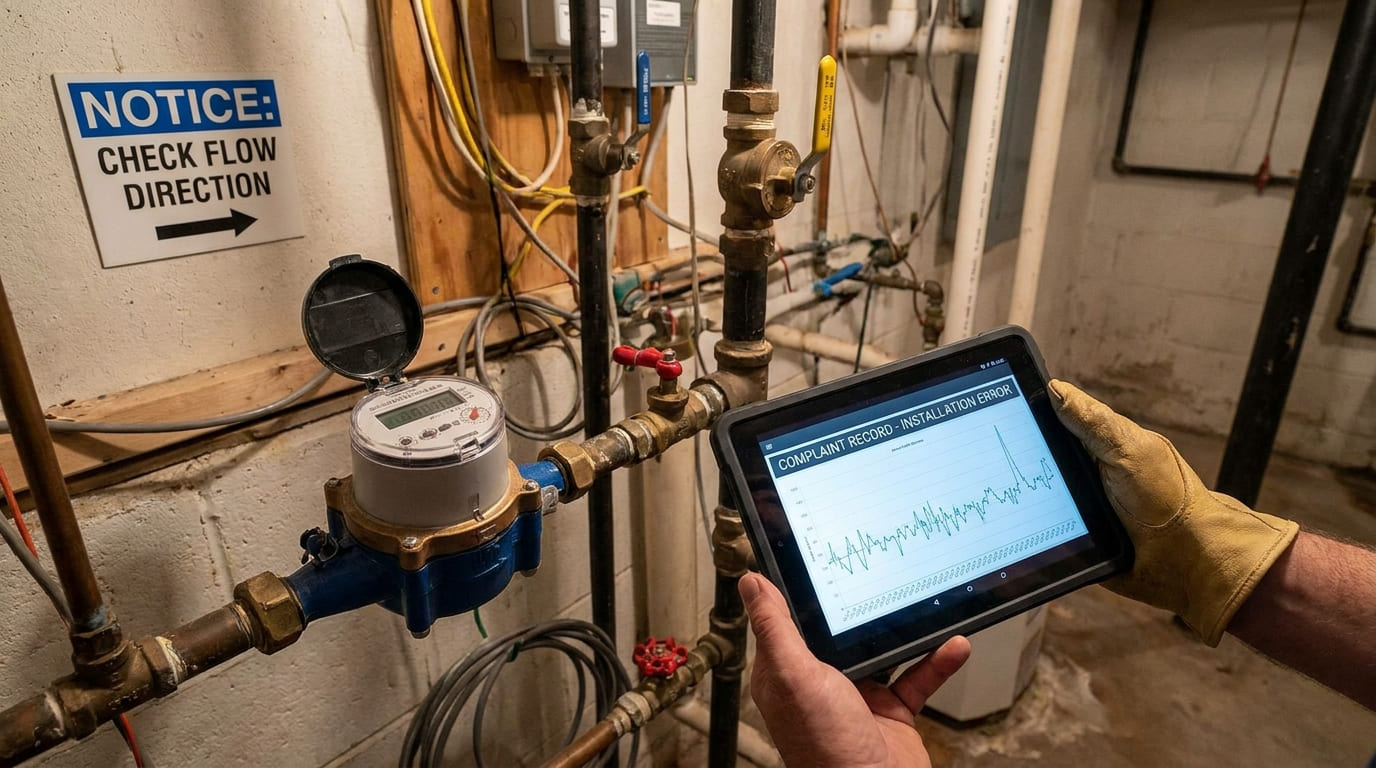
Installation quality dominates complaint statistics because water meters are sensitive to flow direction, 空气, 振动, pipe stress, upstream disturbance, flooding, and thermal movement. In my complaint records, 关于 40% of complaints finally traced back to installation conditions.

I separate product defects from installation defects before I judge the case
I never start a complaint review by asking, “Who is wrong?” I start by asking, “What condition did the meter see after installation?” A water meter must be installed so that it is completely filled with water under normal conditions, and this single requirement already explains many field complaints. If the meter runs with air pockets, empty-pipe start-up, water hammer, or unstable pressure, the meter is not working under the condition that the design expects.
I also check whether the pipe was cleaned before installation. ISO guidance warns that solid particles can collect in a water meter, especially after work on the upstream pipework. I have seen sand, welding slag, plastic tape, rust, and stone chips enter new meters after pipe repair. The customer only saw a stuck counter or abnormal noise. The root cause was dirt in the line.
In my own complaint files, 关于 40% of complaints ended as installation-condition cases. This does not mean all products are perfect. It means the field environment is often stronger than the product design margin. A correct installation can protect a normal meter. A poor installation can damage even a good meter.
| Complaint seen by user | Common field cause I check first | 为什么这很重要 |
|---|---|---|
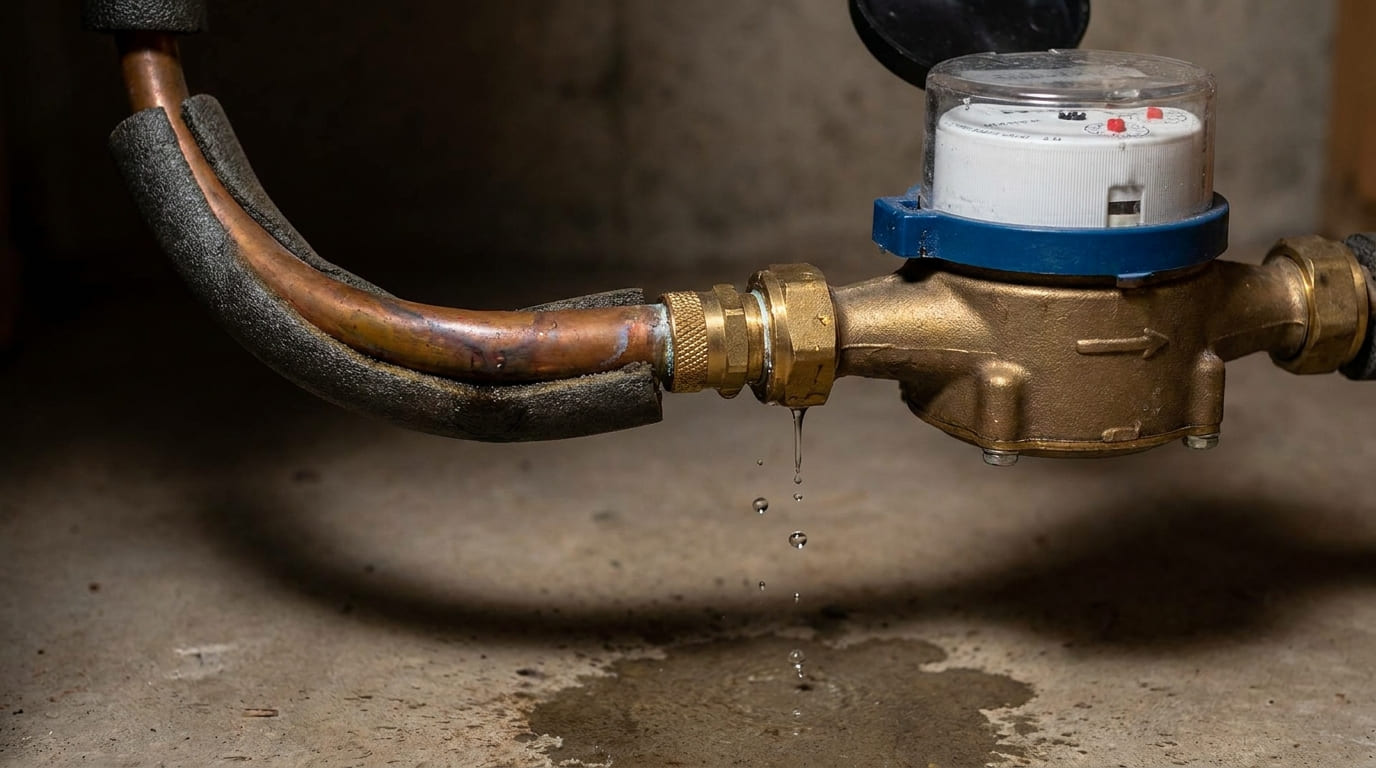
| Leakage after installation | Pipe stress, gasket shift, thermal movement | The meter body becomes a stressed connector |
| Counter stuck | Dirt, air impact, gear-box stress, dry running | The register or measuring unit cannot move freely |
| 读错了 | 流动扰动, 错误的方向, 空气, low flow | The flow pattern does not match the design |
| Cracked counter | External force on upper gear box | The counter is loaded like a pipe support |
| No remote reading | Cable stress, flooded pit, bad module position | The communication part is not protected |
| Repeat failure in one site | Installation method repeated across all meters | The installer repeats the same hidden mistake |
I once reviewed a residential project in Yunnan with 170 vertical water meters. The site reported leakage and jamming. The user believed the meters were poor quality. After checking the field condition, the root cause was thermal expansion and contraction, combined with gas pressure in empty pipe sections during filling. The meters were not the first cause. The installation system created stress and pressure shock.
How should I handle straight pipe, flow direction and orientation?
I have seen meters installed backward, tilted, half full, and squeezed between pipes. These mistakes look simple, but they create expensive complaints.
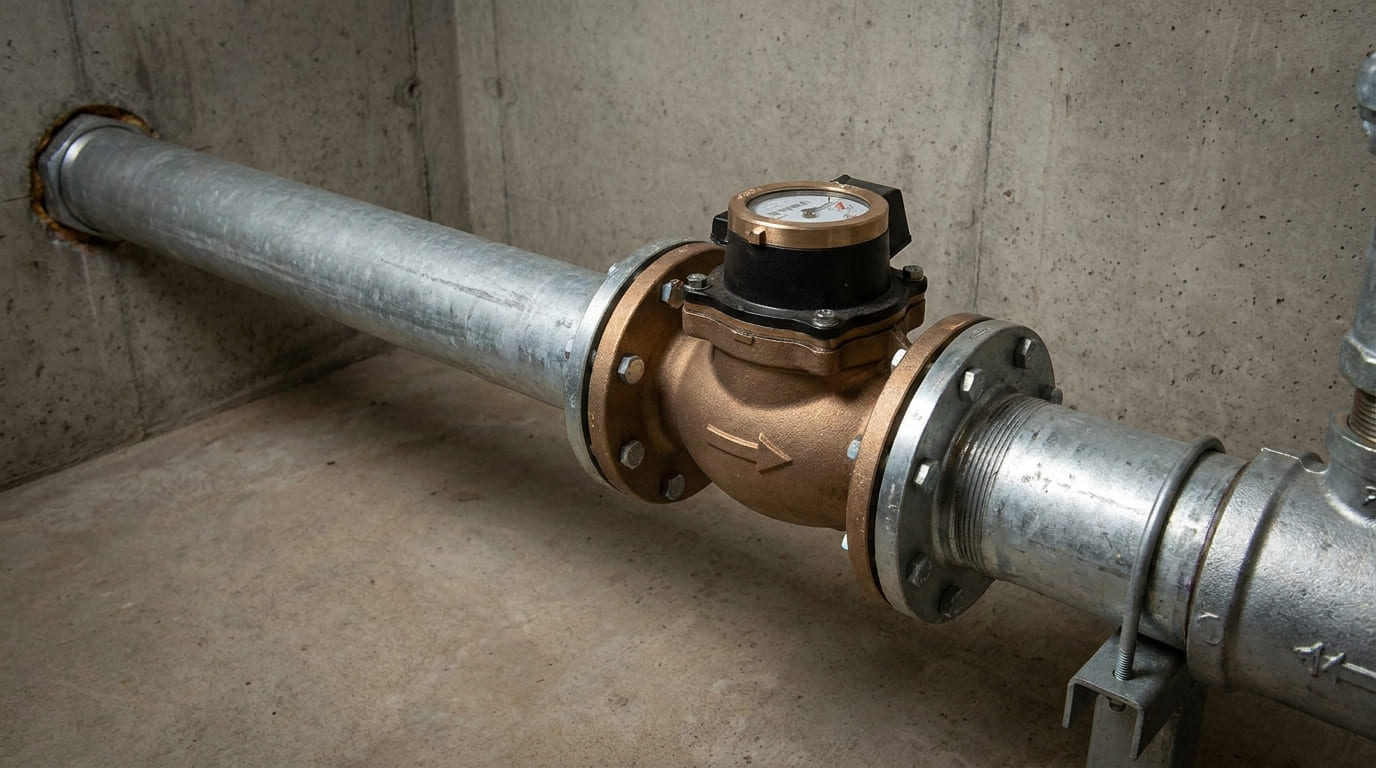
I handle straight pipe, flow direction, and orientation by following the manufacturer’s marked direction, the approved installation position, and the required upstream and downstream straight pipe lengths. Disturbed flow from bends, 阀门, or pumps must be controlled before the meter.

I read the meter markings before I tighten the first nut
I always check the arrow first. The meter must face the flow direction. I also check whether the meter is horizontal, 垂直的, or approved for both. ISO mentions that provision may be made on a water meter to allow it to be correctly levelled during installation, such as a flat surface for a level device. This small detail matters because a tilted meter can trap air, load the mechanism unevenly, or create reading problems.
I also check straight pipe. If upstream or downstream disturbances from bends, 阀门, 或泵影响仪表精度, the meter must have enough straight pipe length, 带或不带整流器, 按照制造商的规定. This is not a decorative requirement. A meter does not only measure water volume. It measures water moving through a designed flow path. If the water enters with swirl, turbulence, or uneven velocity, the measuring element may not respond as expected.
Swirl can be caused by two or more bends in different planes, or by one bend together with an eccentric reducer or a partly closed valve. This effect can be controlled by enough upstream straight pipe, a flow straightening device, 或两者兼而有之, but these pipe configurations should be avoided where possible.
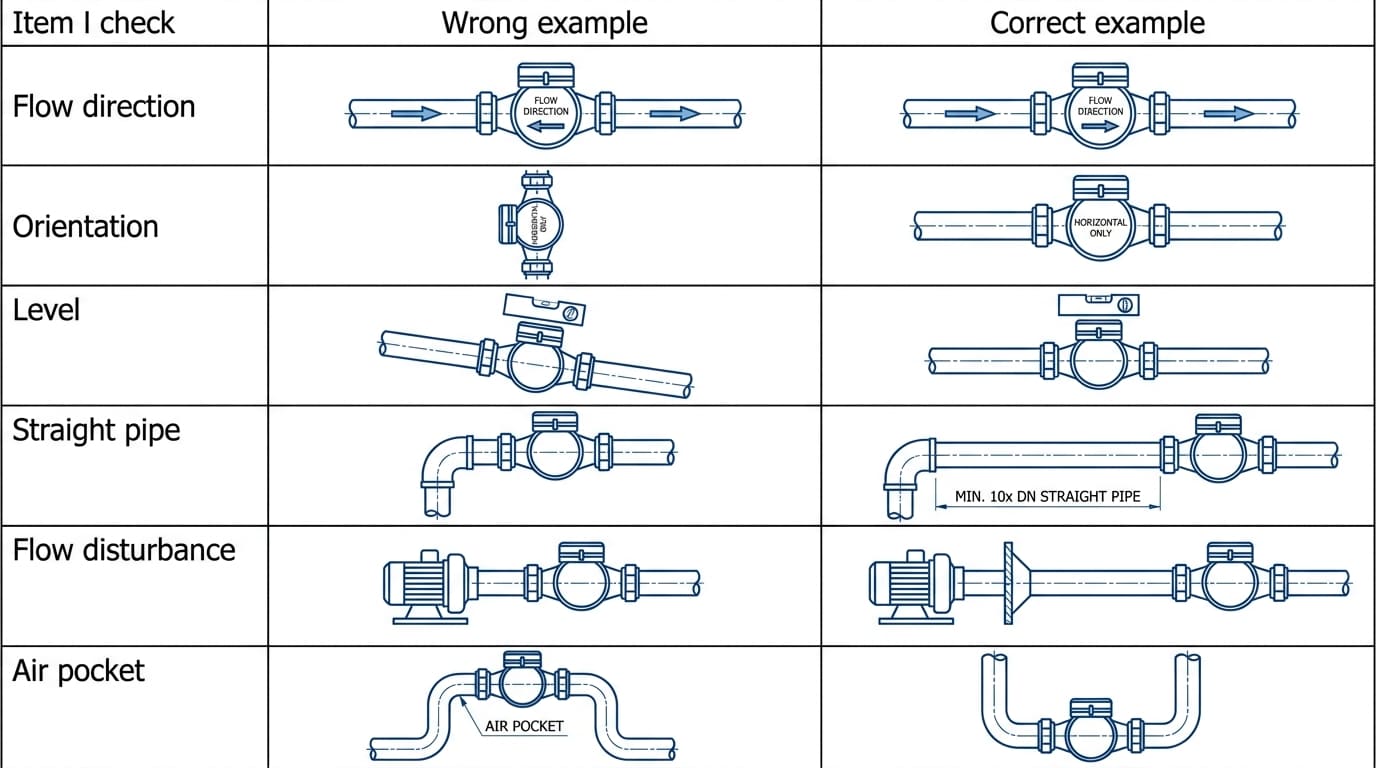
| Item I check | Wrong example | Correct example |
|---|---|---|
| 流向 | Arrow faces opposite flow | Arrow follows real flow |
| 方向 | Horizontal-only meter installed vertical | Meter installed in approved position |
| Level | Meter tilted under pipe stress | Meter level and supported |
| 直管 | Meter directly after bend or valve | Straight pipe follows manufacturer rule |
| 流动扰动 | Pump outlet directly into meter | Buffer pipe or flow conditioning used |
| Air pocket | High point traps air in meter | Pipe layout keeps meter full |

I do not use one straight-pipe rule for every meter type
I avoid saying, “All meters need the same straight pipe.” Some meter types are more sensitive than others. ISO notes that some volumetric meters, such as oscillating piston or nutating disc meters, are considered insensitive to upstream installation conditions, so no special conditions are required in that case. Other meter types may require flow conditioning, 并且必须遵循制造商建议的安装要求.
This is why I ask installers to follow the meter datasheet, not only their past habit. A single-jet meter, multi-jet meter, 沃尔特曼 仪表, 超声波 仪表, electromagnetic meter, and volumetric meter can behave differently. A city crew may install many types in one year. If they use the same habit for all of them, complaints will rise.
What is the thermal expansion problem nobody talks about?
I have seen a meter leak after installation even when the pressure test looked normal. The hidden cause was thermal movement in the pipe.
Thermal expansion becomes a water meter problem when pipes expand and contract, then push force into the meter body, connector, gasket, or upper register. The meter is not designed to absorb pipe movement like an expansion joint.

I treat the meter as a measuring instrument, not a pipe support
A water meter should measure. It should not carry pipe stress. This sounds obvious, but many field layouts use the meter as a connector that fixes two misaligned pipe ends. When temperature changes, the pipe expands or contracts. The force then transfers into the meter threads, flanges, gasket face, or plastic register. The first visible result may be leakage. The second result may be a stuck mechanism. The third result may be a cracked counter.
The Yunnan residential case taught me this lesson clearly. There were 170 vertical meters with leakage and jamming complaints. The first reaction from users was “bad product quality.” But the pipe layout had thermal expansion and contraction, and there was air pressure in empty pipe sections during filling. This created a combined force. The meter became the weak point that showed the problem.
I also handled a counter cracking case. The root cause was force applied to the upper gear box. It was not a product defect. The installer or pipe condition loaded the upper part of the meter. The plastic counter cracked because it was never designed to serve as a handle, support point, or force-bearing pipe joint.
| Thermal or stress problem | What I see in the field | What I ask installers to do |
|---|---|---|
| Pipe expansion | Meter leaks after temperature change | Add flexible design or expansion allowance |
| Pipe contraction | Joint pulls against meter | Align pipe before tightening |
| Empty-pipe filling | Air pressure impacts meter | Fill slowly and vent air |
| Upper gear-box force | Counter cracks | Never press or twist the register |
| Misaligned pipe | Meter body becomes a bridge | Correct pipe position first |
| No pipe support | Meter carries pipe weight | Add pipe brackets near meter |
I control air when filling the pipe
Air is one of the most underestimated causes of meter complaints. Test procedures require all air to be bled from the interconnecting pipework and the meters during testing. Field installation is not the same as a laboratory test, but the lesson is still useful. Air must not be ignored.
When an empty pipe is filled too fast, compressed air can create pressure shock. In vertical installations, air can collect at local high points. In apartment projects, many meters may see the same filling behavior. If the filling process is bad, a large number of meters can show similar leakage, 噪音, or jamming. That is why I tell installers to fill slowly, open vents, check downstream discharge, and avoid sudden valve operation.
What should I do in special cases with pumps, bends, valves and bypass lines?
I have seen meters installed in the worst possible place because the chamber was small. The drawing saved space, but the meter paid the price.
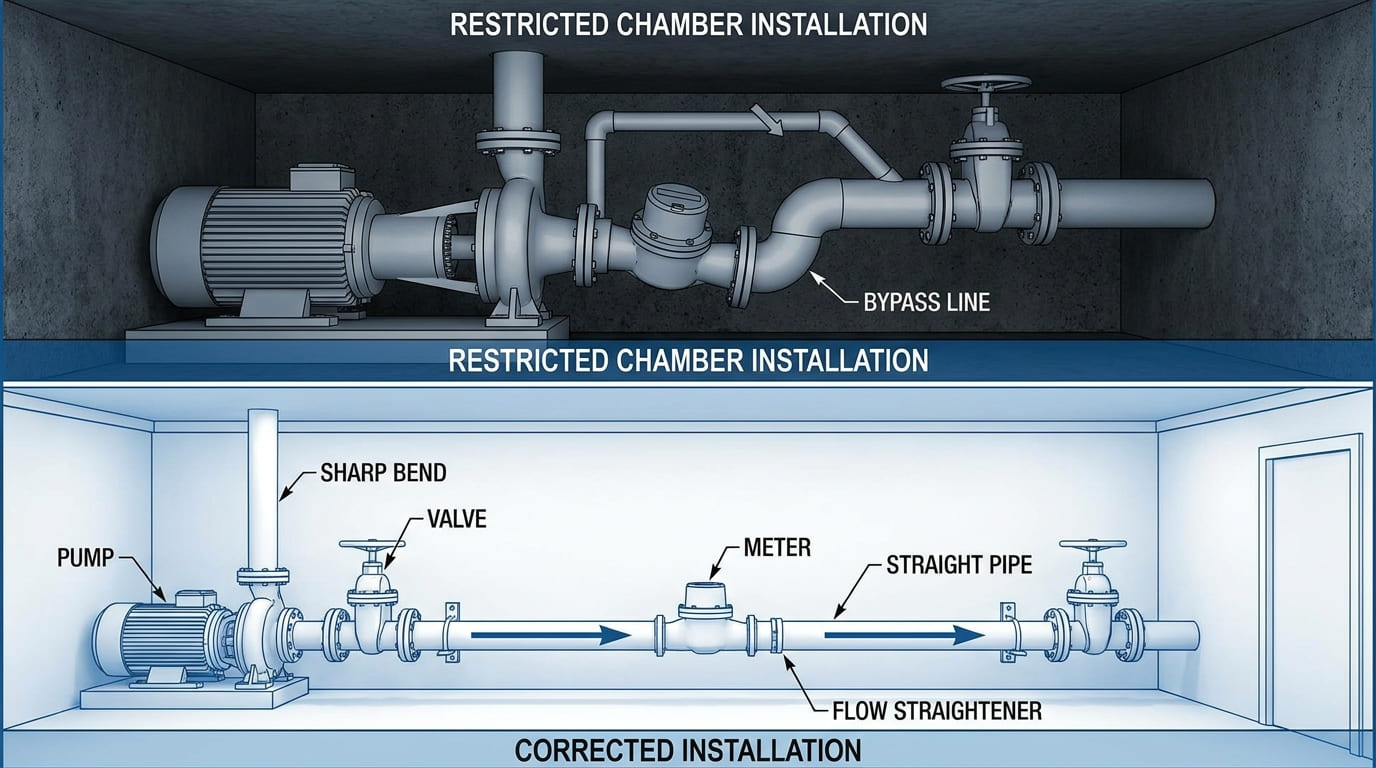
In special cases, I keep meters away from pump outlets, sharp bends, partly closed valves, eccentric reducers, and unstable bypass flow. If I cannot avoid them, I use straight pipe, flow straighteners, supports, and clear valve operation rules.

I never ignore upstream disturbance
Pumps, bends, 阀门, 减速器, and bypass lines can change the flow profile before water reaches the meter. ISO states that if the accuracy of a water meter is affected by upstream or downstream disturbances such as bends, 阀门, or pumps, the meter must be provided with enough straight pipe lengths, 带或不带整流器, 按照制造商的规定. I use this as a basic field rule.
A pump outlet can create pulsation, 振动, and swirl. A bend close to the meter can create uneven velocity. A partly closed valve can create jet flow. A bypass line can create reverse pressure or unstable flow if the valve sequence is poor. A reducer can create asymmetry. Two bends in different planes can create swirl, and one bend with an eccentric reducer or partly closed valve can also create swirl.
I also care about vibration and shock. Test guidance says precautions should be taken to avoid the effects of vibration and shock. 在现场, I apply the same thinking. If a meter sits directly after a pump with no support and no damping, the installation may damage the meter or disturb its reading.
| Special case | Field risk | My best practice |
|---|---|---|
| Pump outlet | Pulsation, 振动, swirl | Add distance, 支持, and stable section |
| 90° bend before meter | Uneven velocity profile | Add straight pipe before meter |
| Two bends in different planes | Swirl | Avoid layout or add flow straightener |
| Partly closed valve | Jet flow and disturbance | Keep control valve away from meter inlet |
| Eccentric reducer | Asymmetric flow | Use proper reducer position and straight pipe |
| Bypass line | Reverse flow or unstable flow | Use clear valve sequence and check valves |
| Sudden valve opening | Pressure shock | Open slowly and vent air |
I write valve operation rules for bypass installations
A bypass line looks simple on a drawing. In real operation, it can create mistakes. If the bypass is opened or closed in the wrong order, the meter can see reverse flow, 空气, pressure shock, or no flow while billing staff still expect readings. I write a short valve operation rule and place it in the chamber or maintenance file.
I also ask the project team to define the normal valve position. A bypass should not become a hidden parallel route that steals flow from the meter. If the meter has reverse-flow detection or smart alarms, I test those features after installation. If it is mechanical only, I rely more on valve tags, 密封件, and inspection.
寻找可靠的水表供应商?
YOUNIO 生产 DN15 至 DN500 机械水表和超声波水表, 经过 MID 认证和 ISO 测试 4064. 为合格买家提供免费样品和工厂测试报告.
How should I design pits and deal with flooding and IP rating reality?
I have opened meter pits that looked like small ponds. The customer still expected the meter and remote module to behave like lab equipment.
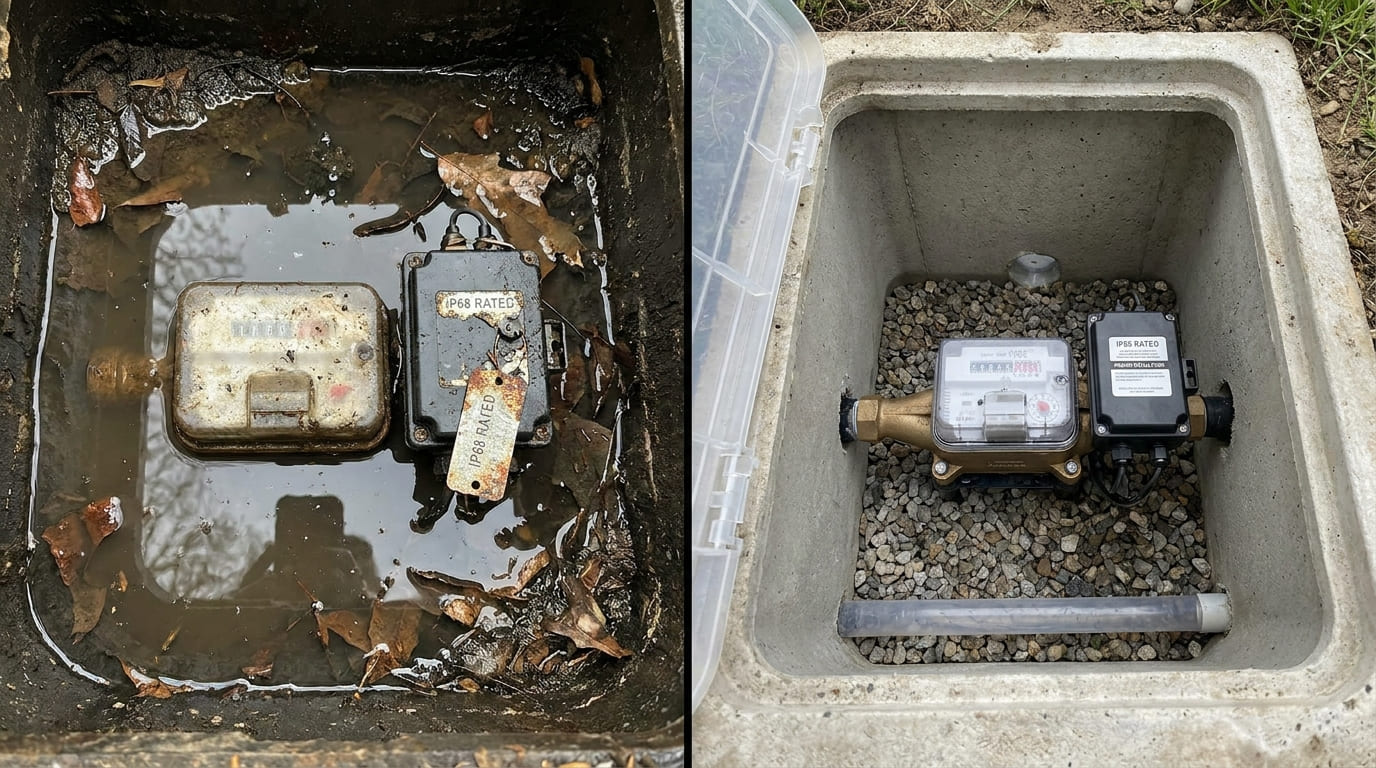
Pit design should keep the meter accessible, supported, dry when possible, ventilated, and protected from flooding, 沉淀, insects, cable strain, and accidental impact. IP rating helps, but it does not replace good pit drainage and installation discipline.

I do not use IP rating as an excuse for bad pits
IP rating is useful. But I do not treat it as permission to install electronics in dirty standing water forever. A meter pit may flood after rain, pipe leakage, groundwater rise, or blocked drainage. If the pit stays flooded, 登记册, 电缆, connector, 模块, 电池, and antenna can face long exposure. Even a product with good sealing can fail earlier if the environment is harsher than expected.
I check whether the pit has drainage. I check whether the meter is above the bottom sludge line. I check whether the register can be read without bending cables or hitting the counter. I check whether the cable has a drip loop. I check whether the module antenna is blocked by metal covers or deep concrete. I also check whether the pit cover can crush cables when closed.
为了 mechanical meters, flooding can still matter. Mud can cover the dial. Sediment can enter if there is a leak or open fitting. Standing water can hide slow leakage. Insects and rodents can damage cables. Maintenance crews may step on the meter if the pit is too small.
| Pit issue | Complaint created | Best practice I use |
|---|---|---|
| Standing water | Module failure, unreadable dial | Add drainage or raise meter |
| Mud and sediment | Dirty register, blocked parts | Clean pit before handover |
| Tight pit | Counter hit or twisted | Leave tool and hand clearance |
| Cable under cover | Cable cut or crushed | Route cable with protection |
| Deep concrete pit | Weak signal | Check antenna position |
| No support | Pipe stress on meter | Add brackets or stable base |
| No access | Poor maintenance | Design for safe reading and removal |
I test the pit after rain when possible
A pit can look perfect on a dry day. I prefer to inspect after rain or after a controlled water test. I want to know where water collects. I want to see whether the installer left space for removal. I want to confirm the register remains visible. I also want to know if the smart module can still transmit when the cover is closed.
This is very important in AMR or 急性心肌梗死 projects. A smart meter project fails quickly when the meter can measure but the data cannot leave the pit. Many complaints called “meter communication failure” are really pit design failures.
What are common wrong and correct installation examples?
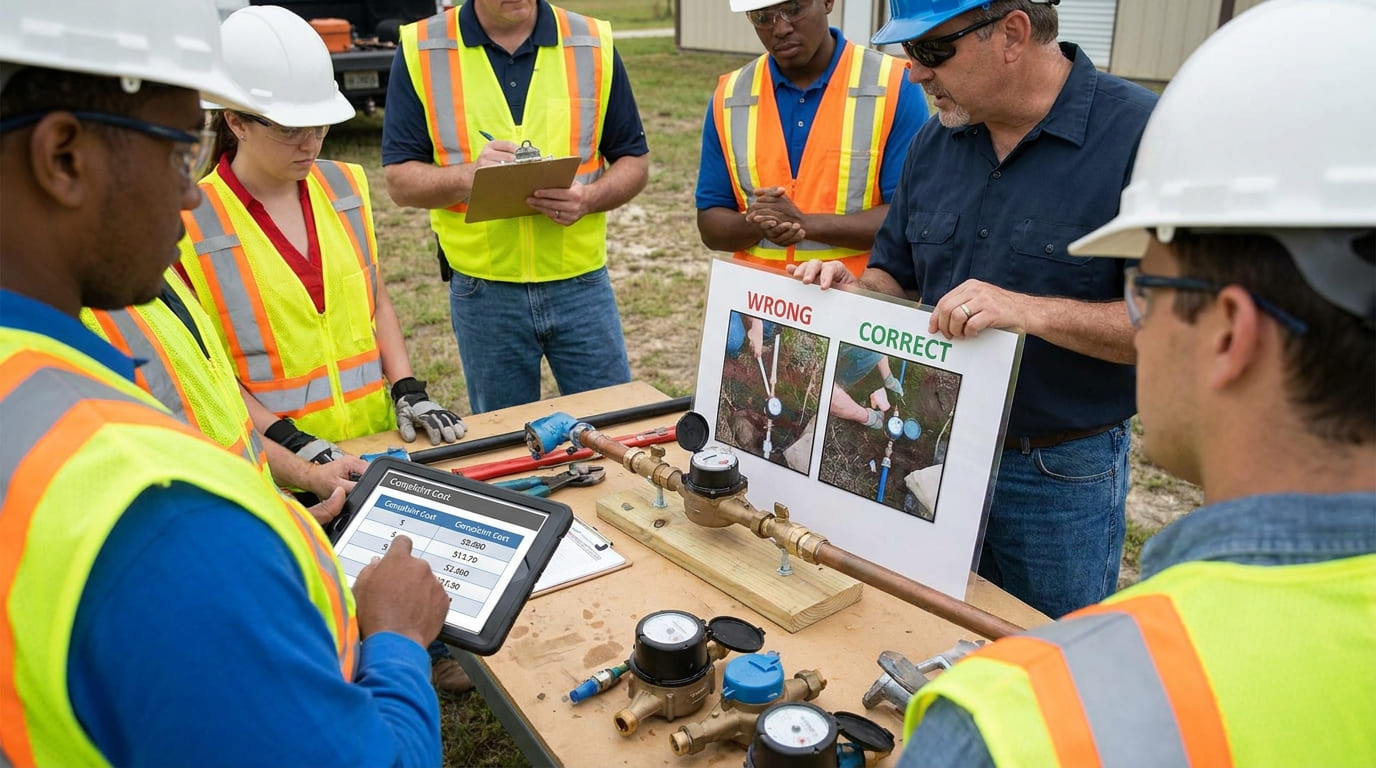
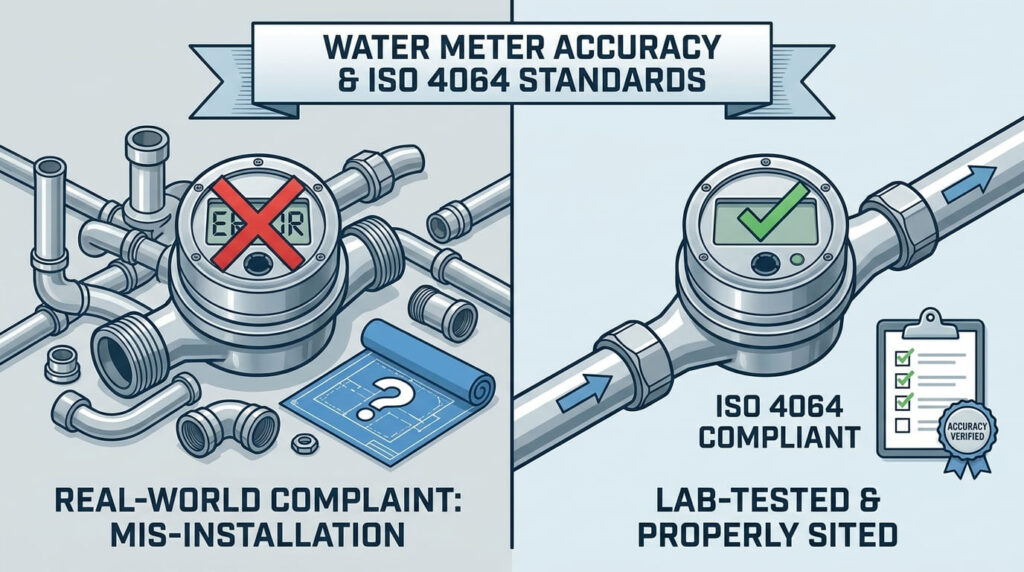
I have found that installers learn faster from pictures than from long text. A clear wrong-vs-correct example prevents repeated mistakes.
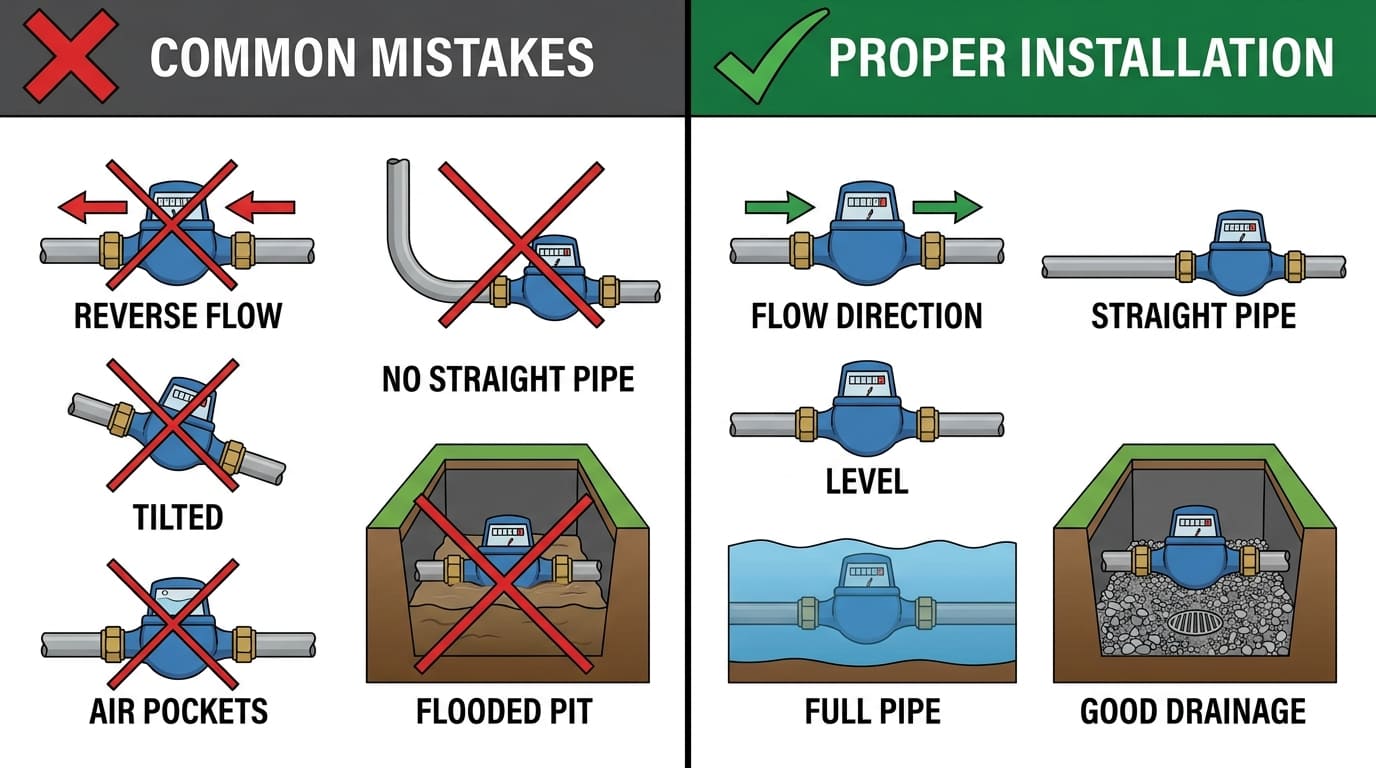
Common wrong installations include reverse direction, no straight pipe after disturbance, tilted meters, dry or half-full meters, pipe stress, flooded pits, and force on the counter. Correct installations control direction, 支持, 空气, flow, 使用权, and drainage.

I use visual examples in every installer training
I do not assume that every installer reads a full manual. I use pictures and short field rules. I show a wrong installation beside a correct installation. Then I ask the installer to explain the difference. This simple method reduces repeat mistakes.

| Example | 错误的 | Correct | Why I care |
|---|---|---|---|
| 流向 | Arrow opposite real flow | Arrow follows flow | Wrong direction causes no reading or reverse behavior |
| 方向 | Vertical-only condition ignored | Meter installed as approved | Position affects air and mechanism |
| 直管 | Meter after pump or bend | Straight run before meter | Disturbed flow affects accuracy |
| Level | Meter tilted by pipe | Meter level and supported | Level support reduces stress |
| Air | Meter at air pocket | Pipe keeps meter full | Meter should be full of water |
| Dirt | Pipe not flushed | Pipe flushed before meter | Particles can collect in meter |
| Counter force | Installer twists register | Installer uses wrench on flats | Upper gear-box stress can crack counter |
| Pit | Meter submerged in mud | Meter raised and accessible | Flooding increases service risk |
I explain the counter cracking case clearly
The counter cracking case is a good training example because it changes installer behavior. The visible problem was a cracked counter. The first claim was product defect. The real cause was force on the upper gear box. The counter is not a handle. The register is not a wrench point. The upper gear box should not receive pipe alignment force.
I tell installers to hold the correct metal flats or connector area when tightening. I tell them to align the pipe before installing the meter. I also tell them not to force the meter into a gap that is too short, too long, or misaligned. If the pipe is wrong, fix the pipe. Do not make the meter fix the pipe.
What step-by-step checklist should installers follow?
I have learned that even experienced teams make mistakes when the job is rushed. A checklist protects the installer and the supplier.
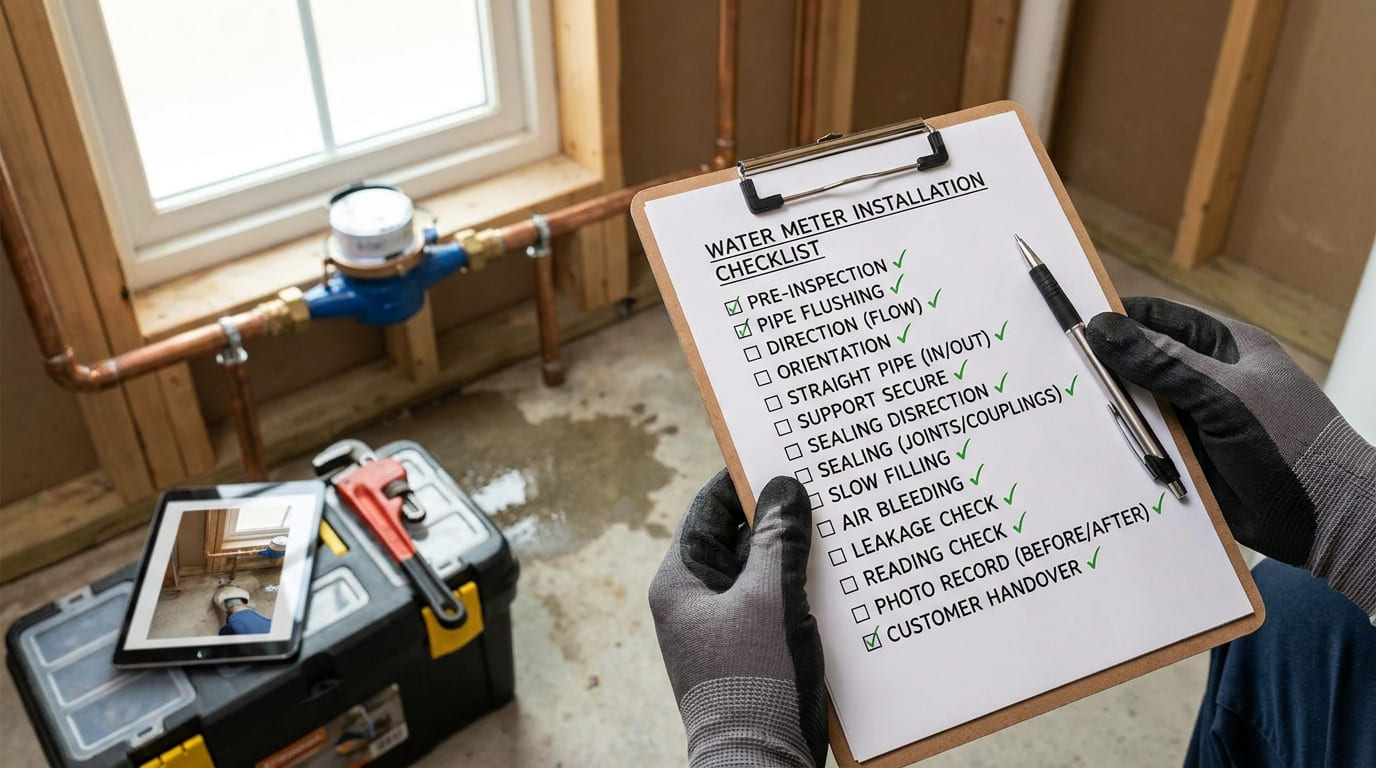
A good installer checklist covers pre-inspection, pipe flushing, 方向, 方向, 直管, 支持, 密封, slow filling, 排气, leakage check, reading check, photo record, and customer handover.

I use one checklist from warehouse to handover
I do not wait until the meter is on the pipe. I start before installation. I check model, DN, flow direction, approved position, gasket, connector, and module. I compare the meter with the work order. I check that the pit or chamber is ready.
Then I flush the upstream pipe when the site condition requires it. This matters because solid particles can collect in the meter after upstream pipework activity. I install the meter after the line is clean. I follow the direction arrow. I follow the approved orientation. I keep the meter level when required. I leave the straight pipe required by the manufacturer when bends, 阀门, or pumps can disturb accuracy.
After tightening, I fill slowly. 我放气. Test procedures require air to be bled from pipework and meters, and I use that as a field principle for stable start-up. I avoid vibration and shock because test guidance also warns against those effects. I check for leakage at low pressure first, then at operating pressure.
| 步 | My installer action | Pass condition |
|---|---|---|
| 1 | Confirm model, DN, and work order | Meter matches site |
| 2 | Check flow arrow and position | Direction and orientation are correct |
| 3 | Inspect pipe alignment | Meter will not carry pipe force |
| 4 | Flush upstream pipe | No visible debris |
| 5 | Check straight pipe | Manufacturer rule is met |
| 6 | Install gaskets correctly | Gasket not twisted or squeezed |
| 7 | Tighten evenly | No body or counter stress |
| 8 | Fill slowly | No pressure shock |
| 9 | 排气 | Meter remains full of water |
| 10 | Check leakage | No joint leak |
| 11 | Check reading movement | Counter responds normally |
| 12 | Check module signal | Data reaches receiver if smart meter |
| 13 | Take photos | 方向, 位置, and pit are recorded |
| 14 | 交出 | Customer signs with visible evidence |
I require photos because memory is weak
A photo record protects everyone. I ask for at least four photos. One photo shows the meter face and serial number. One photo shows flow direction and pipe layout. One photo shows upstream and downstream straight pipe. One photo shows the pit or surrounding environment. 对于智能电表, I add a photo of module position and cable route.
When a complaint appears three months later, these photos help me separate field damage from product defect. They also help the installer prove that the work was done correctly.
How should I train installation teams?
I have seen training fail when it becomes a classroom lecture only. Installers need practical rules, 照片, and feedback from real complaints.
I train installation teams with short field rules, wrong-vs-correct photos, hands-on practice, complaint case studies, supervisor audits, and clear acceptance checklists. Training must connect installation mistakes to real complaint cost.

I build training around real failures
I start training with the complaints that hurt the project most. I show the Yunnan case with 170 vertical meters. I explain thermal expansion, empty pipe air pressure, 泄漏, and jamming. I show the counter cracking case. I explain upper gear-box stress. I show examples of meters installed after pumps, bends, and partly closed valves. I explain that disturbed flow from bends, 阀门, or pumps may require straight pipe or flow straightening according to manufacturer requirements.
Then I move to practice. I give installers a meter, two pipe ends, gaskets, and tools. I ask them to install it. I watch where they hold the meter. I watch whether they twist the register. I watch whether they align the pipe first. I watch whether they check the arrow. I correct habits immediately.
I also train supervisors. A supervisor should not only count installed units. A supervisor should inspect risk points. The supervisor should check direction, 方向, 直管, 支持, pit condition, filling method, 排气, and photo records.
| Training module | What I teach | How I test it |
|---|---|---|
| Product basics | Meter is a measuring instrument | Installer explains risk points |
| Direction and orientation | Arrow and approved position | Installer identifies wrong setup |
| 直管 | Disturbance from bends, 阀门, 泵 | Installer marks required pipe length |
| Pipe stress | Meter is not a support | Installer aligns pipe before tightening |
| Air control | Fill slowly and vent air | Installer performs start-up sequence |
| Pit protection | Drainage, 使用权, cable route | Installer corrects pit layout |
| Smart module | Signal, 电缆, 天线 | Installer checks communication |
| 投诉审核 | Real cases and cost | Installer explains root cause |
I use audits after training
Training without audit fades fast. I use random site checks. I compare installed work with checklist photos. I give feedback to crews. I also track complaint rate by team, 区域, meter type, and installation method. If one team creates more complaints, I do not punish first. I inspect their method. Sometimes the team was trained by an older installer who had a bad habit.
I also update training when a new complaint pattern appears. If I see more flooded modules, I add pit design examples. If I see more cracked counters, I add tool-holding practice. If I see more accuracy disputes after pump outlets, I add flow disturbance training.
How do I connect installation quality with fewer complaints?
I have learned that complaint reduction is not only a factory job. It is a shared job between product design, project planning, 安装, and field service.
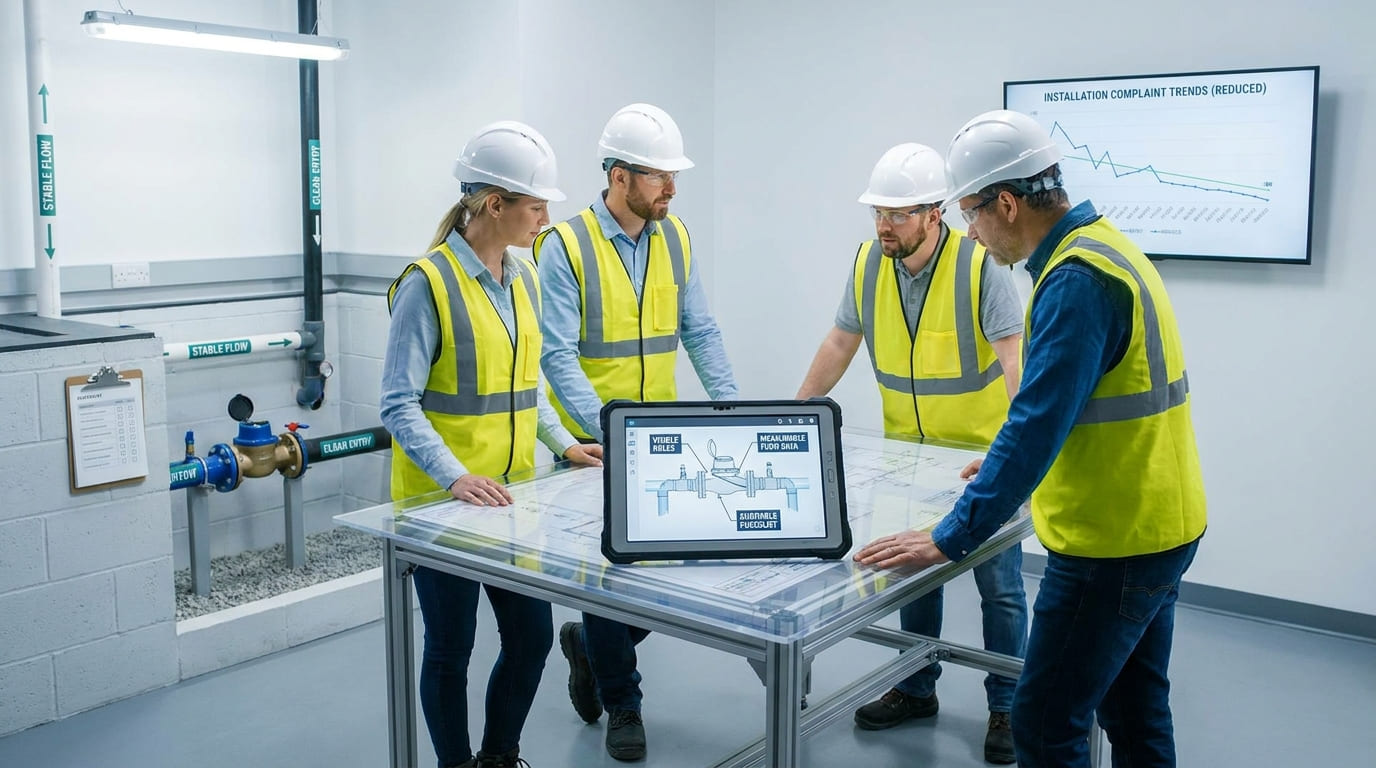
I reduce complaints by making installation rules visible, measurable, and auditable. The best product still needs correct direction, full-pipe operation, clean water entry, stable flow, low pipe stress, and protected pits.

I make responsibility clear before the project starts
A supplier should provide clear installation requirements. The project owner should include them in the tender or installation contract. The installer should follow them. The supervisor should audit them. The service team should use them when reviewing complaints.
ISO guidance says manufacturer installation requirements should be followed when certain meter types require flow conditioning. It also says straight pipe or flow straighteners may be needed when bends, 阀门, or pumps disturb accuracy. These points help me make installation requirements part of the contract, not just a manual in the carton.
I also define complaint evidence. When a complaint arrives, I ask for serial number, installation photo, 管道布置, valve position, pit condition, pressure condition, and failure description. If the complaint is about leakage, I ask whether the pipe is aligned and supported. If the complaint is about jamming, I ask whether the pipe was flushed and whether the meter was filled slowly. If the complaint is about cracking, I ask whether force touched the upper gear box.
| Complaint type | 我要求提供的证据 | Likely decision path |
|---|---|---|
| 泄漏 | Joint photos, pipe support, pressure record | Check gasket, stress, thermal movement |
| Counter stuck | Pipe flushing record, air venting, debris check | Check dirt, 空气, internal mechanism |
| Cracked counter | Tool marks, pipe alignment, register force | Check upper gear-box stress |
| 读错了 | 方向, 方向, 直管, flow data | Check installation and sizing |
| Remote failure | Pit flooding, 电缆, 天线, signal test | Check environment and module setup |
| Batch complaint | Serial numbers and photos by site | Separate product batch from installation pattern |
I use installation quality as a buying criterion
When I choose a meter supplier, I also ask about installation support. A good supplier should not only ship meters. It should provide installation manuals, drawings, straight-pipe guidance, smart module guidance, and complaint analysis support. YOUNIO works with mechanical and 智能水表s across many project types, so I treat installation guidance as part of lifecycle reliability, not an extra service.
For city projects, building projects, and OEM projects, I prefer suppliers who can discuss real field problems. A supplier who says every complaint is “user mistake” is not helpful. A buyer who says every complaint is “factory defect” is also not helpful. I need shared evidence. I need photos, test data, site condition, and root cause analysis.
结论
I trust water meter installation best practices because I have seen them cut complaints. Correct direction, full-pipe operation, 直管, air control, low stress, dry pits, and trained installers protect both the meter and the project.
寻找可靠的水表供应商?
YOUNIO 生产 DN15 至 DN500 机械水表和超声波水表, 经过 MID 认证和 ISO 测试 4064. 为合格买家提供免费样品和工厂测试报告.