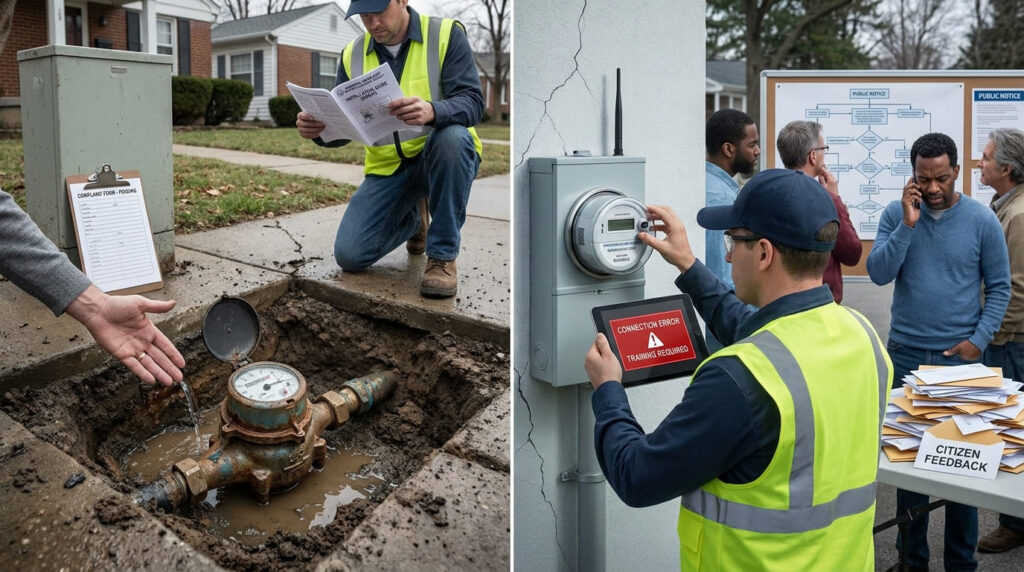




Muchos proyectos de medidores de agua fallan después de la instalación. El coste aparece después como quejas., disputas, y volver a probar. Reduzco ese riesgo antes del envío..
A water meter factory visit site audit helps predict complaint risk because it checks field conditions, product suitability, test capability, documentation quality, and responsibility boundaries before meters are installed.
I do not treat audits as paperwork. I treat them as an early warning system. A project team that checks the site and visits the factory usually finds problems while they are still cheap to correct.
What Does a Good Site Audit Look Like Before a Project?
A weak site audit only counts connection numbers. A good audit finds hydraulic, instalación, acceso, and user conditions before the meter becomes the problem.
A good site audit checks pressure, flow pattern, calidad del agua, condición de la tubería, installation space, acceso, communication signal, temperatura, maintenance method, and local reading habits before meter selection.
I Start With Field Reality, Not the Catalogue
I first ask what the meter will face every day. The answer is usually more useful than the tender wording.
A site audit should check whether the pipe is full, whether the flow direction is clear, whether the meter can be installed horizontally or vertically as required, and whether installers have enough space for tightening, disassembly, and future maintenance. I also check whether the location allows manual reading, even when the project uses remote reading. Remote data is useful, but field teams still need visual confirmation during disputes.
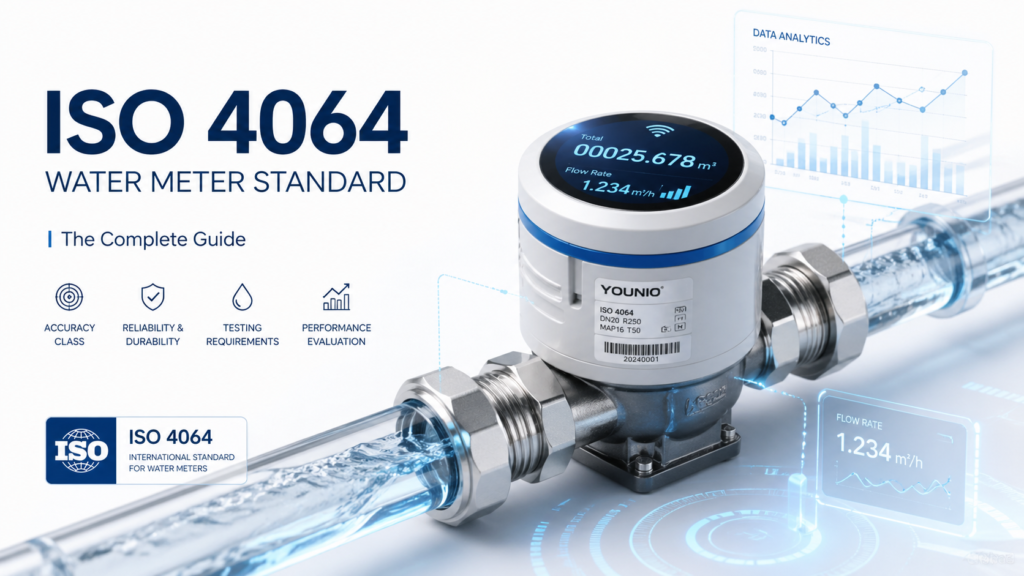
Pressure is another key item. If pressure is unstable, demasiado bajo, or affected by pumps, the project may see customer complaints that look like meter complaints. Water quality also matters. Arena, escala, óxido, aire, and high turbidity can affect some meter types and increase maintenance risk. ISO 4064 notes that some meter types may require flow conditioning when measuring errors, and the manufacturer’s recommended installation requirements should be followed [5]. This is why I do not select a meter only by pipe diameter.
Para contadores inteligentes, I check network conditions. NB-IoT needs operator coverage and SIM management. LoRa or LoRaWAN may need gateways, fuente de alimentación, retorno, and good placement. M-Bus or RS485 needs cable routing and concentrator planning. If the site cannot support the communication system, the meter will be blamed for a project design issue.
| Site Audit Item | lo que reviso | Complaint Risk If Ignored |
|---|---|---|
| Presión | stable, rated, no severe surge | “meter caused low pressure” |
| Calidad del agua | arena, escala, óxido, aire | blockage, tener puesto, wrong diagnosis |
| Installation space | acceso, herramientas, straight pipe if needed | poor installation and leakage |
| Perfil de flujo | pump, válvula, elbow, manifold | unstable measurement conditions |
| Reading access | local display visibility | billing dispute difficulty |
| Comunicación | señal, puerta, fuerza, plataforma | remote reading failure |
| Maintenance | valve access and replacement method | slow service response |
A good audit does not promise zero complaints. It makes complaint causes easier to separate.
What Should You Check During a Factory Visit?
A factory visit is not a showroom tour. It should verify whether the supplier can repeat quality, test correctly, and support documents.
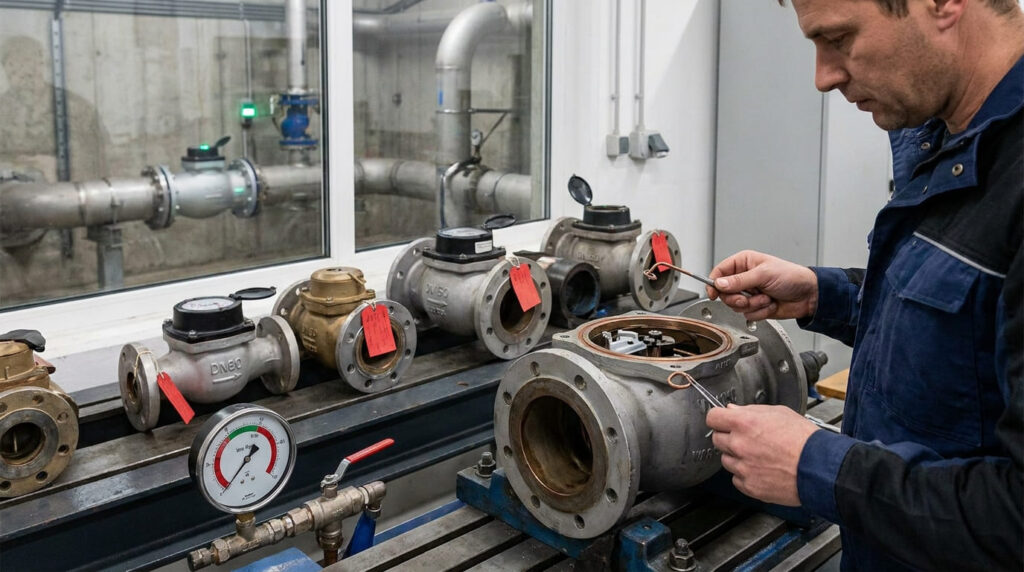
During a water meter factory visit, I check production control, calibration benches, test procedures, serial traceability, alcance del certificado, sample retention, packaging control, electronic checks, and after-sales response capability.
I Look for Repeatable Process, Not Only Clean Floors
A clean factory is good. But I need more than clean floors. I want to know whether the factory can make the same meter, test it the same way, and explain the result after shipment.
I usually start with incoming material control. I check bodies, registers, sensors, módulos de comunicación, baterias, valvulas, juntas, and packaging materials. Then I look at assembly control. Are operators trained? Are torque tools managed? Are critical parts separated by model? Are rejected parts controlled?
The calibration and verification area is very important. ISO 4064-2 states that an initial verification record for an individual meter should include the testing laboratory identification, manufacturer or trademark, clase de precisión, clase de temperatura, Q3, Q3/Q1 ratio, maximum pressure loss, año de fabricación, número de serie, model, and test results [2]. I use this as a practical checklist when I review factory test records.
For durability and high-flow capability, I ask how the factory or approved lab verifies meters under continuous, permanent, or overload flow conditions. ISO 4064-2 describes durability testing by subjecting meters to constant flow rates such as Q3 or Q4 for a specified duration [3]. It also describes test installations with water supply, tuberías, dispositivos reguladores de flujo, válvulas de aislamiento, water temperature measurement, and means for checking flow rate and test duration [3].
| Factory Area | My Question | Evidence I Want |
|---|---|---|
| Incoming materials | How are parts approved? | inspection records |
| Assembly line | How are errors prevented? | work instructions |
| Calibración | What standard and flow points? | bench records |
| Initial verification | What is recorded per meter? | serial-linked reports |
| Durability | How is long-term flow stress checked? | test plan or lab evidence |
| Smart modules | How is data transmission checked? | registros de comunicación |
| Embalaje | How is label accuracy controlled? | carton and barcode records |
| After-sales | How are complaints analyzed? | 8D or root-cause process |
Para contadores inteligentes, I also check electronic functions. ISO 4064-2 states that ancillary devices with primary indications should have checking facilities that verify the device is connected, functioning, and transmitting data correctly [6]. That point matters in AMR and AMI projects because communication problems often become the first complaint after installation.
A good factory visit does not need to be aggressive. It should verify repeatability.
What Patterns Do We See Between Audits and Complaint Rates?
Projects with no audit often discover field problems after mass installation. Projects with audits usually solve many disputes before shipment.
en mi experiencia, projects that complete site audits and factory visits usually have fewer later complaints because they align field conditions, selección de medidor, testing evidence, documentos, and responsibility before rollout.
Complaint Reduction Comes From Fewer Unknowns
I do not claim that audits remove all risk. ellos no. But they reduce unknowns.
The first pattern is installation-related. When a project checks installation space, condición de la tubería, valvulas, dirección, aire, and access before purchase, fewer meters are installed in unsuitable locations. This reduces disputes about leakage, unreadable displays, dirección equivocada, y acceso de mantenimiento.
The second pattern is test-related. If the buyer and supplier agree on Q3, Q1, valor R, clase de temperatura, pérdida de presión, model, and serial traceability before shipment, later retesting becomes easier to discuss. ISO 4064-2 lists these items in initial verification records, including Q3, T3/T1, maximum pressure loss, número de serie, and test results [2]. When these items are missing, every complaint becomes harder to close.
The third pattern is smart communication. Projects that test NB-IoT, lora, Lorawan, Autobús M, RS485, or RF conditions before rollout usually face fewer “meter not reading” complaints. The meter may measure correctly, but remote reading still needs network coverage, colocación de la puerta de enlace, reglas de la plataforma, and installer registration.
| Audit Behavior | Later Pattern I Usually See |
|---|---|
| No site pressure check | complaints about low pressure or unstable service |
| No water quality check | blockage or wear blamed on meter |
| No access check | slow maintenance and customer frustration |
| No factory test review | disputes over accuracy evidence |
| No document alignment | aduanas, tender, or acceptance delay |
| No communication survey | remote reading complaints |
| No complaint process | long arguments without root cause |
The fourth pattern is document discipline. When the project file includes certificates, hojas de datos, manuales, informes de prueba, dibujos, packaging approval, and serial number records, complaint handling is faster. The team can compare site records, installation photos, batch data, and test evidence.
Audits reduce complaints because they create shared facts before problems occur.
What Should an On-Site Checklist Include for Pressure, Water Quality and Access?
A checklist makes field judgment consistent. Without it, every installer reports conditions in a different way.
An on-site checklist should include pressure, calidad del agua, pipe material, posición de instalación, dirección del flujo, straight pipe needs, acceso, flooding risk, temperatura, wireless signal, and maintenance space.
I Use a Checklist to Avoid Memory-Based Decisions
I prefer simple checklists because they make site audits repeatable. The goal is not to create more paperwork. The goal is to protect the project from avoidable complaints.
For pressure, I check normal pressure, peak pressure, fluctuación de presión, pump cycling, and whether the meter pressure rating is suitable. I also ask whether the customer has complained about pressure before meter replacement. If pressure complaints existed before installation, the meter should not become the target later.
For water quality, I check visible particles, arena, óxido, escala, aire, and chemical or conductivity concerns if the measuring principle depends on them. ISO 4064-2 notes that some meter types should operate within the conductivity range specified by the manufacturer [5]. This is a useful reminder that site conditions and measuring principle must match.
For access, I check whether the meter can be installed, read, replaced, and sealed. A meter hidden behind walls, under deep covers, or near unsafe traffic creates service problems. Para contadores inteligentes, I also check whether the antenna position is blocked by metal covers, cámaras subterráneas, or thick concrete.
| Checklist Category | Field Question | Record Type |
|---|---|---|
| Presión | What is normal and peak pressure? | gauge reading or site note |
| Calidad del agua | Any sand, óxido, escala, or air? | photo and sample note |
| Pipe condition | old pipe, corrosión, fuga? | photo |
| Instalación | dirección, posición, full pipe? | photo and sketch |
| Access | can staff read and replace it? | access rating |
| Ambiente | inundación, congelación, calor, humedad? | risk note |
| Comunicación | NB-IoT signal or gateway path? | prueba de señal |
| User behavior | past disputes or tamper risk? | customer record |
I also record photos. Photos solve many arguments later. A photo can show flow direction, installation angle, available space, pipe corrosion, or meter chamber condition.
The checklist should become part of the project file, not a separate forgotten document.
Which Factory Questions Reveal Real Capabilities?
A factory can answer sales questions easily. Technical questions reveal whether the supplier can support the project after delivery.
Factory questions should cover test method, serial traceability, rejected products, alcance del certificado, calibration control, smart module testing, sample retention, complaint analysis, piezas de repuesto, and document responsibility.
I Ask Questions That Connect Production With Future Complaints
I do not ask only “What is your capacity?” Capacity matters, but capability matters more.
I ask how each meter is identified. Can the factory link a serial number to production date, resultado de la prueba, operador, banco, lote, and packing carton? If not, later complaints become general arguments instead of traceable investigations.
I ask what information appears in the test record. ISO 4064-2 gives a useful minimum list for initial verification records, including laboratory identification, manufacturer or trademark, clase de precisión, clase de temperatura, Q3, Q3/Q1 ratio, pérdida de presión, año, número de serie, model, and results [2]. If a factory cannot show this type of traceability, I become cautious.
Para contadores inteligentes, I ask how the factory confirms data transmission. ISO 4064-2 states that checking facilities for ancillary devices should verify connection, functioning, and correct data transmission [6]. I want to see how that requirement is translated into factory practice.
For electronic meters with checking facilities, I also ask how faults are handled. ISO 4064-2 describes checking facility actions such as automatic correction, stopping the faulty device under certain conditions, or visible or audible alarms for significant faults [4]. This helps me understand whether the factory treats alarms as real diagnostic tools or just brochure words.
| Factory Question | Good Answer Looks Like |
|---|---|
| How do you trace each meter? | serial-linked production and test records |
| What does the verification record include? | Q3, T3/T1, model, serial, resultado |
| How do you control rejected meters? | clear isolation and root-cause process |
| How do you test communication? | device-to-platform or device-to-tool logs |
| How do you manage certificates? | model, DN range, validity, configuration |
| How do you handle complaints? | joint analysis with evidence |
| How do you control packaging? | artwork approval and barcode checks |
| How do you retain samples? | batch sample policy |
The best factories answer with records, not only words. I trust a supplier more when they show limits clearly.
How Can Audit Results Be Used in Contract and Design?
Audit findings are wasted if they stay in a report. They must change the specification, contract, and installation plan.
Use audit results to define meter size, Q3, valor R, reglas de instalación, método de comunicación, informes de prueba, embalaje, alcance del certificado, acceptance method, warranty limits, and complaint evidence requirements.
I Turn Findings Into Written Requirements
A site audit may show high sediment. Then the design should include suitable meter selection, filtration discussion if needed, y acceso de mantenimiento. A site audit may show poor NB-IoT coverage. Then the project may need LoRaWAN, Autobús M, RF, or a different network plan. A factory visit may show that one model has stronger documentation than another. Then the contract should specify the documented model, not a vague equivalent.
I use audit results to define the acceptance basis. The contract should state the applicable standard, meter model, DN range, Q3, valor R, Q1, clase de temperatura, pressure loss class, posición de instalación, método de comunicación, ciclo de presentación de informes, and required documents. ISO 4064-2 shows that initial verification records should identify the meter, its Q3, Q3/Q1 ratio, pérdida de presión, número de serie, type or model, and test conclusions [2]. These are good contract anchors.
I also add installation clauses. If the manufacturer recommends flow conditioning or specific installation requirements, the project should follow them. ISO 4064-2 states that manufacturer-recommended installation requirements should be followed for meter types requiring flow conditioning, and these requirements should be reported in the type approval certificate [5].
| Audit Finding | Contract or Design Action |
|---|---|
| Unstable pressure | define pressure rating and site responsibility |
| Poor water quality | define meter type and maintenance plan |
| Limited access | change meter position or box design |
| Señal débil | add gateway survey or change communication |
| Factory traceability gap | require serial-linked test records |
| Certificate scope issue | specify exact model and DN range |
| Special installation need | include manual and installer training |
| Smart device functions | define platform, ciclo de carga, and diagnostics |
Para contadores inteligentes, I define what the meter does and what the system must do. A smart meter can measure, almacenar, detect events, and transmit data. It cannot alone repair leaks, fix pressure, clean billing records, or guarantee NRW reduction.
A contract built from audit results is more practical than a contract built from assumptions.
How Do Audits Become Long-Term Cooperation, Not Policing?
Some suppliers fear audits because they feel like inspection. I prefer audits that build shared responsibility.
Audits become long-term cooperation when both sides use findings to improve design, training, documentación, pruebas, instalación, and after-sales response instead of using them only to assign blame.
I Use Audits to Create Shared Facts
A good audit should not feel like a police visit. It should create a common project language.
The buyer learns what the factory can and cannot do. The factory learns what the site really needs. The installer learns which conditions matter. The utility learns what evidence is needed for complaint analysis. This is how a project moves from price negotiation to technical cooperation.
I usually recommend a joint audit report. The report should list findings, risks, responsible party, action plan, deadline, and evidence. If the site has pressure problems, the utility owns part of the correction. If the factory needs clearer packaging labels, the supplier owns that correction. If the communication system needs gateway placement, the integrator owns that action.
ISO 4064-2 recognizes that water meters can include ancillary devices and additional measurement functions such as flow rate, presión de agua, and water temperature [6]. This reminds me that modern metering projects involve more than one actor. Meter supplier, platform provider, instalador, and utility must cooperate.
| Audit Output | Cooperation Value |
|---|---|
| Site photos | prevents arguments about installation condition |
| Test records | supports objective complaint review |
| Communication logs | separates meter, red, and platform issues |
| Certificate map | avoids tender and customs confusion |
| Training notes | improves installer consistency |
| Complaint procedure | shortens response time |
| Corrective action list | creates continuous improvement |
I also prefer post-installation reviews. After the pilot, the team should compare audit assumptions with real results. Were pressure conditions correct? Did the signal survey match actual upload success? Did customers complain about access, mostrar, o facturación? Did factory documents answer field questions?
Long-term cooperation grows when both sides are willing to learn from evidence.
Conclusión
Use site audits and factory visits to define conditions, tests, documentos, reglas de instalación, and responsibilities before rollout. Early clarity usually means fewer later disputes.