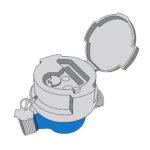

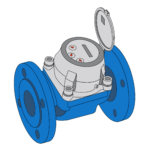

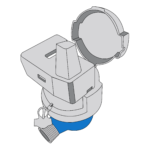

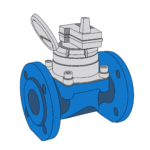

La sostituzione dei contatori in tutta la città sembra semplice sulla carta. Acquista metri, scambiare i contatori, inviare fatture. Nella vita reale, Vedo cittadini arrabbiati, orari in ritardo, e titoli che nessuna utilità vuole.
I see seven hidden municipal water meter replacement risks: weak specs, untrained contractors, poor citizen communication, install errors, ignored alarms, weak complaint handling, and missing data baselines. Cities without clear training and complaint workflows often face combined media and technical pressure.
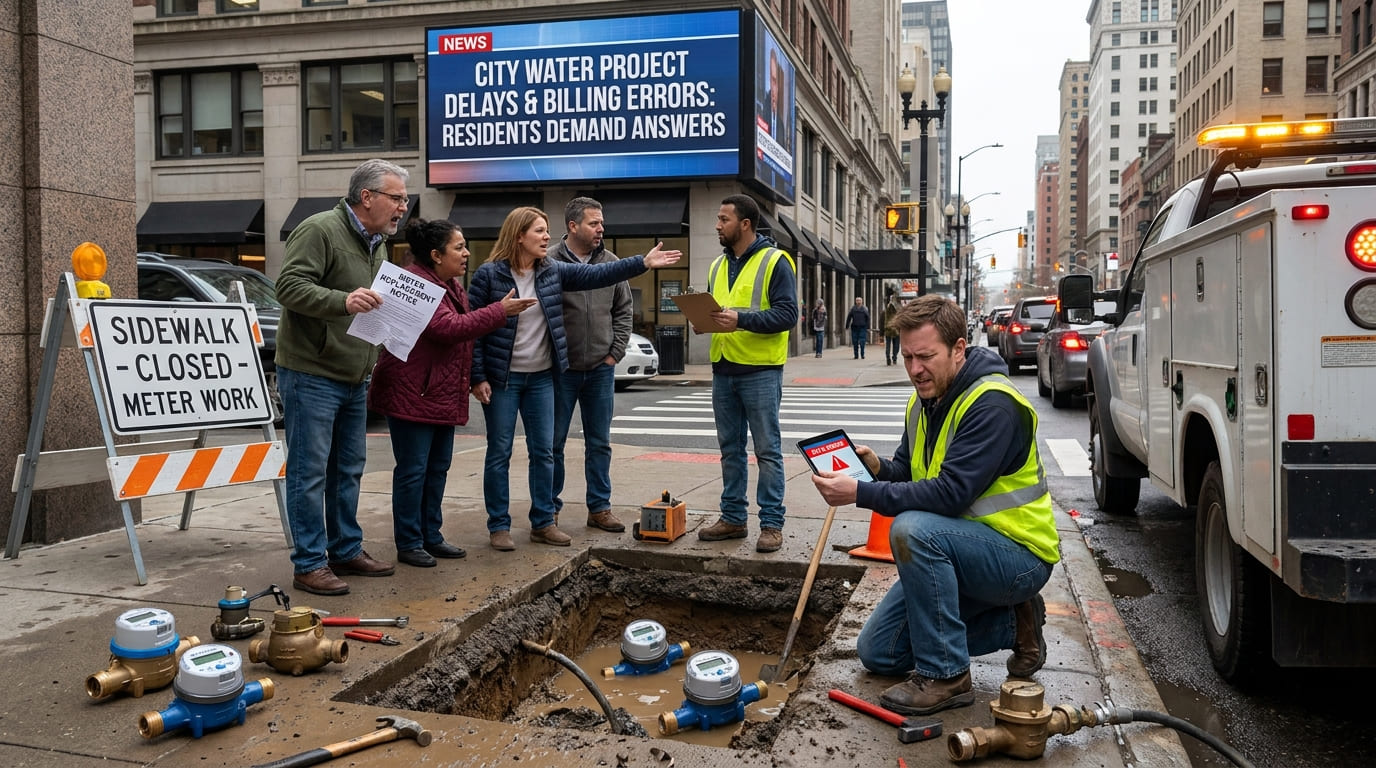
I have walked through complaint files from many city projects. The same patterns repeat. The technical part is almost never the worst problem. The worst problem is the gap between technical reality and citizen expectations, and the lack of a real plan for handling complaints when they spike. In questo articolo, I share what I learn from those files, and I give a practical checklist that utilities can use before, during, and after roll-out.
Why Cities Launch Meter Replacement Programs?
Old meters under-read. Old meters fail. Old meters cannot talk to a system. I see cities replace meters to fix all three problems at once.
I see four main drivers for city-wide replacement: aging mechanical fleets, NRW reduction targets, billing fairness, and digital transformation toward smart water systems with remote reading and active alarms.
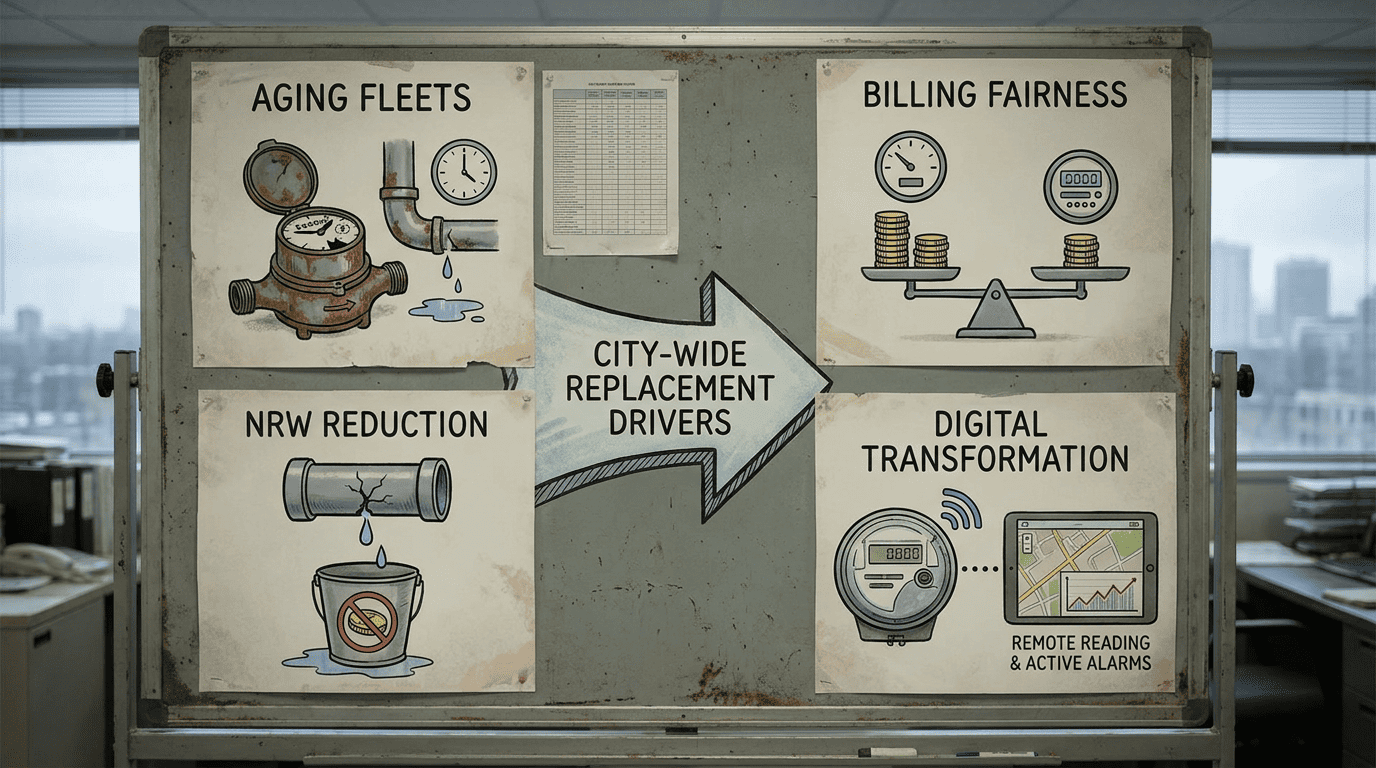
What Cities Want From the New Fleet
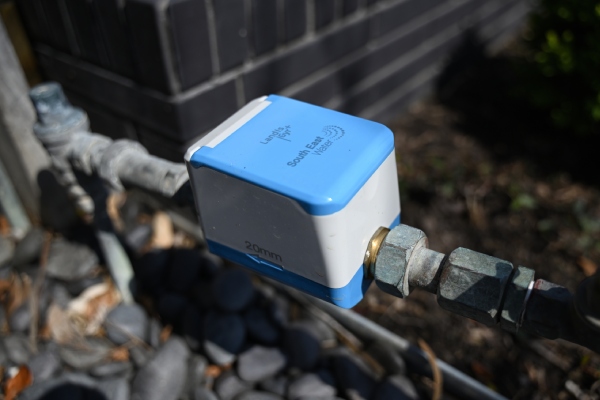
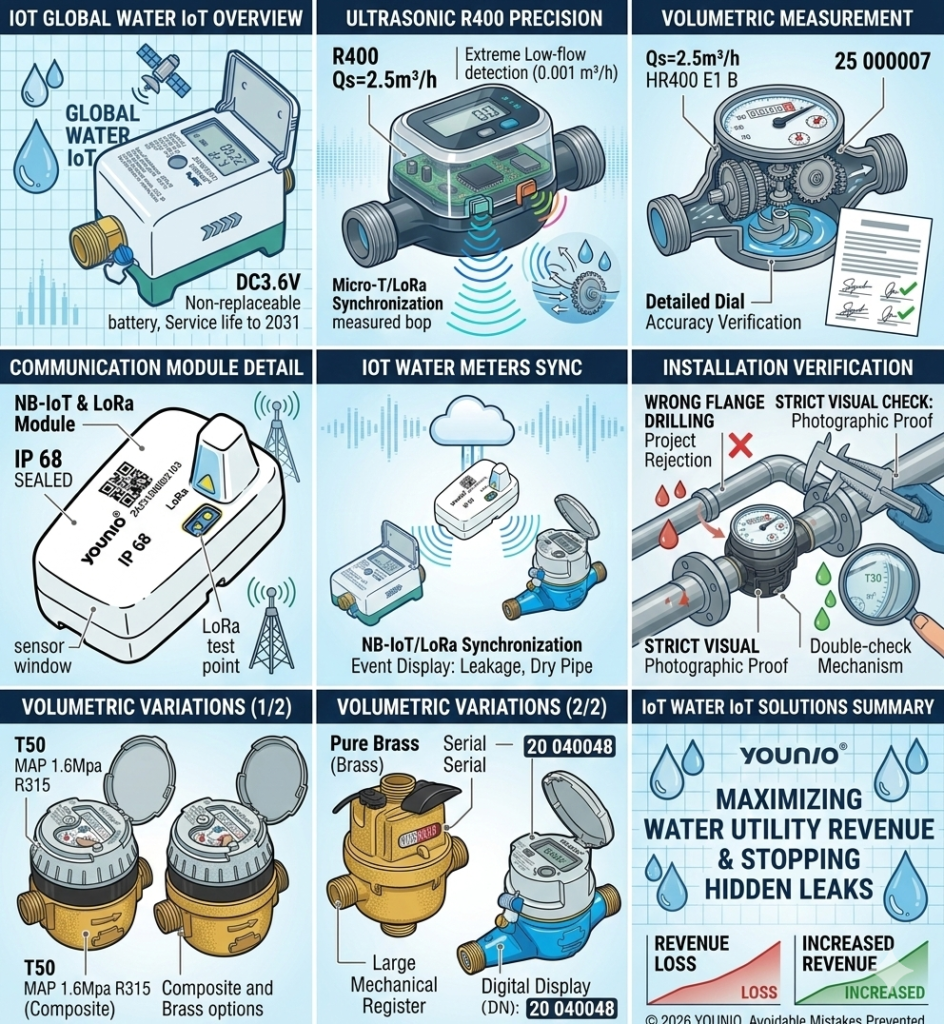
I ask every utility the same question: what do you want from the new fleet? The answers usually overlap. They want accurate measurement under modern standards, with verification based on JJG 162-2009 for cold-water meters or Iso 4064:2014 / OIML R49-2013 for ultrasonic meters. They want remote reading. The smart ultrasonic meter relates to a GSM wireless data collector and uses GSM mobile public network to form a wireless monitoring system, easy to manage and saving operating costs. They want event data: the system actively reports abnormal information from the pipeline network, including leaks, scoppia, direzione sbagliata, ed eventi di assenza di flusso. They want a path toward smart city integration, which is exactly what NB-IoT contatore dell'acqua intelligente projects support as a node for IoT and smart city construction. The new fleet is not just hardware. It is a data platform.
| Driver | What the city expects | Fonte |
|---|---|---|
| Aging fleet | Modern accuracy class | Iso 4064 / JJG 162 |
| NRW | Active leak/burst alarms | Event reporting |
| Billing fairness | Reliable readings | Smart meter menu |
| Digital city | IoT integration | NB-IoT smart meter |
Seven Hidden Risks We See in Real Projects?
The risks are rarely about the meter itself. They sit in specs, persone, and communication.
I see seven hidden risks: vague specs, install errors, ignored alarms, untrained contractors, weak citizen communication, no complaint workflow, and no baseline data. Each one alone is manageable; together they create a public crisis.
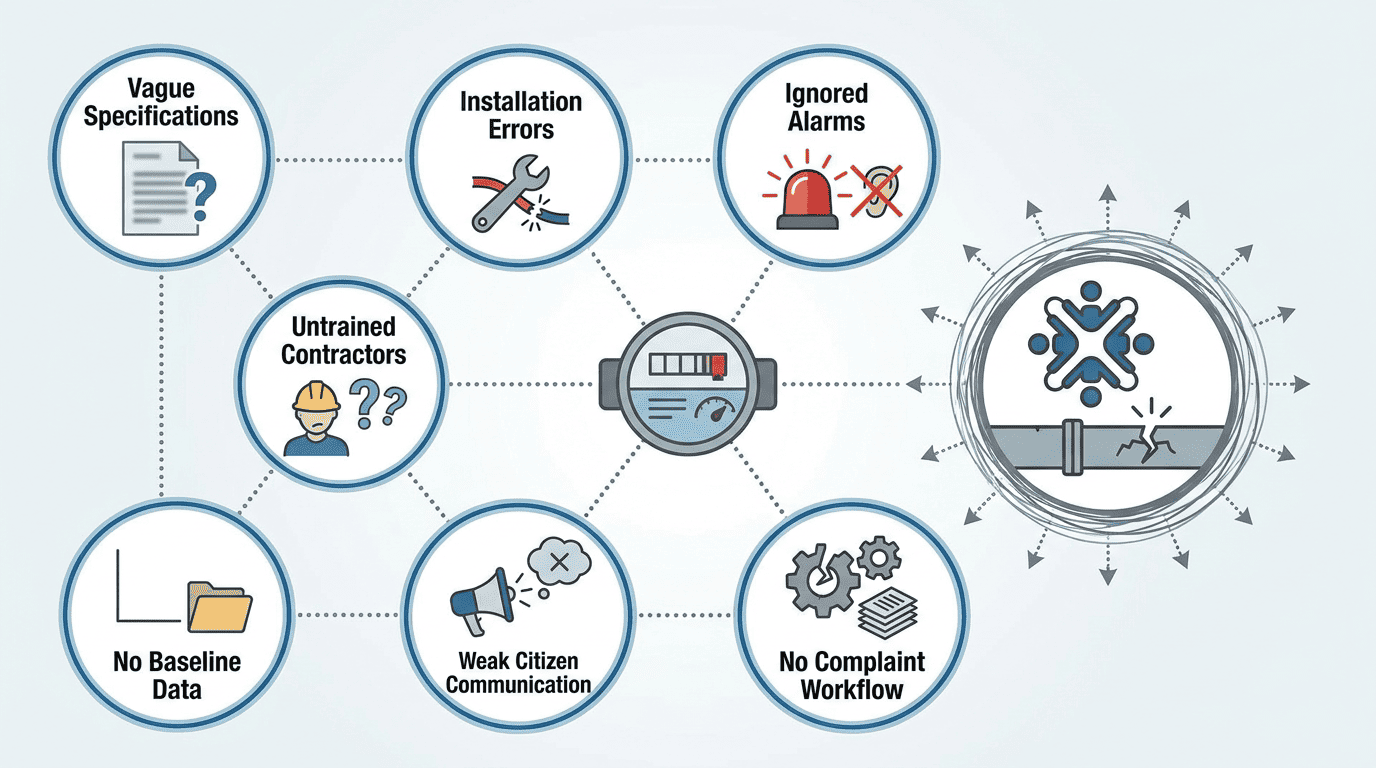
The Seven Risks in Plain Words
I list each risk in plain words. Risk one: vague procurement specs that ignore real water quality. Risk two: install errors, such as wrong flow direction or short straight sections, which cause negative readings or random data. Risk three: ignored alarms, such as leak or burst events the system reports actively but no one reads. Risk four: untrained contractors who skip steps and break the rule that installation must follow the site professional engineering design, senza alcuna alterazione senza il permesso dell'ingegnere. Risk five: weak citizen communication before bills change. Risk six: no complaint workflow, so each call becomes an emergency. Risk seven: no baseline data, so the utility cannot prove a new meter reads correctly compared with the old one. Cities that miss these risks face technical issues and media pressure at the same time.
| Rischio | Typical sign | Mitigation |
|---|---|---|
| Vague specs | Mixed product quality | Reference ISO 4064 / METÀ |
| Install errors | Lettura negativa [3] | Engineer-led design |
| Ignored alarms | Late leak repairs | Active reporting system |
| Untrained contractors | Wrong direction, bad position | Formazione + audit |
| Weak comms | Citizen anger | Pre-launch information |
| No workflow | Long disputes | Defined complaint script |
| No baseline | "New meter reads high" | Old vs. new comparison data |
Procurement Specs vs Real-World Conditions?
A spec written in an office is not a spec for a real city pipe. I see this gap in every problem project.
I close the gap by writing specs that name standards, opzioni di comunicazione, alarm features, and storage rules. Iso 4064:2014, OIML R49-2013, and JJG 162-2009 give a defensible base, plus event reporting and battery rules from the meter itself.
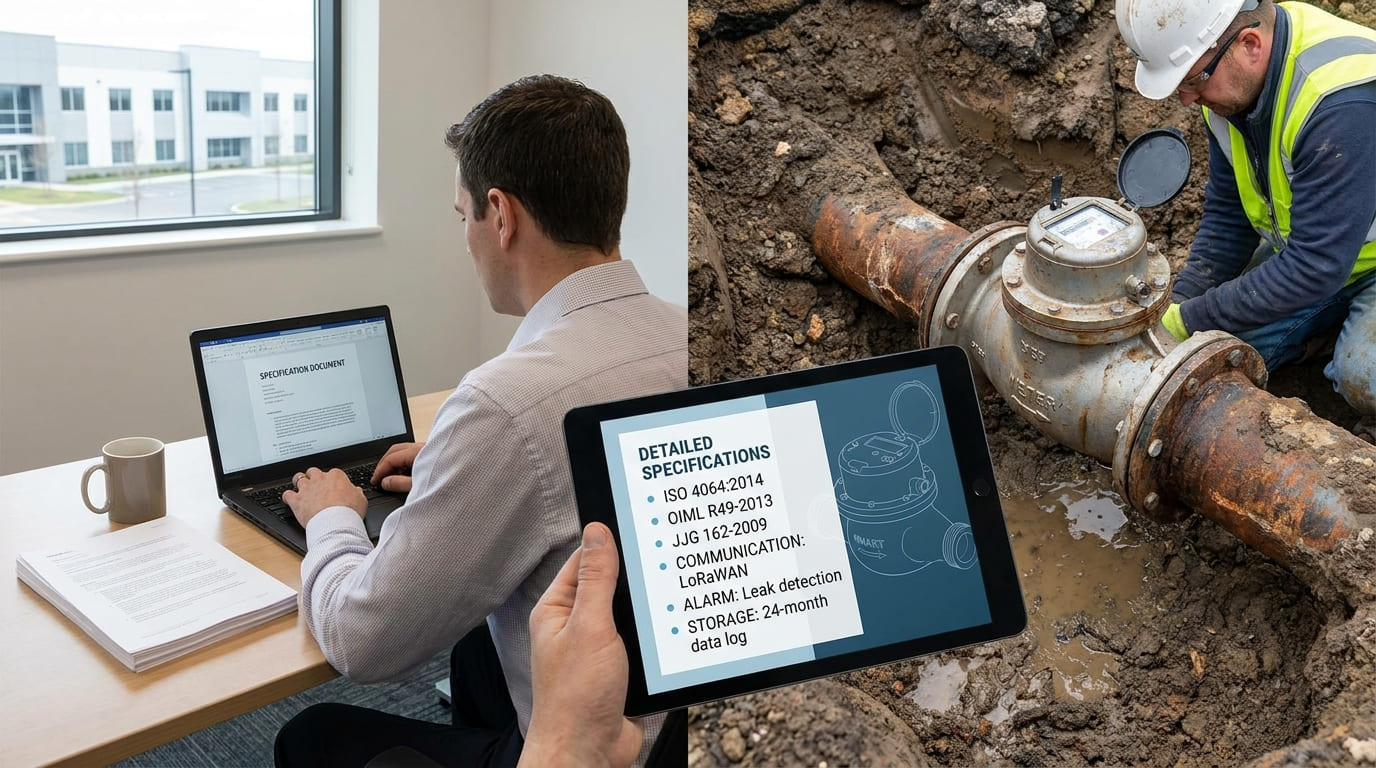
What I Put in a Strong Spec
I put four blocks in a strong spec. Block one is metrology: meters must comply with ISO 4064:2014 and OIML R49-2013, with R250 or R400 ratios and clear Q1, Q2, Q3, Q4 values for each diameter. For Chinese projects, JJG 162-2009 verification regulation for cold-water meters is the legal reference. Block two is communication and events: the meter must support remote reading and actively report leak (long flow over 24h), scoppiare (large flow for set time), direzione sbagliata, no-flow, and low-battery events. Block three is environment: protection class, medium temperature, storage temperature, and battery life ≥ 8 years for ultrasonic meters. Block four is logistics and storage: meter stored in original package at 5–40°C, in aria priva di gas corrosivi, with stacking no more than 5 boxes. With these blocks, the spec matches reality, not a brochure.
| Spec block | Key content | Fonte |
|---|---|---|
| Metrology | Iso 4064 / Oiml / JJG 162 | |
| Events | Leak/burst/direction/no-flow alarms | |
| Environment | Battery ≥8 years, IP class | |
| Magazzinaggio | 5–40°C, no corrosive gas, ≤5 boxes |
Alla ricerca di un fornitore affidabile di contatori dell'acqua?
YOUNIO produce contatori d'acqua meccanici e ad ultrasuoni da DN15 a DN500, Certificato MID e testato ISO 4064. Campioni gratuiti e rapporti sui test di fabbrica disponibili per acquirenti qualificati.
Contractor Training and Quality Control at Scale?
A city replaces tens of thousands of meters. Even small install error rates create big complaint waves.
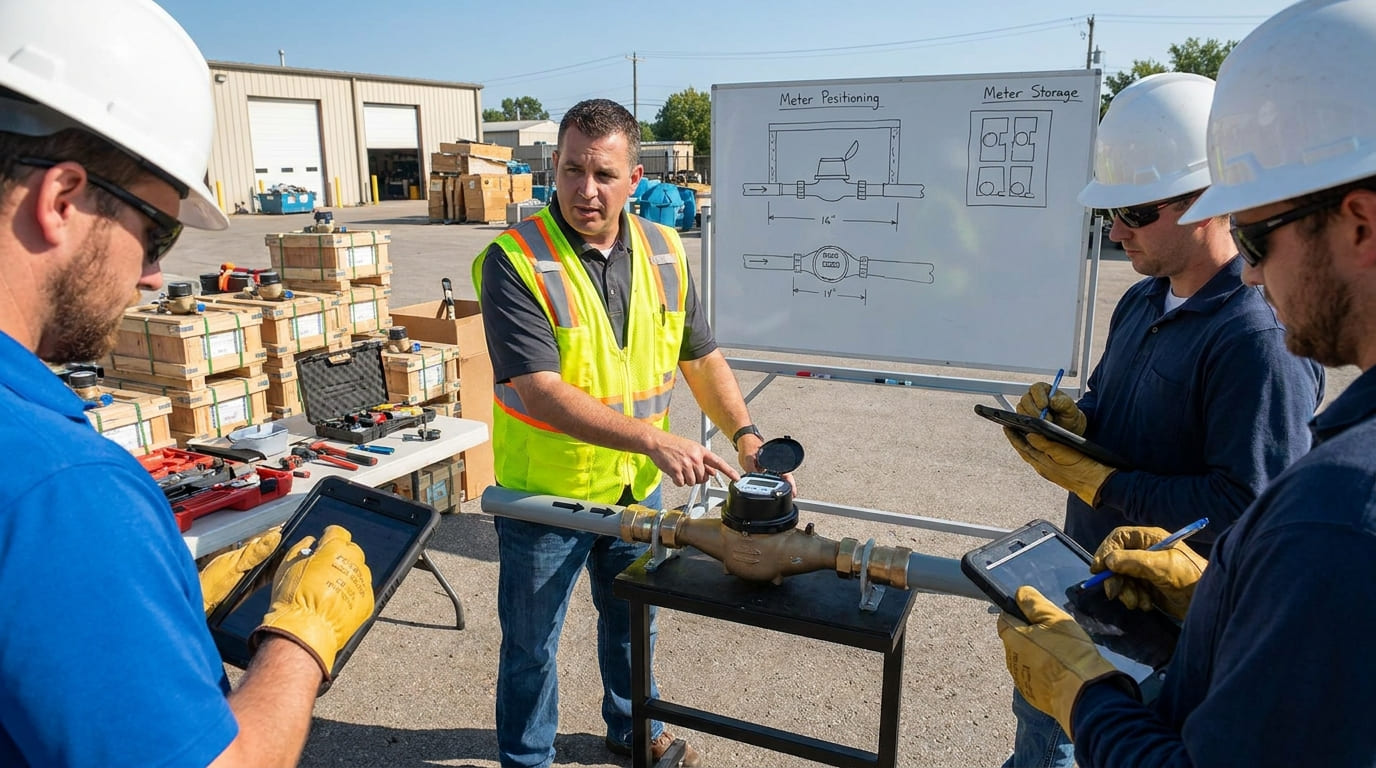
I cut install errors with two tools: short, repeatable training for contractors, and quality audits keyed to the meter’s own troubleshooting points — flow direction, straight sections, posizione, and storage.
What I Train and What I Audit
I train contractors on a small number of points and audit the same points. Primo, installation must follow the site professional engineering design, and alteration without engineer permission is strictly prohibited. Secondo, flow direction must match the arrow; otherwise the meter reads negative and the troubleshooting first step is to check whether direction is reversed. Terzo, install position must give a full pipe with proper straight sections; a short straight section, big bend, or large pipe diameter before the table causes abnormal or random data. Quarto, storage on site must respect 5–40°C and corrosive-gas-free conditions, with stacking ≤ 5 boxes. Quinto, before energizing, contractors check the LCD for low-battery symbol, since a low battery should be replaced as soon as possible. I tie each training point to a one-line audit checkbox so quality control scales across thousands of installations.
| Training point | Audit check | Fonte |
|---|---|---|
| Engineering design | Approved drawing on site | |
| Direzione del flusso | Arrow matches flow | |
| Straight sections | No short bend before meter | |
| Magazzinaggio | 5–40°C, ≤5 boxes | |
| Batteria | LCD low-battery icon |
Communication with Citizens During Replacement?
Most "meter scandals" I read are communication scandals. The meter works; the message did not.
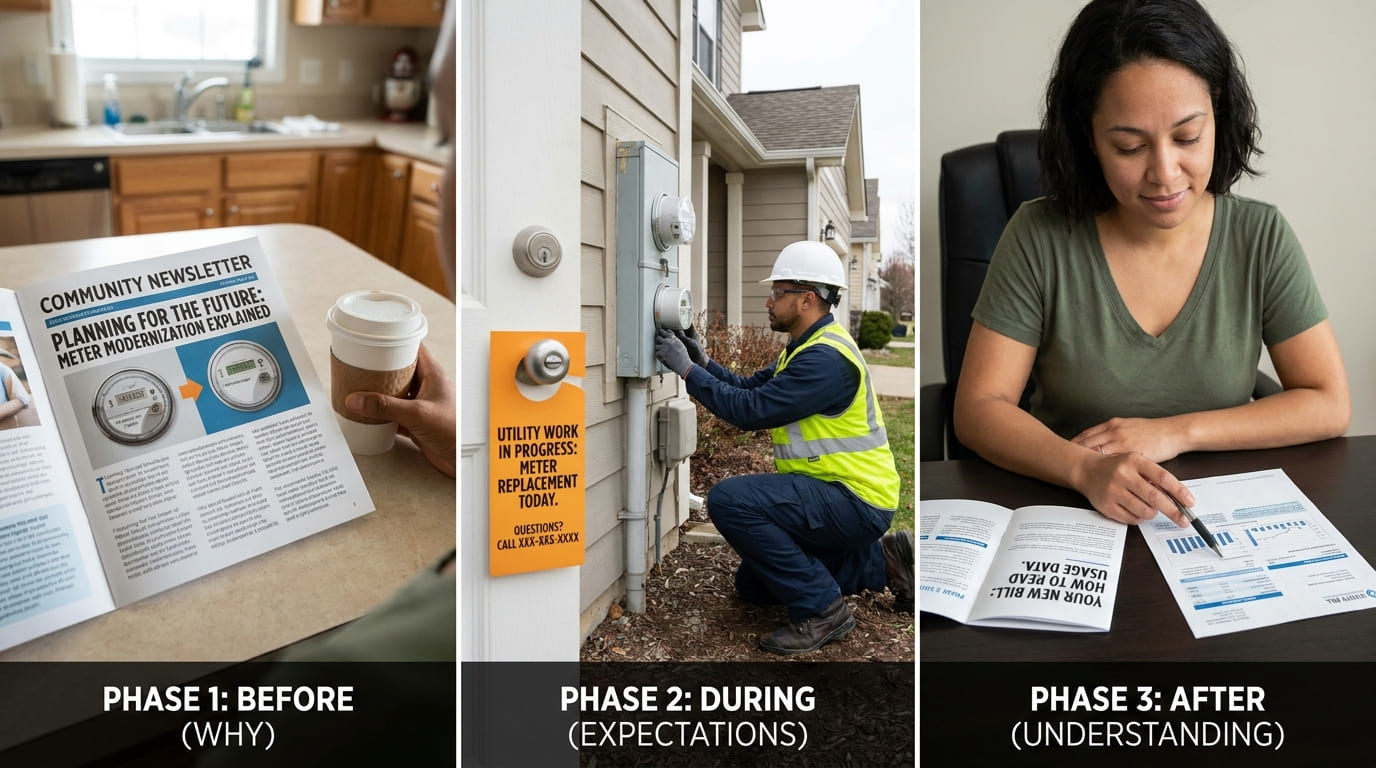
I plan citizen communication in three phases: before (why we replace), during (what to expect at home), and after (how to read the new bill). Without this plan, even correct readings trigger anger and media coverage.
What I Tell Citizens at Each Phase
Before replacement, I tell citizens what the new meter does and does not do. I explain that the smart meter reports abnormal events such as leak (24h running) and burst (large flow over time) actively to the system, which actually protects them from huge bills hidden in walls. During replacement, I tell them what they see at home: a small ultrasonic or mechanical meter, an LCD with menus showing instantaneous flow, flusso cumulativo, orario di lavoro, e data, switchable by magnetic rod. I also warn that a low-battery icon may appear over time and that the utility will replace the battery. After replacement, I explain how the new reading appears on bills, and I share the troubleshooting basics: a negative reading means the team checks flow direction first. Clear messages turn the new meter from a threat into a service.
| Fase | Messaggio | Fonte |
|---|---|---|
| Prima | Smart alarms protect you | |
| During | LCD menu and meter basics | |
| Dopo | How to read the bill | |
| Anytime | What to do on negative reading |
What Complaint Data Tells Us After Roll-Out?
Complaints are not noise. They are data. I read them like a fault map of the project.
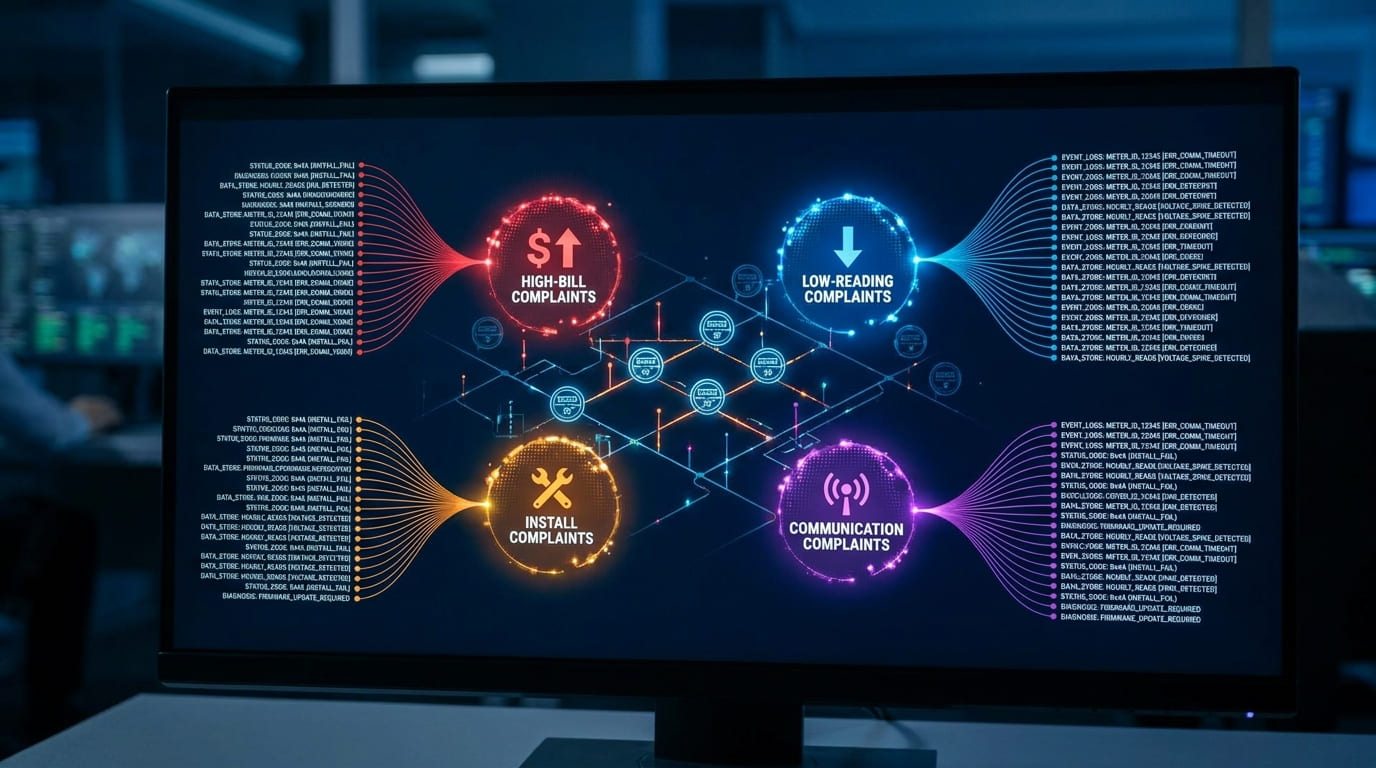
I cluster post-roll-out complaints into four groups: high-bill complaints, low-reading complaints, install complaints, and communication complaints. Smart meter event logs and stored data turn each cluster into a fixable issue, not an argument.
How I Use Complaint Data
I use complaint data with the meter’s own records. For high-bill complaints, I check the long-flow alarm: if the meter reported 24h continuous flow, the user has a real leak, not a meter error. For low-reading complaints, I check the direction alarm and the reversed-flow note from troubleshooting; if the meter is installed in the wrong direction, the system actively reports and stores the error. For install complaints (random data, deriva), I check the troubleshooting notes for incorrect installation position, low water level, short straight sections, big bend, or large pipe diameter before the meter. For communication complaints, I check whether the citizen received the pre-launch message and the bill explanation. I also rely on stored data: the smart ultrasonic meter shows cumulative flow, orario di lavoro, e data, which gives a clean timeline for any dispute. With this approach, complaint files become an improvement engine, not a public-relations crisis.
| Gruppo di reclami | Data I check | Fonte |
|---|---|---|
| High bill | Allarme a flusso lungo (24H) | |
| Lettura bassa | Allarme di direzione | |
| Install drift | Posizione / straight section | |
| Batteria / no data | Low-battery report |
A Practical Risk Mitigation Checklist for Utilities?
A long report does not help a busy utility. A short checklist does.
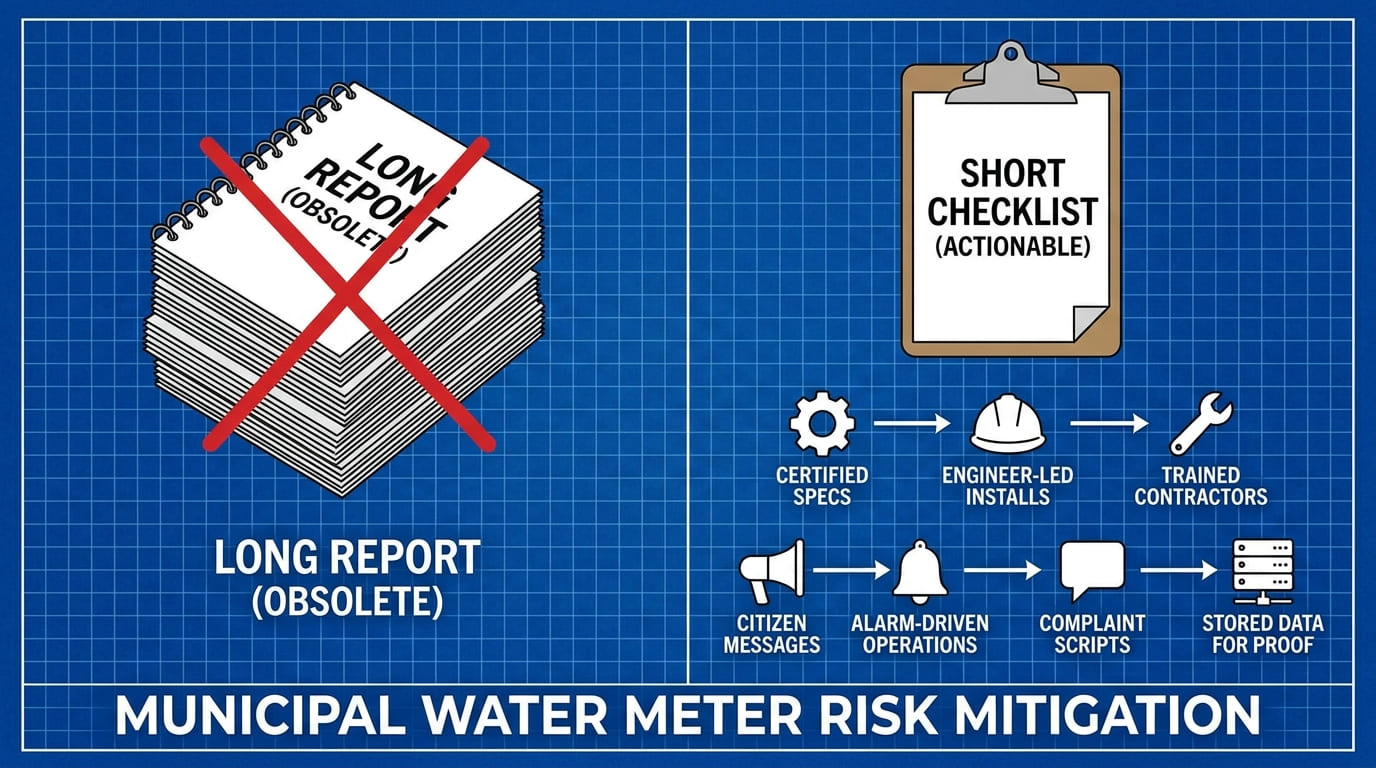
I give utilities a short checklist for municipal water meter replacement risks: certified specs, engineer-led installs, trained contractors, citizen messages, alarm-driven operations, complaint scripts, and stored data for proof. Each item maps to a meter feature or a documented rule.
The Checklist I Hand to Project Managers
I keep the checklist short on purpose. Item one: specs reference ISO 4064:2014, OIML R49-2013, and JJG 162-2009 where applicable, with clear Q1–Q4 values per diameter. Item two: installations follow the site professional engineering design, with no unauthorized alteration. Item three: contractors are trained on flow direction, straight sections, install position, and storage rules (5–40°C, ≤5 boxes). Item four: citizens receive pre-, during-, and post-replacement messages explaining the LCD menu and what alarms mean. Item five: operations teams act on the four standard alarms — leak (long flow 24h), scoppiare (large flow over time), direzione sbagliata, and no-flow — actively reported by the system. Item six: complaint handlers follow a script: check direction first on negative readings, check battery icon on missing data, and pull stored events for any high-bill case. Item seven: utilities keep a baseline of old vs. new readings to defend against "the new meter reads too high" claims.
| Voce della lista di controllo | Source of truth |
|---|---|
| Certified specs | Iso 4064 / JJG 162 |
| Engineer-led install | Engineering design rule |
| Trained contractors | Troubleshooting points |
| Citizen messaging | LCD menu explanation |
| Alarm-driven ops | Active event reporting |
| Complaint script | Direzione + battery checks |
| Baseline data | Old vs. new comparison |
Conclusione
City-wide meter replacement fails on people, not on meters. Strong specs, trained contractors, citizen messages, and alarm-driven operations turn risk into a manageable, data-backed program.
Alla ricerca di un fornitore affidabile di contatori dell'acqua?
YOUNIO produce contatori d'acqua meccanici e ad ultrasuoni da DN15 a DN500, Certificato MID e testato ISO 4064. Campioni gratuiti e rapporti sui test di fabbrica disponibili per acquirenti qualificati.