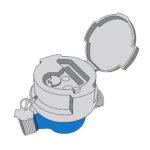

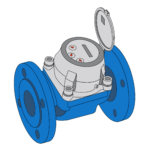

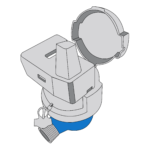

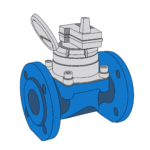

Ik zie vaak dat “nauwkeurigheidsklachten” beginnen als een meterprobleem, maar eindigt als een installatieprobleem. De kosten stijgen snel als niemand de site eerst controleert.
Onder ISO 4064, Nauwkeurigheid van de watermeter betekent dat de indicatiefout van de meter binnen de vereiste grenzen blijft onder gedefinieerde test- en bedrijfsomstandigheden, niet onder een willekeurige veldconditie. Veel klachten ontstaan door druk, temperatuur, rechte pijp, stroom conditionering, of nominale bedrijfsomstandigheden worden niet gerespecteerd.
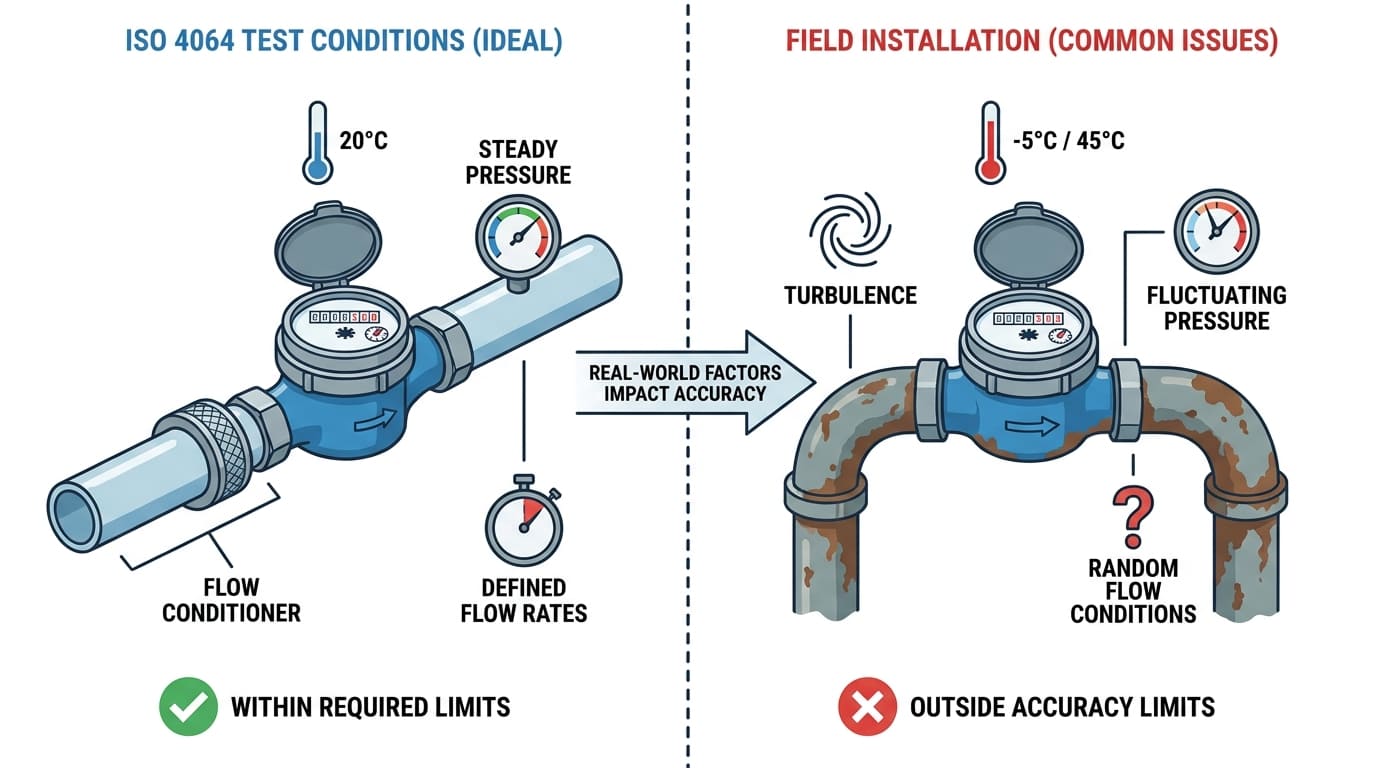
Ik gebruik ISO 4064 als praktische grenslijn. Aan één kant, Ik laat een meter testen onder gecontroleerde omstandigheden. Aan de andere kant, Ik heb een veldinstallatie met bochten, kleppen, pompen, vuil, verkeerde richting, en onstabiele druk. Het argument begint meestal wanneer deze twee werelden als hetzelfde worden behandeld.
Hoe werkt ISO 4064 Definieer nauwkeurigheid en klassen?
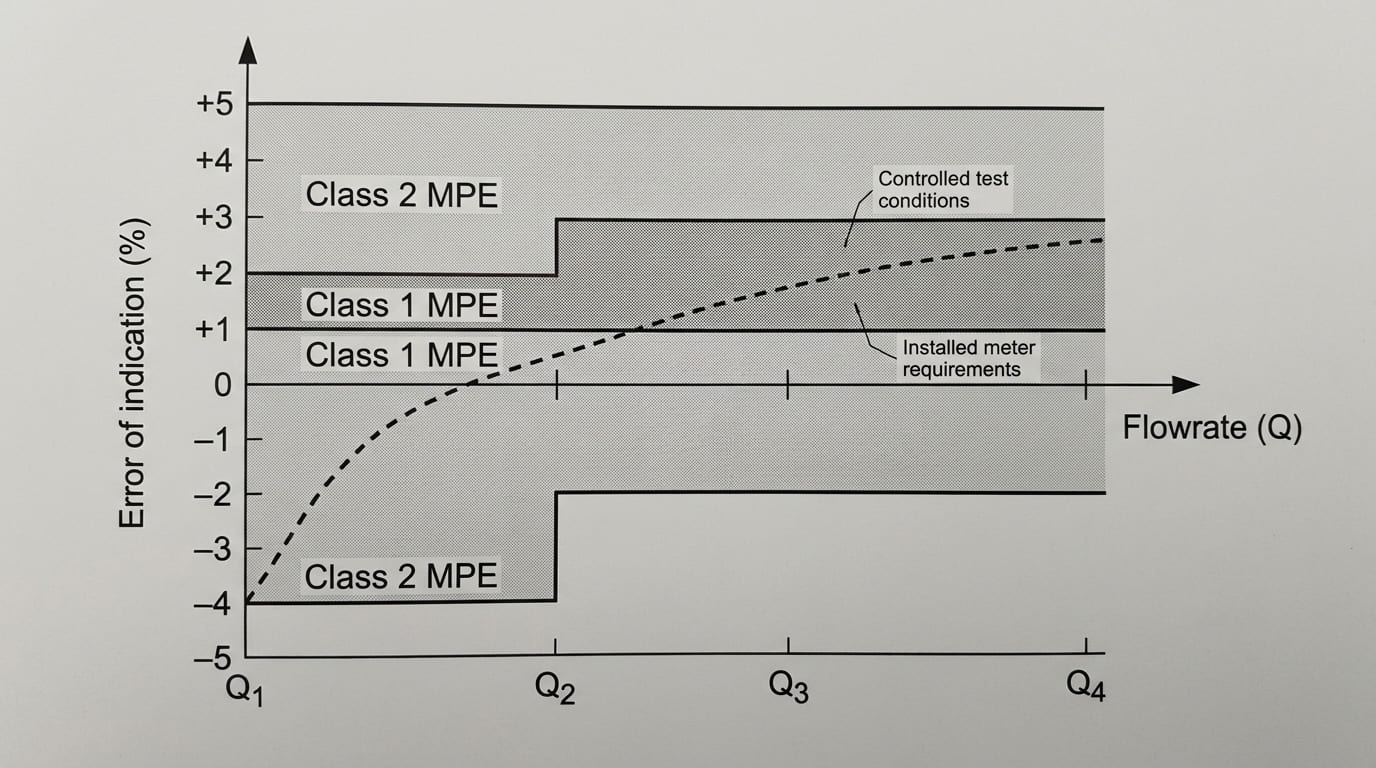
Ik heb dat ISO geleerd 4064 definieert nauwkeurigheid niet als een vage belofte. Het definieert het door middel van een indicatiefout, maximaal toelaatbare fouten, nauwkeurigheidsklasse, en gecontroleerde testomstandigheden.
ISO 4064 vereist dat meterindicatiefouten worden gemeten met behulp van gespecificeerde apparatuur en procedures, met stroompunten zoals Q1, Vraag 2, en Q3 gecontroleerd onder gecontroleerde omstandigheden. De geïnstalleerde meter moet ook voldoen aan de MPE-vereisten volgens de nauwkeurigheidsklasse wanneer installatiestoringen op de juiste manier worden afgehandeld.
Wat “nauwkeurigheid” in de praktijk werkelijk betekent
Als ik dit aan een nutsingenieur uitleg, Ik vermijd te zeggen “deze meter is nauwkeurig” zonder context. Ik zeg het liever, “Deze meter voldoet aan zijn nauwkeurigheidsklasse wanneer hij is getest en geïnstalleerd onder de voorwaarden die zijn vastgelegd in de norm en de typegoedkeuring.” Die zin klinkt langer, maar het voorkomt veel discussies later.
ISO 4064 is gestructureerd als een familie van normen. Deel 1 omvat metrologische en technische vereisten, Deel 2 omvat testmethoden, Deel 3 omvat het formaat van het testrapport, Deel 4 omvat niet-metrologische eisen, en deel 5 dekt de installatievereisten. Dit is van belang omdat nauwkeurigheid niet alleen een fabrieksclaim is. Het verbindt productontwerp, testmethode, bewijsmateriaal melden, en veldinstallatie.
| ISO 4064 gebied | Wat ik controleer | Waarom het ertoe doet |
|---|---|---|
| Deel 1 | Nauwkeurigheidsklasse en MPE-vereisten | Hierin wordt vastgelegd waaraan de meter moet voldoen |
| Deel 2 | Testprocedure en voorwaarden | Het definieert hoe fouten worden gemeten |
| Deel 5 | Installatievereisten | Het beïnvloedt of veldmetingen geldig blijven |
| Typegoedkeuringscertificaat | Speciale regels voor installatie of stromingsconditionering | Het kan meterspecifieke eisen bevatten |
Ik herinner projectteams er ook aan dat daaropvolgende verificatie de nationale wettelijke metrologieregels kan volgen, omdat ISO 4064-1 merkt op dat daaropvolgende verificatie moet worden toegepast overeenkomstig de nationale regelgeving. Dit is van belang bij klachten vanwege een laboratoriumhertest, een veldcontrole, en een juridisch verificatieproces is misschien niet hetzelfde.
Hoe werken R-waarden, Q3/Q4, en startstroom beïnvloeden nauwkeurigheidsclaims?
Ik zie dat veel misverstanden beginnen met stroomtermen. Kopers vragen om “hoge nauwkeurigheid,Maar ze controleren niet of de meter in de buurt van Q1 werkt, Vraag 2, Q3, of buiten het normale bereik.
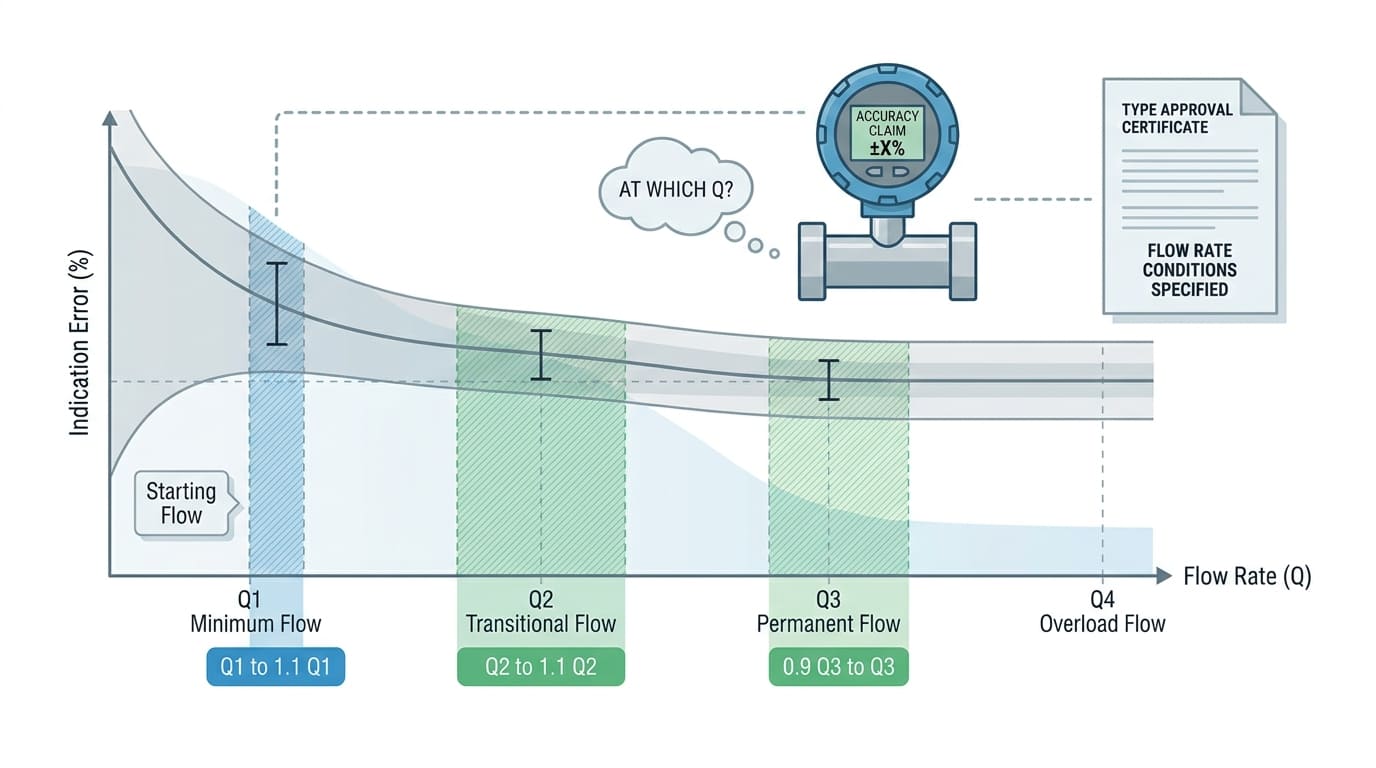
ISO 4064 testprocedures meten indicatiefouten bij gedefinieerde stroombereiken, inclusief Q1 tot 1.1 Q1, Q2 tot 1.1 Vraag 2, En 0.9 Q3 tot Q3, tenzij in het typegoedkeuringscertificaat afwijkende debieten zijn vermeld. Dat betekent dat nauwkeurigheidsclaims samen met de stroomsnelheidsomstandigheden moeten worden gelezen.
Waarom ik R-waarde nooit alleen lees
In de moderne watermetertaal, De R-waarde wordt normaal gesproken begrepen als de verhouding tussen Q3 en Q1. Een hogere R-waarde betekent meestal dat de meter over een groter bereik kan meten, van laag debiet tot permanent debiet. Maar ik beschouw R-waarde niet als een magisch label. Ik vraag altijd naar de daadwerkelijke Q1, Vraag 2, Q3, en Q4-waarden op het gegevensblad.
De referentietekst hier laat duidelijk zien dat ISO 4064 testen maakt gebruik van Q1, Vraag 2, en Q3 als gedefinieerde teststroompunten. Het laat ook zien dat alternatieve debieten kunnen worden gespecificeerd in het typegoedkeuringscertificaat. Dit is een belangrijk punt. Als het goedkeuringsdossier of certificaat bijzondere voorwaarden bevat, Ik kan ze niet negeren en vertrouw alleen op een cataloguslijn.
Ik scheid ook ‘startstroom’ van ‘nauwkeurigheidsstroom’. Startstroom is de stroom waarbij de meter begint te bewegen of te registreren. Q1 is het minimale debiet voor nauwkeurigheidsevaluatie in het nominale raamwerk. Een meter kan beginnen met registreren onder Q1, maar dat betekent niet automatisch dat het daar aan dezelfde foutgrenzen moet voldoen. Dit onderscheid voorkomt veel geschillen over lage stromen.
| Termijn | Hoe ik het gebruik in projecten | Veel voorkomende fout |
|---|---|---|
| Q1 | Minimumstroompunt voor nauwkeurigheidsbereik | Het behandelen van elke beweging onder Q1 als gecertificeerde nauwkeurigheid |
| Vraag 2 | Overgangsstroompunt | Het negeren van de verandering tussen lage en hoge zones |
| Q3 | Permanente stroomsnelheid | Alleen selecteren op DN en de echte vraag negeren |
| Q4 | Overbelastingsdebiet | Overbelasting behandelen als normaal langdurig gebruik |
| Startstroom | Stroom waar de meter begint te registreren | Verwar het met Q1-nauwkeurigheidsprestaties |
Waarom verschilt het resultaat van een testbank van de omstandigheden in de echte wereld??
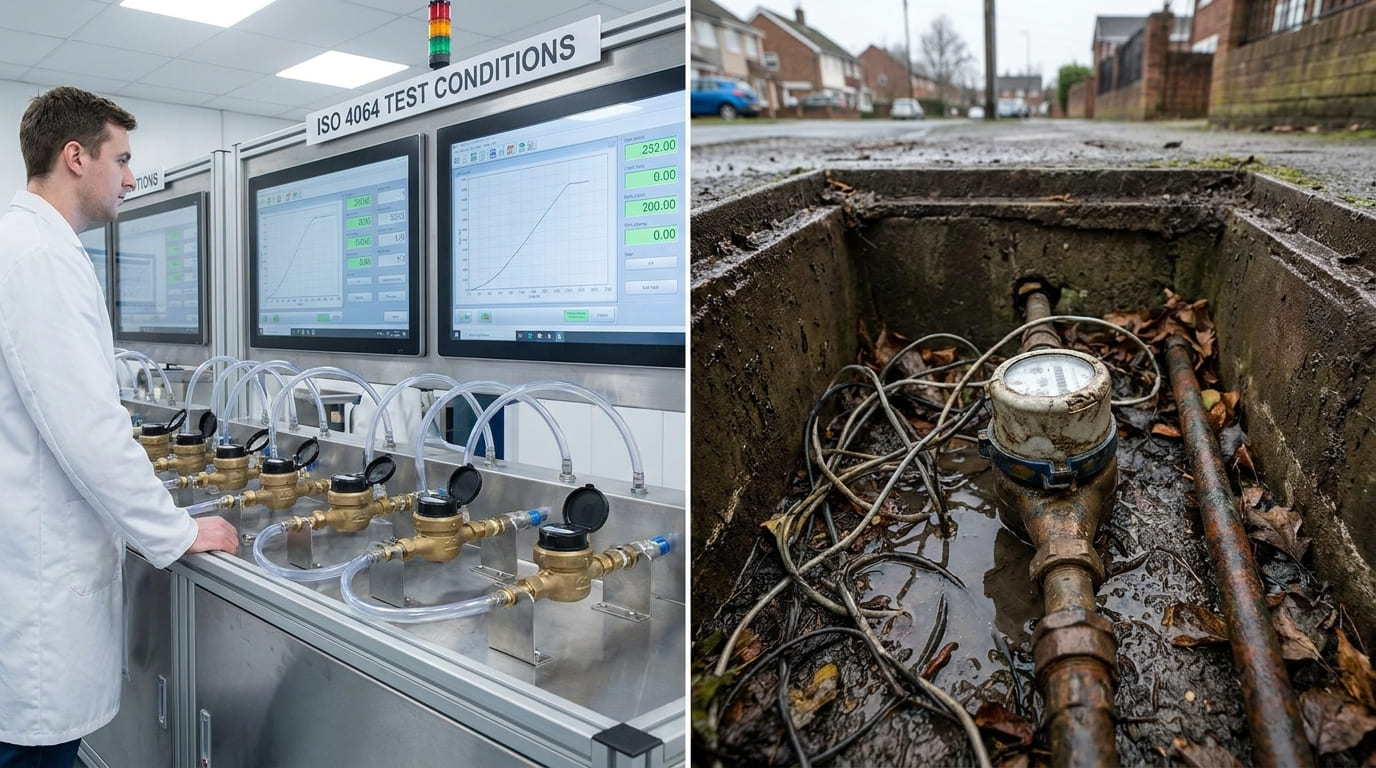
Deze zin hoor ik vaak: “De meter passeerde het laboratorium, maar de veldwaarde klopt niet.” Mijn eerste antwoord is simpel. Het laboratorium en het veld zijn niet dezelfde hydraulische wereld.
ISO 4064 testprocedures vereisen gecontroleerde omstandigheden, zoals geen significante interactie tussen meters in serie, uitlaatdruk niet lager 0.03 MPa, gedefinieerde werkwatertemperatuurbereiken, en alle andere invloedsfactoren die binnen de nominale bedrijfsomstandigheden van de meter blijven. Veldinstallaties falen vaak precies op deze punten.
Wat de bank controleert, negeert het veld vaak
Er is een testbank gebouwd om twijfel weg te nemen. Het regelt de watertemperatuur. Het controleert de druk. Het controleert teststart- en stopfouten. Het regelt de lay-out. Het controleert de meter op specifieke stroombereiken. Het probeert ook de onzekerheid veroorzaakt door de werking van de testopstelling te verminderen.
Een echte site doet het tegenovergestelde, tenzij het projectteam voorzichtig is. Het kan zijn dat de leiding een klep heeft die te dicht bij de meter zit. Er kan een pomp stroomopwaarts staan. Een bocht kan een werveling veroorzaken. Het is mogelijk dat de kamer geen goede waterpasstelling mogelijk maakt. Na reparatiewerkzaamheden kan de leiding vuil bevatten. ISO 4064-1 merkt zelfs op dat vaste deeltjes zich kunnen ophopen in een watermeter na stroomopwaarts leidingwerk. Dat is precies het soort klein sitedetail dat later een grote klacht van klanten wordt.
Het grootste verschil is dit: vraagt de bank, “Kan de meter onder gedefinieerde voorwaarden aan de norm voldoen??', vraagt het veld, “Heeft het project die omstandigheden gecreëerd??'Als het antwoord nee is, dan noem ik niet het eerste probleem meternauwkeurigheid. Ik noem het installatierisico.
| Staat van de proefbank | Veldrisico wanneer genegeerd |
|---|---|
| Uitlaatdruk gecontroleerd | Lage druk of onstabiele druk beïnvloedt het gedrag |
| Temperatuurbereik gecontroleerd | Hete of koude omstandigheden op de locatie kunnen buiten het nominale bereik liggen |
| Invloedsfactoren gecontroleerd | Factoren op de werkelijke locatie kunnen de nominale omstandigheden overschrijden |
| Stroompunten gedefinieerd | De veldstroming kan buiten het bruikbare bereik blijven |
| Testonzekerheid verminderd | Klachten uit het veld kunnen een combinatie zijn van meterfouten en locatiefouten |
Wanneer het probleem de testbank is, Niet de Meter
Voordat je de installatie de schuld geeft, er is een derde categorie nauwkeurigheidsklachten die zelden openlijk wordt besproken: discrepantie op de testbank tussen de fabriek van de fabrikant en het lokale laboratorium van de klant.
ISO 4064 definieert nauwkeurigheidsklassen onder referentieomstandigheden - specifieke druk, temperatuur, en stromingsprofielvereisten. In de praktijk, geen twee testbanken zijn identiek. Wanneer de bank van de fabrikant om draait 6.5 bar en de lokale autoriteiten testen op 1.0 bar, dezelfde meter zal meetbaar verschillende resultaten opleveren – niet omdat de meter is veranderd, maar omdat de vloeistofdynamica verandert met de druk.
Wij beschikken hierover over directe gegevens. In één gedocumenteerd geval voor een enkele bestelling van 30 eenheden:
-
Fabriekstestresultaat: 100% doorgang , alle eenheden binnen ±2% in Q1-Q4
-
Klant autoriteit (INACAL, Peru) resultaat: 5 uit 10 bemonsterde eenheden mislukten, 50% afwijzingspercentage
-
Oorzaak: Referentiedrukverschil (6.5 balk versus 1.3 bar) en verschil in stroombereik (30 m³/u vs 60 m³/u)
In aparte grotemeterkoffer (DN50, 740+ eenheden), dezelfde partij meters werd getest op twee verschillende banken binnen onze eigen faciliteit. Bank A (standaard): alle eenheden passeren Q1 en Q2. Bank B (opnieuw gekalibreerd 0.45 MPa referentiedruk): bijna alle eenheden faalden in het eerste kwartaal, met fouten van –25% tot –35%.
De praktische implicatie: als uw project meters betreft die zullen worden getest door een extern laboratorium of een lokale overheid, een gezamenlijke test vóór verzending aanvragen met gebruikmaking van de referentievoorwaarden van de autoriteit – of op zijn minst, afstemmen op testdruk en stroombereik in het koopcontract. Deze ene stap elimineert een categorie geschillen die geen enkele verbetering van de productkwaliteit kan voorkomen.
Op zoek naar een betrouwbare leverancier van watermeters?
YOUNIO produceert mechanische en ultrasone watermeters van DN15 tot DN500, MID-gecertificeerd en ISO-getest 4064. Gratis monsters en fabriekstestrapporten beschikbaar voor gekwalificeerde kopers.
Wat zijn de meest voorkomende foutieve installatiepatronen die ik tegenkom??
De meeste nauwkeurigheidsklachten die ik zie, worden niet veroorzaakt door één dramatische fout. Ze worden veroorzaakt door gewone installatiefouten die vaak worden herhaald.
ISO 4064-1 stelt dat bij stroomopwaartse of stroomafwaartse verstoringen door bochten, kleppen, of pompen beïnvloeden de nauwkeurigheid, de meter moet voldoende rechte leidinglengtes hebben, met of zonder stroomgelijkrichter, zoals gespecificeerd door de fabrikant. ISO 4064-2 zegt ook dat voor sommige metertypes stroomconditionering nodig is en dat de installatievereisten van de fabrikant moeten worden gevolgd.
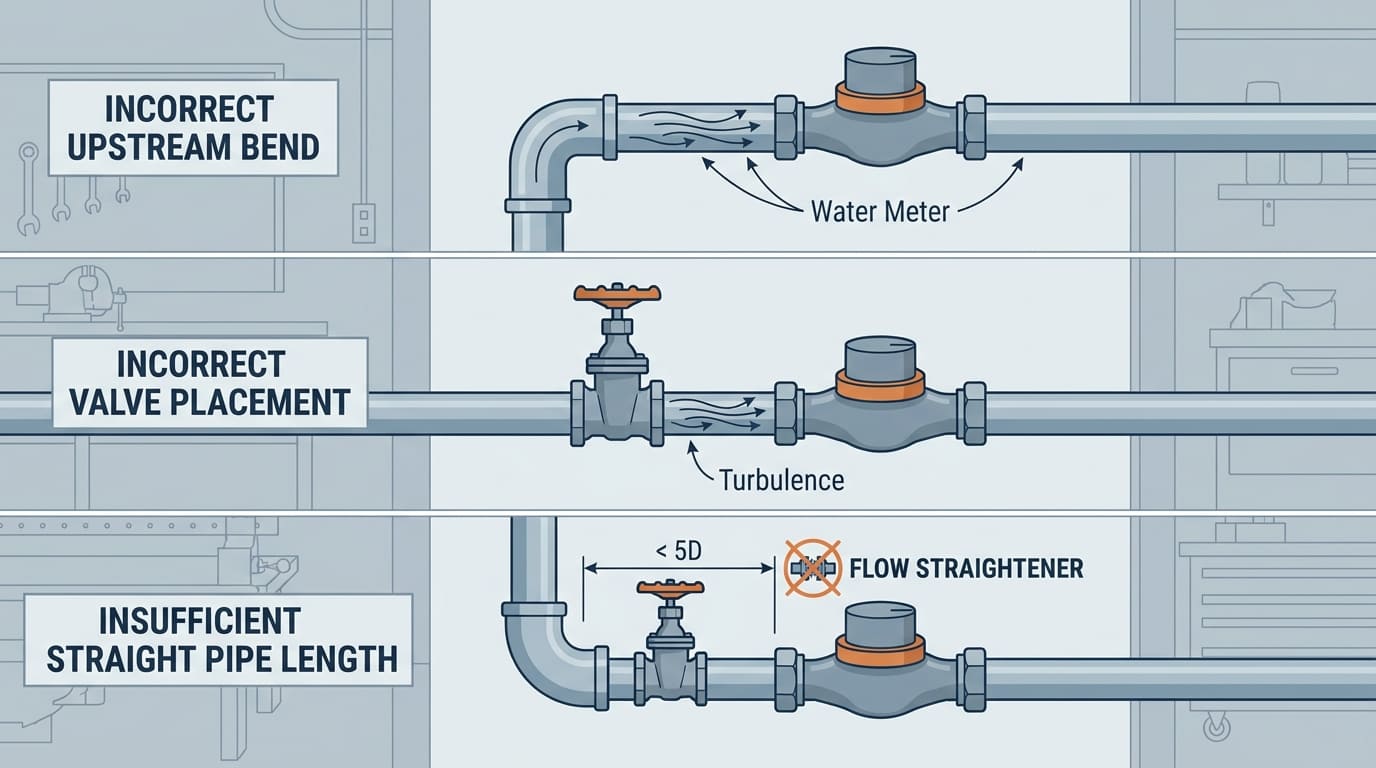
De herhaalde fouten die klachten over ‘nauwkeurigheid’ veroorzaken
Bij het eerste patroon ontbreekt een rechte pijp. Ik zie dit bij retrofitprojecten omdat de kamer al bestaat. De installateur wil dat de meter past, dus het project buigt de standaard rond de site. Dat zorgt vaak voor een verstoorde stroming nabij de meter. ISO 4064 Het is duidelijk dat rechte stukken of stroomrichters nodig zijn wanneer verstoringen de nauwkeurigheid kunnen beïnvloeden, en de eisen van de fabrikant zijn van belang.
Het tweede patroon is verkeerde stromingsconditionering. Sommige meterprincipes vereisen speciale stroomconditionering bij het meten van indicatiefouten, en de door de fabrikant aanbevolen installatievereisten moeten worden gevolgd. Als deze eisen worden vermeld in het typegoedkeuringscertificaat, Ik behandel ze als projectregels, geen suggesties.
Het derde patroon is slechte nivellering. ISO 4064-1 zegt dat er voorzieningen kunnen worden getroffen voor een watermeter om tijdens de installatie een correcte waterpasstelling mogelijk te maken. In de praktijk, dit betekent dat installateurs de oriëntatie niet met het oog mogen raden als het meterontwerp afhankelijk is van de juiste positie.
Het vierde patroon is vuil leidingwerk. ISO 4064-1 merkt op dat vaste deeltjes zich kunnen ophopen in een watermeter na stroomopwaarts leidingwerk. Ik vertel teams altijd dat ze de lijn moeten doorspoelen en controleren voordat ze de meter de schuld geven.
| Verkeerd installatiepatroon | Wat ik eerst controleer | ISO 4064 link |
|---|---|---|
| Geen rechte pijp | Bochten, kleppen, pompen vlakbij de meter | Rechte lengtes kunnen nodig zijn |
| Geen stromingsconditionering | Instructies en certificaat van de fabrikant | Er moet aan de vereisten worden voldaan |
| Slechte nivellering | Meterpositie en kamerindeling | Er kan gebruik worden gemaakt van een nivelleringsvoorziening |
| Vuile stroomopwaartse leiding | Recente pijpreparatie of aanleg | Na het leidingwerk kunnen zich deeltjes ophopen |
| Verkeerde bedrijfstoestand | Druk, temperatuur, stroom bereik | Invloedsfactoren moeten binnen de nominale omstandigheden blijven |
Waarom kan een meter het laboratorium passeren, maar toch een klacht in het veld veroorzaken??
Ik heb deze zaak vaak gezien. Een klant klaagt. De meter keert terug naar het laboratorium. Het laboratoriumresultaat is geslaagd. De klant blijft volhouden dat het veldresultaat verkeerd was.
Een laboratoriumpas kan naast een veldklacht bestaan omdat ISO 4064 testen houdt invloedsfactoren binnen nominale bedrijfsomstandigheden vast, terwijl het veld mogelijk een verstoorde stroming bevat, slechte installatie, vuil, of bedrijfsomstandigheden buiten de nominale limieten van de meter. Het conflict speelt zich vaak niet af tussen de klant en de fabriek. Het ligt tussen de testconditie en de locatieconditie.
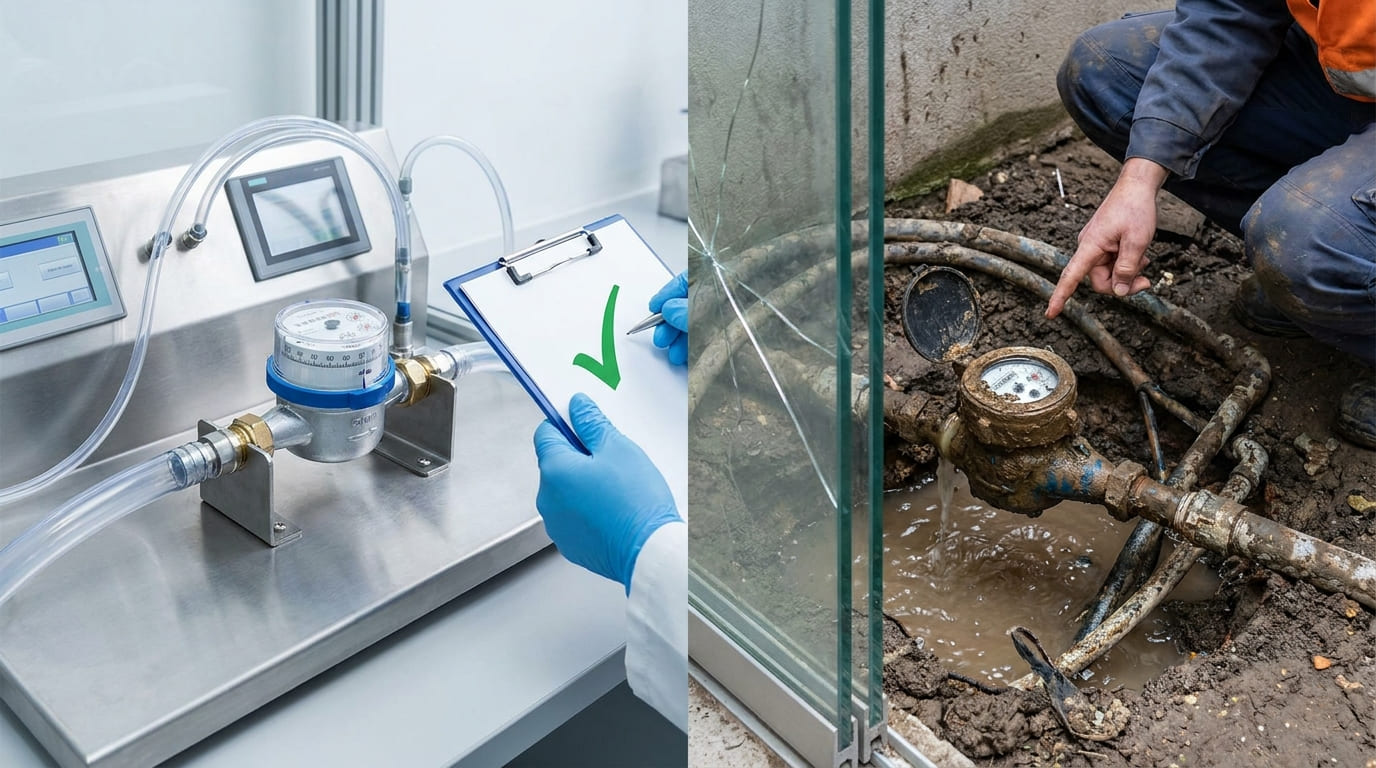
Casestudie 1: De meter ging voorbij, maar de klep was te dichtbij
In één typisch geval, Ik zou verwachten dat de geretourneerde meter in Q1 zou slagen, Vraag 2, en Q3 op een goede bank. Vanuit het perspectief van de klant kan de klacht nog steeds reëel zijn. Het probleem is dat de veldleiding een klep dicht bij de inlaat had, en het stromingsprofiel was niet wat de meter nodig had. ISO 4064-1 vermeldt direct bochten, kleppen, en pompen als stroomopwaartse of stroomafwaartse verstoringen die de nauwkeurigheid kunnen beïnvloeden. In die situatie, Ik beschouw het laboratoriumrapport niet als een belediging voor de klant. Ik beschouw het als bewijs dat de meter en de locatie afzonderlijk moeten worden beoordeeld.
Casestudie 2: De meter ging voorbij, maar de temperatuur ter plaatse was verkeerd
Een ander veel voorkomend geval is temperatuur. ISO 4064-2 geeft gedefinieerde werkwatertemperatuurbereiken voor testen, zoals 20 °C ± 10 °C voor T30- en T50-meters, en andere gedefinieerde bereiken voor hogere temperatuurklassen. Als de veldomstandigheden buiten de specificaties van de meter vallen, Ik kan de uitslag van het laboratorium niet alleen gebruiken om de klacht te verklaren.
Casestudie 3: De meter ging voorbij, maar de typegoedkeuringsvoorwaarde werd genegeerd
Voor sommige metertypen is mogelijk stromingsconditionering vereist, en de door de fabrikant aanbevolen installatievereisten moeten worden gevolgd. Als het typegoedkeuringscertificaat deze eisen vermeldt en het project deze negeert, de klacht is geen eenvoudig probleem met de fabrieksnauwkeurigheid.
Hoe moet ik installaties ontwerpen die aan ISO voldoen 4064?
Ik ontwerp ISO 4064-vriendelijke installaties door uit te gaan van de nominale bedrijfsomstandigheden van de meter en de door de fabrikant goedgekeurde installatievereisten. Ik ga niet uit van de beschikbare kamerruimte.
ISO 4064 testen vereist dat invloedsfactoren binnen de nominale bedrijfsomstandigheden van de meter worden gehouden. ISO 4064-1 vereist ook voldoende rechte pijplengtes of stroomrichters bij verstoringen door bochten, kleppen, of pompen beïnvloeden de nauwkeurigheid van de meter.
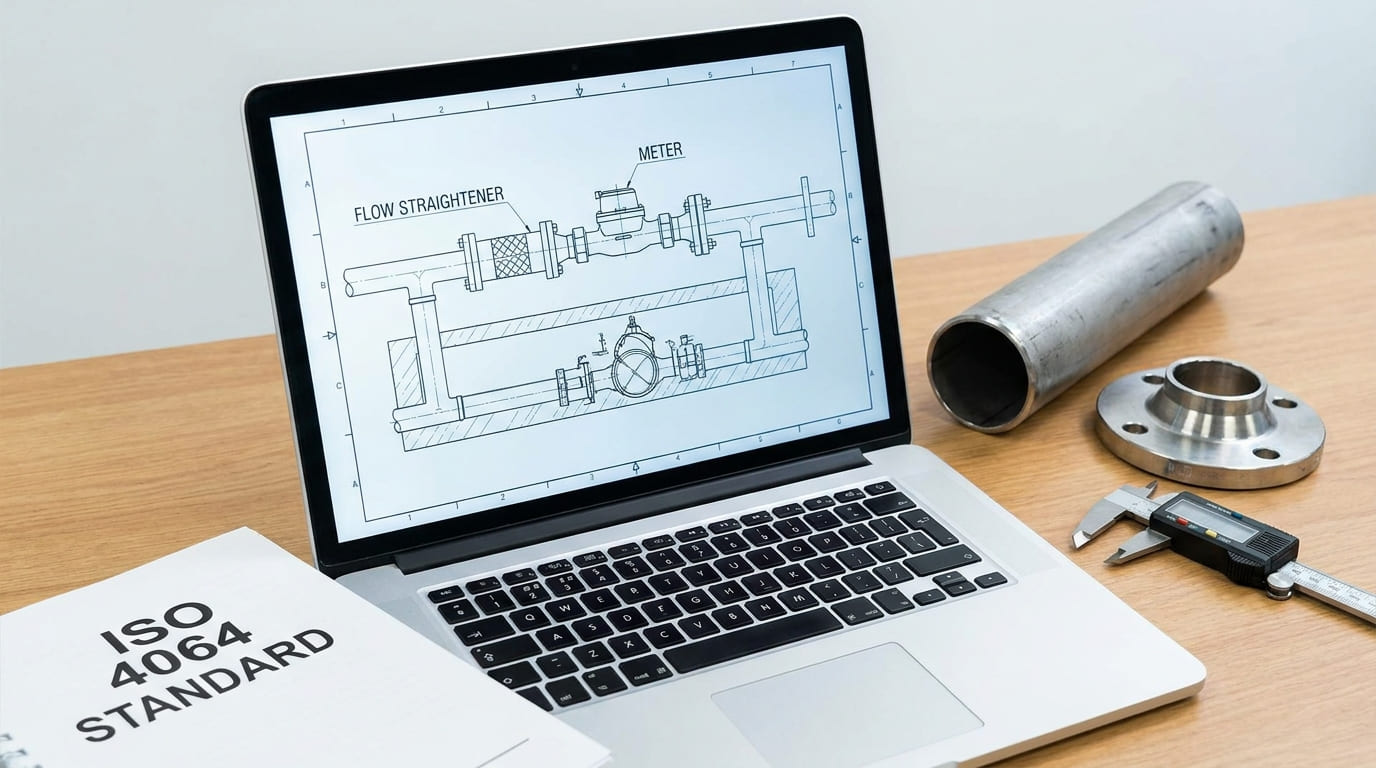
Mijn praktische ontwerpmethode
Eerst, Ik controleer de meter selectie. Ik vergelijk Q1, Vraag 2, Q3, en verwachte sitestroom. Ik wil dat de normale bedrijfsstroom binnen het bruikbare bereik ligt, gedurende het grootste deel van de dag niet onder de juiste meetzone van de meter. ISO 4064-2 meet fouten binnen gedefinieerde bereiken rond Q1, Vraag 2, en Q3, dus die punten moeten aansluiten bij het echte vraagprofiel.
Seconde, Ik controleer de druk. De ISO 4064-2 testprocedure zegt dat de uitlaatdruk van elke meter tijdens het testen niet minder mag zijn dan 0.03 MPa, of 0.3 bar. Dat betekent niet dat elk veldprobleem voor die waarde is opgelost, maar het herinnert me eraan dat de drukomstandigheden deel uitmaken van betrouwbare metingen.
Derde, Ik controleer de temperatuur. Als de watertemperatuur ter plaatse niet overeenkomt met de nominale klasse van de meter, Ik stop en selecteer de meter opnieuw. ISO 4064-2 geeft gedefinieerde werkwatertemperatuurbereiken weer voor verschillende temperatuurklassen tijdens het testen.
Vierde, Ik controleer de leidingindeling. Als bochten, kleppen, of pompen bevinden zich in de buurt van de meter, Ik volg de door de fabrikant vereiste rechte pijplengte of stroomrichterregel [3]. Als een ander meetprincipe stromingsconditionering nodig heeft, Ik volg de installatievoorschriften van de fabrikant en het typegoedkeuringscertificaat.
| Ontwerp stap | Mijn vraag | Waarom het ertoe doet |
|---|---|---|
| Stroombereik | Komt de sitestroom overeen met het gebruik van Q1-Q3?? | Fouten worden getest bij gedefinieerde stroombereiken |
| Druk | Is de druk binnen de nominale omstandigheden? | Uitlaatdruk en invloedsfactoren zijn van belang |
| Temperatuur | Komt de watertemperatuur overeen met de classificatie?? | Er zijn testtemperatuurbereiken gedefinieerd |
| Indeling van de pijp | Zijn bochten, kleppen, pompen te dichtbij? | Storingen kunnen de nauwkeurigheid beïnvloeden |
| Stroomconditionering | Heeft dit model een speciale behandeling nodig?? | De vereisten van de fabrikant moeten worden gevolgd |
Welke praktische nauwkeurigheidschecklist moeten hulpprogramma's gebruiken??
Ik zeg tegen nutsbedrijven dat ze een checklist moeten gebruiken voordat ze een nauwkeurigheidsklacht als productdefect accepteren. Dit beschermt het hulpprogramma, de klant, en de leverancier.
Een goede checklist moet het testbewijs bevestigen, nominale bedrijfsomstandigheden, druk, temperatuur, rechte pijp, stroom conditionering, nivellering, en recent stroomopwaarts leidingwerk alvorens te concluderen dat een meter defect is. Deze methode komt overeen met ISO 4064 beter dan alleen te oordelen naar een betwist wetsvoorstel.
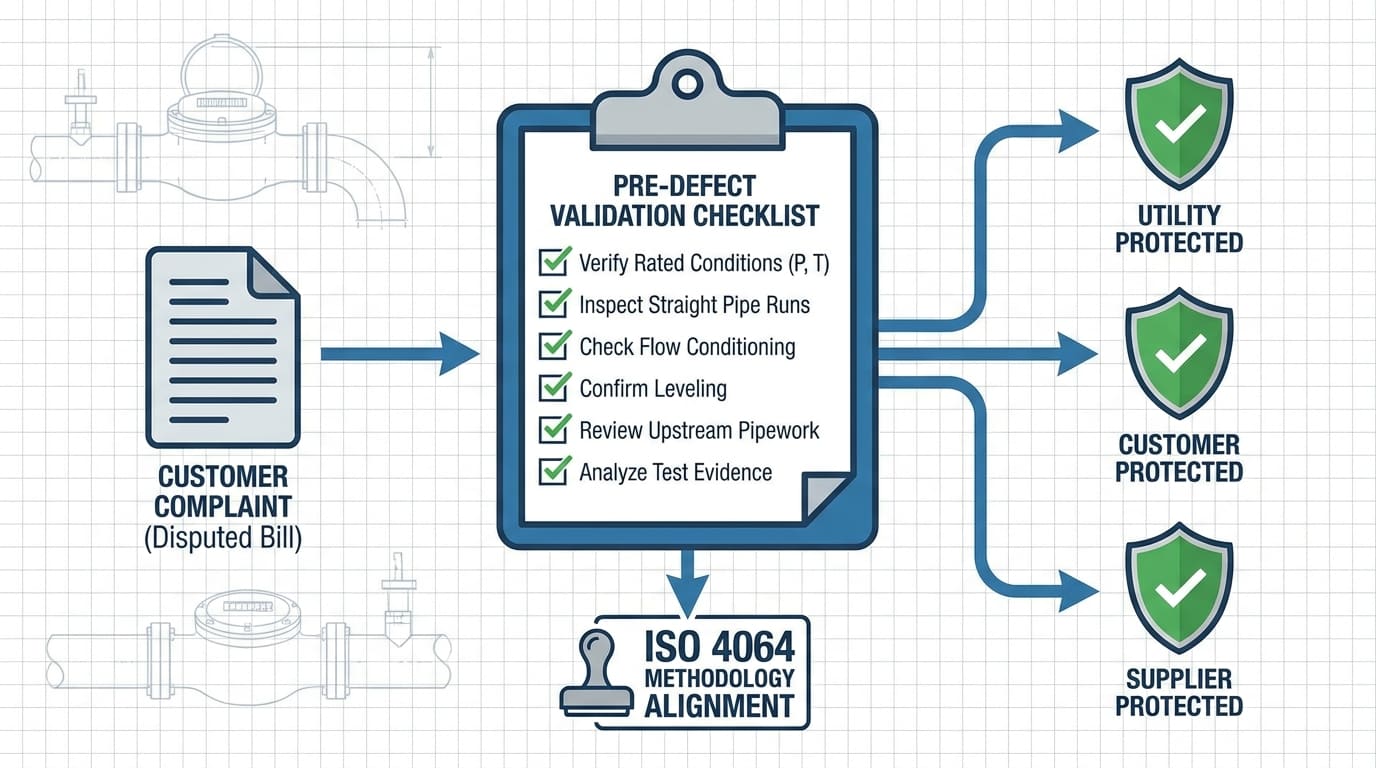
Mijn veldchecklist
Ik zou de volgende checklist gebruiken bij elk project waar klachten over “nauwkeurigheid” verschijnen.
| Controlelijstitem | Wat ik vraag | Referentiebasis |
|---|---|---|
| Meteridentiteit | Is dit hetzelfde model, maat, en goedkeuring zoals gespecificeerd? | Typegoedkeuring kan voorwaarden stellen |
| Stroombereik | Is de werkelijke stroom nabij Q1, Vraag 2, Q3, of buiten bruikbaar bereik? | Fouten worden gemeten in Q1, Vraag 2, en Q3-bereiken |
| Druk | Is de uitlaat- en bedrijfsdruk stabiel en binnen de nominale waarden? | Uitlaatdruk en nominale omstandigheden zijn van belang |
| Temperatuur | Is de watertemperatuur binnen het werkbereik van de meter?? | Temperatuurbereiken worden tijdens het testen gedefinieerd |
| Rechte pijp | Zijn bochten, kleppen, of pompen te dichtbij? | Mogelijk is een rechte pijp of een stijltang nodig |
| Stroomconditionering | Heeft de fabrikant speciale conditionering nodig?? | Er moet aan de vereisten worden voldaan |
| Nivellering | Is de meter correct gepositioneerd?? | Een nivelleringsvoorziening kan een correcte installatie ondersteunen |
| Vuil en puin | Het stroomopwaartse leidingwerk is onlangs gerepareerd? | Vaste deeltjes kunnen zich ophopen na stroomopwaartse werkzaamheden |
| Verificatieroute | Vereist de lokale wetgeving een specifieke verificatiemethode?? | De daaropvolgende verificatie volgt de nationale regels |
Waarom deze checklist valse geschillen vermindert
Deze checklist helpt mij drie verschillende problemen te scheiden. Het eerste probleem is een echt prestatieprobleem van de meter. Het tweede probleem is een verkeerde installatie. Het derde probleem is een discrepantie tussen het goedgekeurde gebruik van de meter en de veldomstandigheden. Deze problemen lijken op elkaar in een klachten-e-mail, maar ze vereisen verschillende acties.
Als de meter een goede testbank niet doorstaat, Ik behandel het als een product- of kalibratieprobleem. Als de meter de bank passeert, maar de veldinstallatie een pomp heeft, kromming, of klep te dichtbij, Ik beschouw het als een installatieprobleem. Als de locatietemperatuur, druk, of de stroom blijft buiten de nominale omstandigheden, Ik beschouw het als een toepassingsprobleem.
Dit is de reden waarom ik de uitdrukking “de meter is onnauwkeurig” niet leuk vind totdat ik de installatiegegevens zie. ISO 4064 maakt nauwkeurigheid tot een gecontroleerde technische voorwaarde, geen oppervlakkige mening.
Conclusie
Ik zie dat veel klachten over de nauwkeurigheid van de watermeter duidelijk worden zodra ik de laboratoriumomstandigheden vergelijk met de echte installatie. ISO 4064 wijst mij op de juiste vragen: stroom bereik, druk, temperatuur, beoordeelde omstandigheden, rechte pijp, stroom conditionering, en installatiediscipline.
Op zoek naar een betrouwbare leverancier van watermeters?
YOUNIO produceert mechanische en ultrasone watermeters van DN15 tot DN500, MID-gecertificeerd en ISO-getest 4064. Gratis monsters en fabriekstestrapporten beschikbaar voor gekwalificeerde kopers.